Multi-Port Ball Valve
About
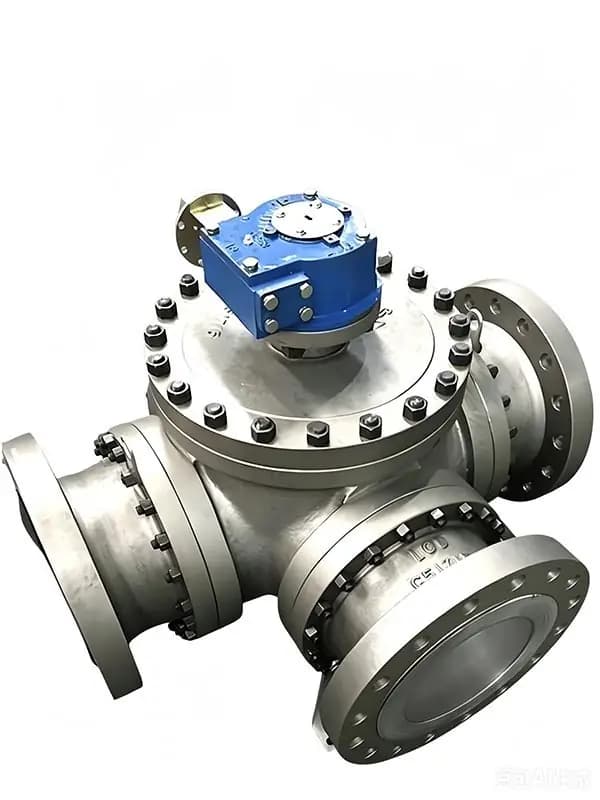
Most piping layouts handle flow diversion the conventional way——install two or three standard two-port ball valves on branching pipelines, add elbows and tee fittings to route media between different process lines, and hope the assembly holds together without developing leaks at every flange and threaded connection. It works. But it’s expensive to build, expensive to maintain, and it creates more potential leak points than the process actually needs. A multi-port ball valve replaces that entire arrangement with a single valve body——one installation, one sealing system, one actuator (if you need one), and a flow path that changes direction by rotating the ball instead of opening and closing multiple valves in sequence.
FLOWKS multi-port ball valves cover the full range of port configurations: L-port and T-port three-way designs for basic direction switching between two flow paths, four-way valves for simultaneous diversion and isolation across multiple pipeline branches, and five-way configurations for complex routing requirements that standard two-port valves simply can’t handle without elaborate manifold assemblies. Sealing configurations vary by design——three-way three-seal, three-way two-seal, and three-way four-seal options are available depending on how many flow paths need to be independently isolated at any given ball position. The right configuration isn’t something you pick from a catalog. It depends on your specific piping layout, how many directions the media needs to switch between, which paths must be blocked while others remain open, and whether the process requires simultaneous or sequential flow diversion. That’s why these valves are engineered to order——not mass-produced in standard configurations hoping one of them happens to fit your application.
The port configuration determines what the valve does at each rotational position. An L-port three-way valve directs flow between two of three connected pipelines, with the third port blocked——straight-through or diverted, one active path at a time. A T-port three-way allows flow through two ports simultaneously or diverts between any two of the three connections——more routing flexibility, but less isolation control because at least two ports remain open at every position. Four-way and five-way designs add further routing complexity——flow can be directed, combined, or isolated across multiple branches in a single valve rotation, replacing manifold setups that would otherwise require four to six individual valves and the piping connections between them. Every additional port and seal in a multi-port valve eliminates an entire valve-plus-fitting assembly that would otherwise exist in the piping system——and every elimination removes a potential leak point, a maintenance item, and a piece of hardware that has to be procured, installed, and inspected separately.
These are custom-engineered valves. The port arrangement, ball bore geometry, seat material selection, body material, and end connection type are specified to match the exact process conditions the valve will serve——media type, operating pressure, temperature range, cycling frequency, and the specific diversion logic the piping system requires. A three-way L-port valve handling clean water at Class 150 gets a different specification package than a four-way valve routing sour gas between multiple processing units at Class 600. The engineering team works from the customer’s piping layout and diversion requirements, not from a standard product matrix. That customization capability is the product——not just the valve itself, but the engineering process that determines exactly which configuration, which sealing arrangement, and which material combination will perform reliably in the specific application for the intended service interval.
Body construction follows the same material quality standards as the entire FLOWKS ball valve series. Forged steel bodies for high-pressure and high-integrity applications where material density and pressure containment matter. Cast steel bodies for larger sizes and quantity-sensitive projects where casting economics deliver better unit value. Body materials include A216 WCB carbon steel for general process service, A351 CF8M stainless steel for corrosive media, A182 F51 duplex and A182 F53 super duplex for aggressive chloride-containing environments——the same alloy options available across the full product range, applied here in multi-port configurations. Seat materials cover PTFE, reinforced PEEK, Nylon, Delrin (POM), PCTFE, and metal hard seat options——specified based on what the process media will do to the seat surface over the valve’s service life, not chosen from a default list.
API 6D compliance applies where pipeline service requirements dictate it. API 608 governs the general ball valve design and dimensional baseline. For multi-port valves serving in...
Technical Specifications
| Size Range | 2"-24" |
| Pressure Class | Class150-1500 |
| Design Standard | API 6D,ASME B16.34 |
| Body Materials | A105、WCB、L245、L360、F304、F316 |
| Parent Standards | API 6D, API 608, ASME B16.34, API 607 Fire Safe |
| Parent Size Range | 2" - 48" |
| Parent Pressure Class | Class 150 - 2500 |
Product Downloads
| Size Range | 2"-24" |
| Pressure Class | Class150-1500 |
| Design Standard | API 6D,ASME B16.34 |
| Body Materials | A105、WCB、L245、L360、F304、F316 |
Need a quote?
Contact our engineering team for pricing and technical support on Multi-Port Ball Valve.
Request a QuoteLooking for more options?
Explore our complete range of industrial valves or contact us for custom solutions.
DBB Valves
FLOWKS Double Block & Bleed (DBB) valves provide dual isolation with bleed verification in a single compact body. Replacing traditional multi-valve installations, FLOWKS DBB valves reduce weight, space and potential leak paths. Available in bolted bonnet, all-welded and expanding gate designs per API 6D and API 607.
Gate Valves
FLOWKS gate valves for isolation service in piping systems. Flexible wedge, solid wedge, slab and expanding gate designs per API 600, API 602 and ASME B16.34.
Globe Valves
FLOWKS globe valves for throttling and isolation. Standard, angle, Y-pattern and bellows seal configurations per API 602 and BS 1868.
Check Valves
FLOWKS check valves prevent reverse flow. Dual plate, swing, tilting disc and lift check designs per API 594 and BS 1868.