Top Entry Ball Valve
About
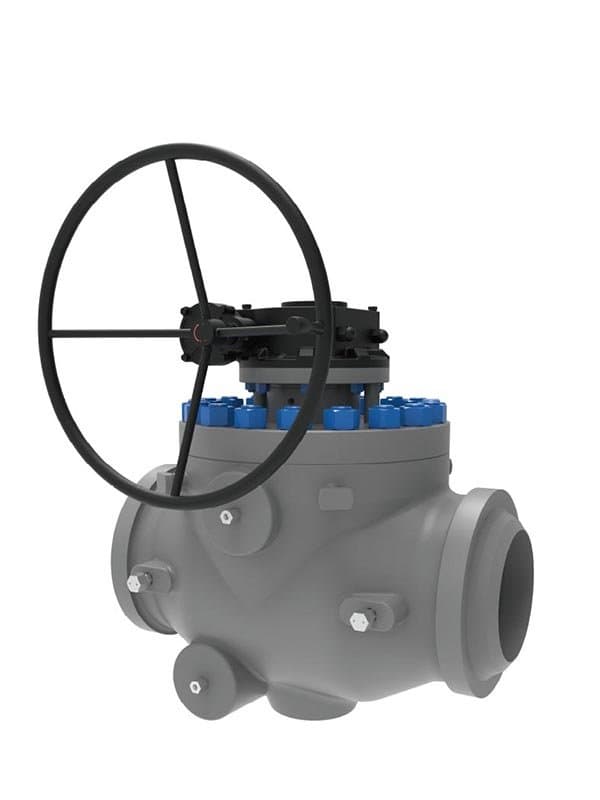
You don’t pull it off the pipe. That’s the whole point. A top entry ball valve lets you remove the bonnet cover from above, pull out the ball and seat assembly, replace worn seals, reassemble, and close it back up——all without breaking the flange connections or cutting the valve out of the line. On a buried pipeline where excavation costs more than the valve itself, or on a welded installation where the valve body is permanently joined to the pipe, that top-access capability isn’t a convenience feature. It’s the reason this valve exists.
FLOWKS top entry ball valves cover sizes from 2" through 48" with pressure ratings from Class 150 to Class 2500. The pressure range sits between what floating ball valves handle (Class 150-600) and what full-spec trunnion side-entry valves cover (up to Class 2500)——and that positioning is deliberate. Most buried pipeline and welded-line applications in oil & gas transmission and petrochemical distribution operate within the Class 150-2500 band, and the top entry design is optimized exactly for that service window. You get trunnion anchored ball reliability and spring-loaded bidirectional sealing, but in a body configuration built for in-line maintenance access rather than side-entry convenience.
The trunnion anchoring principle works the same way here as it does in side-entry designs. The ball is pinned at the top and bottom shaft journals, and the spring-loaded seats press independently against the ball surface to create seals from both upstream and downstream directions. Bidirectional sealing means the valve holds pressure regardless of flow direction——critical in transmission pipelines where pressure surges can reverse flow momentarily, and where double-block-and-bleed isolation procedures require both seats to seal reliably before a downstream section gets opened for work.
The top entry bonnet design has a structural implication worth understanding. Because the entire internal assembly——ball, seats, stem——loads through the top opening, the bonnet cover and its bolting carry the full internal pressure load in addition to maintaining the body seal. This means the bonnet flange, gasket, and bolt pattern are engineered to a tighter standard than what you’d find on a side-entry valve where the side cover only handles a portion of the pressure differential. FLOWKS top entry valves use a robust bonnet design with adequate bolt circle sizing and controlled gasket compression to ensure the top seal holds through pressure cycling, thermal swings, and long-term service without developing weep paths. The bonnet isn’t just a lid; it’s a pressure boundary.
Where this valve really proves its value: buried gas transmission lines, underground crude oil pipelines, subsea tie-in points, and any welded installation where removing the valve from the line means shutting down a section, excavating if it’s underground, or hot-tapping a bypass——all of which cost orders of magnitude more than the seat replacement itself. On those installations, the maintenance economics are simple. Replace seats from the top in hours, or shut down and dig up the line for days. Top entry design makes the first option possible.
Body materials cover the essential grades: A216 WCB carbon steel for standard transmission and utility pipeline service, A351 CF8M stainless steel for corrosive media and sour gas environments, and A182 F51 duplex for conditions requiring higher mechanical strength alongside corrosion resistance——typically offshore and coastal pipeline installations where salt exposure and stress corrosion cracking are realistic design considerations. The material selection follows the same logic as our other ball valve series: match the body alloy to what the process fluid and external environment will throw at it over the valve’s intended service life.
Every FLOWKS top entry ball valve meets API 6D and API 607 requirements. API 6D governs the complete design, production, and pressure-testing regime——shell integrity, seat sealing verification at high and low pressure, and operational cycling endurance testing. API 607 certifies fire-safe performance: the valve maintains sealing capability through fire exposure and returns to effective shut-off after the fire event subsides. On buried pipelines carrying flammable media, that fire-safe rating isn’t optional in most regulatory frameworks——it’s a compliance requirement. These two standards together give you the baseline assurance that the valve will hold when it’s supposed to hold, whether under normal service conditions or during the kind of emergency event that buried pipeline operators plan for but hope never happens.
Technical Specifications
| Size Range | 2" - 48" |
| Pressure Class | Class 150 - 2500 |
| Design Standard | API 6D, API 607 |
| Body Materials | A105, F11, F22, F304, F316, F304L, F316L, WCB, WC6, CF8, CF8M, Monel, Hastelloy |
| Parent Standards | API 6D, API 608, ASME B16.34, API 607 Fire Safe |
| Parent Size Range | 2" - 48" |
| Parent Pressure Class | Class 150 - 2500 |
Product Downloads
| Size Range | 2" - 48" |
| Pressure Class | Class 150 - 2500 |
| Design Standard | API 6D, API 607 |
| Body Materials | A105, F11, F22, F304, F316, F304L, F316L, WCB, WC6, CF8, CF8M, Monel, Hastelloy |
Need a quote?
Contact our engineering team for pricing and technical support on Top Entry Ball Valve.
Request a QuoteLooking for more options?
Explore our complete range of industrial valves or contact us for custom solutions.
DBB Valves
FLOWKS Double Block & Bleed (DBB) valves provide dual isolation with bleed verification in a single compact body. Replacing traditional multi-valve installations, FLOWKS DBB valves reduce weight, space and potential leak paths. Available in bolted bonnet, all-welded and expanding gate designs per API 6D and API 607.
Gate Valves
FLOWKS gate valves for isolation service in piping systems. Flexible wedge, solid wedge, slab and expanding gate designs per API 600, API 602 and ASME B16.34.
Globe Valves
FLOWKS globe valves for throttling and isolation. Standard, angle, Y-pattern and bellows seal configurations per API 602 and BS 1868.
Check Valves
FLOWKS check valves prevent reverse flow. Dual plate, swing, tilting disc and lift check designs per API 594 and BS 1868.