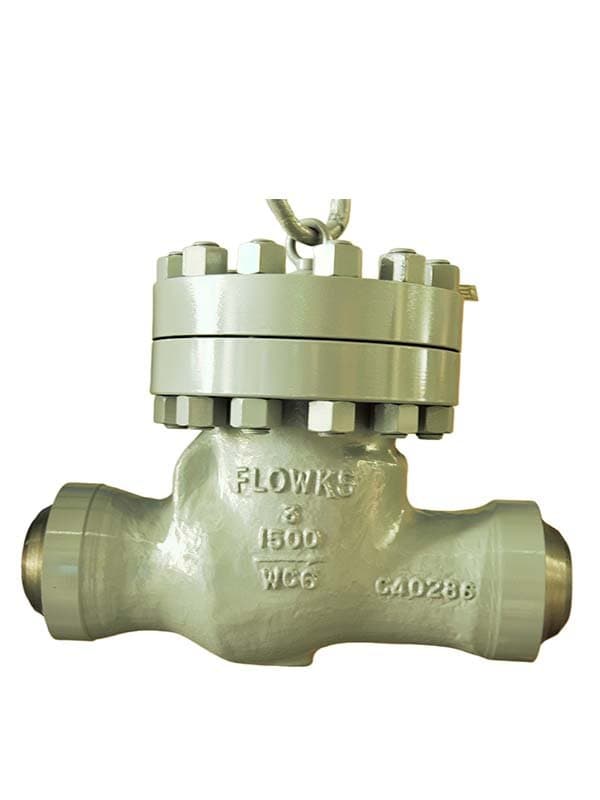
Butt Weld Swing Check Valve
About
Size: 2" - 24" (DN50 - DN600)
Pressure: Class 150 - 2500 / PN 10-420
Standard: API 6D, ASME B16.34, MSS SP-71
Body Materials: A182 F316 (forged), A182 F304 (forged), A182 F22/F91 (forged Cr-Mo for high-temperature). Forged body eliminates casting defects at high-pressure ratings.
Seat: Metal-to-metal with Stellite overlay standard—high-pressure applications demand harder seat surfaces that survive disc impact slamming force at Class 600+.
Disc: Swing disc on hinge pin, same mechanism as flanged swing check. Opening angle up to 80°. Gravity closure.
Design: Butt weld ends—valve welds directly into the pipeline. No flanged connections, no flange gasket leak paths. Forged body for high-pressure integrity. Bolted or welded body cover options (welded cover eliminates one more potential leak path for extreme pressure/temperature service).
Why Butt Weld Instead of Flanged
Two reasons. Both of them come down to the same thing: you don't want leak paths on a passive component that operates automatically with no manual intervention.
Reason one—high pressure. At Class 600 and above, flanged connections get expensive. The flanges are heavier, the bolting is larger, and the gaskets become a reliability liability. High-pressure gaskets cold-flow under sustained load. They creep. They leak. A flanged swing check at Class 900 with a leaking gasket means you have to shut down the line to re-torque or replace the gasket, because you can't tighten a flange on a running check valve—you can't access it safely under pressure. Butt welding eliminates the gasket entirely. The valve welds directly into the pipe. Permanent joint, zero gasket leak path.
Reason two—hazardous and high-temperature service. Hydrogen service, steam at 600°F and above, high-pressure gas lines. Every flanged joint is a potential emission point. The gasket, the bolt stress relaxation over thermal cycles, the flange face condition after years of service. On a check valve—a component that sits there passively, cycling automatically on flow direction—you have no opportunity to monitor or tighten a flanged connection during operation. Butt weld it in and the joint is permanent. No gasket to degrade. No bolts to relax. No flange faces to inspect.
Forged Body — No Casting Defects at High Pressure
Cast bodies work fine at Class 150 and 300. The casting process produces parts with adequate wall thickness and acceptable porosity levels for those pressure ranges. At Class 600 and above—Class 900, 1500, 2500—casting defects become unacceptable. Porosity in a cast body under sustained high pressure can leak through the body wall. Surface shrinkage cavities can initiate cracks under cyclic pressure loading.
Forged bodies eliminate those defects. The forging process compacts the metal grain structure, closes internal voids, and produces a body with uniform mechanical properties through the full wall thickness. No porosity. No shrinkage cavities. No internal defects that become leak paths under sustained high-pressure service.
That's why the material spec is A182—forged stainless and forged Cr-Mo alloy. F316 and F304 for corrosive service at high pressure. F22 and F91 for high-temperature service where you need Cr-Mo alloy strength at 600°F+ operating temperatures. All forged, all defect-free at the pressure ratings where casting can't guarantee integrity.
Stellite Overlay — Standard, Not Optional
On a flanged swing check at Class 150, Stellite overlay on the seat is optional because the disc impact force at low pressure is manageable. Base metal seating survives.
On a butt weld swing check at Class 600+, Stellite overlay on the disc face and seat ring is standard. Here's why: the slamming force increases with pressure rating. At Class 600, the disc hits the seat with significantly more force than at Class 150 because the backpressure driving the disc closure is higher. That higher impact force deforms the base metal seat surface faster—repeated cycling at Class 600+ pounds the seat ring every time the disc closes.
Stellite overlay resists that impact deformation. Cobalt-chromium alloy is harder than the base stainless or Cr-Mo steel, and it maintains its surface integrity under repeated high-force disc impact. On a butt weld swing check, you can't easily pull the valve out of the line to re-machine the seat—it's welded in. Stellite overlay from the start means the seat survives for years without seat repair.
Welded Cover — When You Need Zero Leak Paths
The body cover is the access point for the hinge pin and disc assembly during maintenance. Standard configuration is a bolted cover with a gasket—same leak path concern as any bolted flange joint.
For extreme service—high-pressure hydrogen, superheated steam, toxic or flammable gas at Class 900+—a welded cover option eliminates that gasket leak path too. The cover welds to the body, creating...
Technical Specifications
| Size Range | 2" - 24" |
| Pressure Class | Class 150 - 600 |
| Design Standard | API 594, ASME B16.34 |
| Body Materials | A216 WCB, A351 CF8M |
| Parent Standards | API 594, BS 1868, ASME B16.34 |
| Parent Size Range | 2" - 48" |
| Parent Pressure Class | Class 150 - 2500 |
Product Downloads
| Size Range | 2" - 24" |
| Pressure Class | Class 150 - 600 |
| Design Standard | API 594, ASME B16.34 |
| Body Materials | A216 WCB, A351 CF8M |
Need a quote?
Contact our engineering team for pricing and technical support on Butt Weld Swing Check Valve.
Request a QuoteLooking for more options?
Explore our complete range of industrial valves or contact us for custom solutions.
Ball Valves
FLOWKS offers floating ball valve, trunnion mounted ball valve and top entry ball valve for oil & gas, petrochemical and power generation. Designed per API 6D, API 608 and ASME B16.34.
DBB Valves
FLOWKS Double Block & Bleed (DBB) valves provide dual isolation with bleed verification in a single compact body. Replacing traditional multi-valve installations, FLOWKS DBB valves reduce weight, space and potential leak paths. Available in bolted bonnet, all-welded and expanding gate designs per API 6D and API 607.
Gate Valves
FLOWKS gate valves for isolation service in piping systems. Flexible wedge, solid wedge, slab and expanding gate designs per API 600, API 602 and ASME B16.34.
Globe Valves
FLOWKS globe valves for throttling and isolation. Standard, angle, Y-pattern and bellows seal configurations per API 602 and BS 1868.