About
Size: 2" - 24" (DN50 - DN600)
Pressure: Class 150 - 600 / PN 10-100
Standard: API 6D, ASME B16.34, manufacturer-specific for external pin mechanism
Body Materials: A216 WCB, A351 CF8M, A351 CF8
Seat: Metal-to-metal, Stellite overlay optional
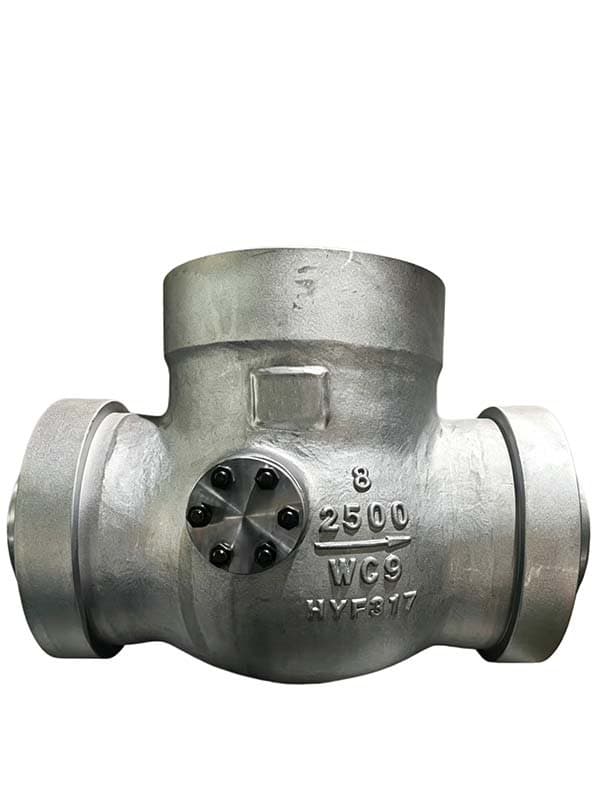
Disc: Swing disc with external dashpot/pin mechanism—hinge pin extends through the body wall to an external dashpot cylinder mounted on the outside of the valve body. Dashpot contains a hydraulic cylinder or pneumatic chamber that connects to the disc through the extended hinge pin. Dashpot resistance slows disc closing rate—instead of slamming shut instantly, the disc closes gradually over 1-3 seconds.
Design: Flanged ends. External dashpot cylinder mounted on body exterior, connected to disc hinge pin through sealed penetration in body wall. Adjustable closing speed—dashpot valve settings control how fast the disc closes. Optional opening assist (air/hydraulic) for disc lifting on low-flow startup.
The Slamming Problem — and How the Dashpot Solves It
Standard swing check valves slam shut. When forward flow stops, the disc swings back to the seat in a fraction of a second—gravity and backpressure accelerate it, no resistance, no damping. That fast closure generates water hammer. A pressure spike travels back up the pipeline from the sudden disc impact, and that spike can damage pipe supports, burst fittings, crack weld seams, or overload downstream equipment.
If you've ever heard a pipe system bang on pump trip, that's water hammer from a slamming check valve. It's not a theoretical risk—it's a real mechanical event that causes real damage, especially on long pipelines where the pressure wave has time to build amplitude.
The external pin dashpot eliminates that slamming by slowing the disc closure. The hinge pin extends through the body wall and connects to a hydraulic or pneumatic dashpot cylinder on the outside of the valve. As the disc swings toward the closed position, the dashpot absorbs the closing energy and decelerates the disc to a controlled, gradual seating speed. Instead of slamming shut in 0.1 seconds, the disc closes smoothly over 1-3 seconds. The pressure spike doesn't happen because the disc isn't accelerating into the seat—the dashpot is pulling it down gradually.
Water hammer eliminated. Seat impact damage eliminated. The disc reaches the closed position without the violent impact that destroys seat surfaces on standard swing checks over repeated cycling.
Adjustable Closing Speed — Tune It to Your Pipeline
Not every pipeline needs the same closing speed. A short process line with high backpressure needs the disc to close relatively fast—if the disc takes too long to seat, reverse flow establishes and the pressure drop across the valve reverses before the disc reaches the seat. A long transmission pipeline with low backpressure needs slower closure—water hammer risk increases with pipeline length, and the longer the line, the more energy the pressure wave carries.
The dashpot valve settings give you that adjustment range. You tune the closing speed to match the pipeline conditions. Fast enough to prevent reverse flow from establishing. Slow enough to eliminate water hammer. It's a balance, and the adjustable dashpot lets you find it during commissioning instead of guessing during specification.
This is the advantage over non-adjustable dampening schemes. Some swing check designs use a counterweight or an internal dashpot with fixed damping—one closing speed, no field adjustment. If the closing speed doesn't match the pipeline, you're stuck. The external pin dashpot is field-adjustable through the dashpot valve settings. Change the setting, change the closing speed. No valve replacement required.
Opening Assist — When Flow Velocity Isn't Enough
On startup, flow velocity through the pipe starts at zero and ramps up. The disc on a standard swing check starts closed and opens gradually as velocity increases. At low flow velocities—early startup on a large-diameter line, for example—the disc may only open to 30° or 40°. It's partially open, sitting in the flow stream, fluttering as velocity fluctuates. That partial-open flutter causes two problems: seat wear from repeated light contact at partial angles, and disc fatigue from oscillating at the hinge pin.
The external pin mechanism offers an opening assist option. Air or hydraulic pressure lifts the disc to full open position on startup before the flow velocity reaches the point where it can push the disc open naturally. The disc goes straight to 80° open. No flutter. No partial-open wear. Once the flow velocity is high enough to hold the disc open on its own, the opening assist releases and the disc stays open by flow force alone.
This option matters on large-diameter lines where startup flow velocity is low relative to the disc mass, and on systems with frequent start/stop...
Technical Specifications
| Parent Standards | API 594, BS 1868, ASME B16.34 |
| Parent Size Range | 2" - 48" |
| Parent Pressure Class | Class 150 - 2500 |
Product Downloads
Need a quote?
Contact our engineering team for pricing and technical support on External Pin Swing Check Valve.
Request a QuoteLooking for more options?
Explore our complete range of industrial valves or contact us for custom solutions.
Ball Valves
FLOWKS offers floating ball valve, trunnion mounted ball valve and top entry ball valve for oil & gas, petrochemical and power generation. Designed per API 6D, API 608 and ASME B16.34.
DBB Valves
FLOWKS Double Block & Bleed (DBB) valves provide dual isolation with bleed verification in a single compact body. Replacing traditional multi-valve installations, FLOWKS DBB valves reduce weight, space and potential leak paths. Available in bolted bonnet, all-welded and expanding gate designs per API 6D and API 607.
Gate Valves
FLOWKS gate valves for isolation service in piping systems. Flexible wedge, solid wedge, slab and expanding gate designs per API 600, API 602 and ASME B16.34.
Globe Valves
FLOWKS globe valves for throttling and isolation. Standard, angle, Y-pattern and bellows seal configurations per API 602 and BS 1868.