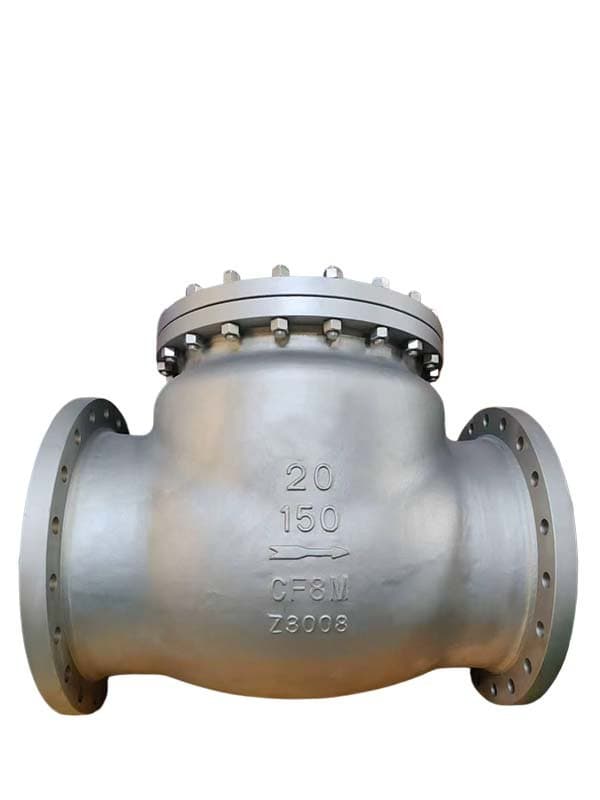
Swing Check Valve
About
Size: 2" - 24" (DN50 - DN600)
Pressure: Class 150 - 600 / PN 10-100
Standard: API 6D, ASME B16.34, MSS SP-71
Body Materials: A216 WCB, A351 CF8M, A351 CF8, cast iron (GG25), ductile iron (GGG40)
Seat: Metal-to-metal — disc face contacts body seat ring for shutoff. Stellite overlay on disc and seat ring available for abrasive/erosive service.
Disc: Swing disc on hinge pin — disc swings open with forward flow (up to 80° maximum opening angle), swings closed when forward flow stops. Hinge pin mounted inside the body bore on the inlet side. Disc weight and flow velocity determine opening dynamics.
Design: Flanged or butt weld ends. Full-bore body passage — disc opening angle doesn't restrict flow when fully open. Bolted body cover for hinge pin access. Disc swings freely—no spring assist, gravity closure.
Why the Swing Check Is the Default Choice
Walk into any pump house and you'll find swing check valves on the discharge lines. Not because they're fancy—they're not. They're the default because the mechanism is dead simple. A disc hangs on a hinge pin inside the body. Forward flow pushes it open. Flow stops, the disc swings back shut by gravity. No springs. No close-tolerance machining. No parts that wear out from friction against each other every cycle.
That simplicity translates directly to reliability. Fewer moving parts, fewer failure modes, longer service intervals. For a pump discharge line where the pump runs steady and the check valve sits open most of the day, you don't need anything more complicated.
Low Pressure Drop — Full Bore at 80° Open
Here's the number that matters: 80° maximum disc opening angle. At full forward flow, the disc swings to 80° and the flow path through the valve body is nearly full bore. The disc isn't sitting in the stream throttling the flow like it does in a lift check or a dual plate design where the hinge pin and spring occupy the bore.
That low pressure drop is why swing checks dominate on pump discharge lines. You sized that pump to deliver a certain flow at a certain head. The last thing you want is a check valve eating 2-3 psi of your pump output just sitting there doing its job. With a swing check at 80° open, the pressure loss through the valve is minimal—close to an open pipe segment of the same diameter.
Metal-to-Metal Seating — and When You Need Stellite
Standard seating is disc face against body seat ring, metal on metal. That's the default because it works across the widest range of process conditions—steam, water, oil, gas, moderate temperatures, frequent cycling. The disc contacts the seat ring with enough force to seal under normal backpressure.
But if your process media carries abrasive particles—sand in water service, catalyst fines in refining, slag in steel mill cooling water—plain metal-on-metal seating wears fast. The disc face and seat ring erode from particle impact every time the valve cycles. Stellite overlay on both the disc face and the seat ring is the upgrade for abrasive and erosive service. Stellite is a cobalt-chromium alloy that resists erosion and abrasion far better than base carbon steel or stainless. It costs more, but it keeps the seat sealing surface intact for years instead of months in abrasive media.
The Slam — What Happens When the Pump Trips
This is the swing check's real limitation. When forward flow stops abruptly—pump trip, emergency shutdown, power failure—the disc swings back fast and hits the seat with impact. No spring to slow it. No dashpot to damp it. Just gravity and reverse-flow pressure accelerating the disc into the seat.
That slamming action causes three problems. Water hammer—the pressure spike from the sudden disc closure travels back up the pipeline and can damage pipe supports, burst fittings, or overload downstream equipment. Seat damage—repeated slamming deforms the seat sealing surface over time, and the valve starts leaking in the closed direction. Disc wear—the disc hinge pin and disc body accumulate fatigue from repeated impact cycles.
If your system has frequent pump start/stop sequences, or if the pipeline is long and water hammer risk is real, the standard swing check is not the right choice. An external pin swing check with a dashpot slows the closure. A dual plate check closes faster with shorter disc travel and less slamming energy. But for steady-flow pump discharge protection where the pump runs continuously and the check valve rarely cycles, the swing check is the simplest, most reliable, and most cost-effective option.
Up to 80° at full forward flow. That gives near-full-bore passage through the valve body with minimal pressure drop.
No. The disc closes by gravity and by reverse-flow backpressure if present. No spring assist. This is the simplest closing mechanism—no spring to fatigue, no spring to replace during maintenance.
When the process media contains...
Technical Specifications
| Size Range | 2" - 48" |
| Pressure Class | Class 150 - 2500 |
| Design Standard | API 594, BS 1868,API 6D |
| Body Materials | A216 WCB, A351 CF8M |
| Parent Standards | API 594, BS 1868, ASME B16.34 |
| Parent Size Range | 2" - 48" |
| Parent Pressure Class | Class 150 - 2500 |
Product Downloads
| Size Range | 2" - 48" |
| Pressure Class | Class 150 - 2500 |
| Design Standard | API 594, BS 1868,API 6D |
| Body Materials | A216 WCB, A351 CF8M |
Need a quote?
Contact our engineering team for pricing and technical support on Swing Check Valve.
Request a QuoteLooking for more options?
Explore our complete range of industrial valves or contact us for custom solutions.
Ball Valves
FLOWKS offers floating ball valve, trunnion mounted ball valve and top entry ball valve for oil & gas, petrochemical and power generation. Designed per API 6D, API 608 and ASME B16.34.
DBB Valves
FLOWKS Double Block & Bleed (DBB) valves provide dual isolation with bleed verification in a single compact body. Replacing traditional multi-valve installations, FLOWKS DBB valves reduce weight, space and potential leak paths. Available in bolted bonnet, all-welded and expanding gate designs per API 6D and API 607.
Gate Valves
FLOWKS gate valves for isolation service in piping systems. Flexible wedge, solid wedge, slab and expanding gate designs per API 600, API 602 and ASME B16.34.
Globe Valves
FLOWKS globe valves for throttling and isolation. Standard, angle, Y-pattern and bellows seal configurations per API 602 and BS 1868.