About
Size: 2" - 24" (DN50 - DN600)
Pressure: Class 150 - 300 / PN 10-40
Standard: MSS SP-71, API 6D
Body Materials: A216 WCB, A351 CF8M, ductile iron (GGG40)
Seat: Metal-to-metal or soft seated (elastomer/PTFE seal insert on disc edge or seat ring)
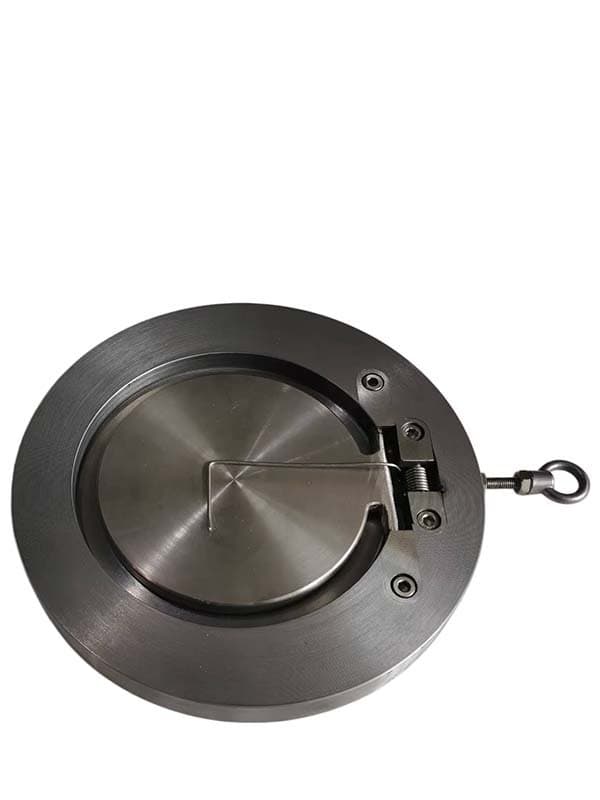
Disc: Single disc — full swing on internal hinge pin, up to 80° opening angle, gravity and backpressure closure
Design: Wafer body — thin face-to-face, no bolt holes, sandwiches between pipeline flanges with through-bolts
The Economy Choice — and What You Give Up
Wafer single disc swing check valves are the simplest reverse-flow prevention device you can put between two flanges. Thin body, no bolt holes, one disc on a hinge pin. Forward flow pushes the disc open. Flow stops, gravity and backpressure swing the disc back onto the seat. No spring, no dashpot, no external mechanism, no complicated internals. Just a disc swinging on a pin inside a thin shell.
That simplicity makes wafer single disc checks the cheapest swing check format. If you're running a Class 150-300 water line, an HVAC circulation loop, or a general process pump discharge where you need basic reverse-flow protection and cost is the primary decision factor, the wafer single disc is what gets specified. It works. It's affordable. It's available from every valve manufacturer in every common material.
But simplicity comes with tradeoffs you need to understand before you install.
Dead-End Service — Wafer Can't Do It
Wafer bodies have no bolt holes. The valve is held in position by through-bolts that pass across the valve body from one pipeline flange to the other. Both pipeline flanges must be present to clamp the valve. If you need to bolt a blind flange on one side — for dead-end isolation, for a line termination, for maintenance isolation where one side gets blanked off — a wafer body can't do it. There are no bolt holes in the wafer body for a blind flange to attach. You need a lug or double flanged body for dead-end service.
This is the most common mistake with wafer check valves. Someone specs a wafer for a pump discharge isolation point, then later wants to blank off the downstream side for pump maintenance. The wafer can't hold a blind flange. The through-bolts that clamp the wafer between the pipeline flanges only work when both flanges are present and bolted. Remove one flange and the wafer has no structural support on that side.
Gravity and Backpressure Closure — No Spring Backup
The disc closes by gravity and backpressure. No spring assist. On horizontal lines with flow direction that lets gravity pull the disc toward the seat, closure is reliable — the disc swings down by gravity, and backpressure pushes it home. But on vertical lines with upward flow, gravity pulls the disc away from the seat. The disc hangs open unless backpressure develops to push it closed. If backpressure builds slowly — a low-head system, a long discharge line with gradual flow deceleration — the disc stays open longer and more reverse flow passes through before closure.
For vertical installations, you need a spring-assisted check valve. Dual plate checks with torsion springs, axial flow checks with spring-loaded discs, or lift checks with short gravity-drop travel all close more reliably on vertical lines. Wafer single disc swing checks are a horizontal-line tool.
Thin Body — Less Structural Depth
Wafer bodies have minimal face-to-face dimension. That's the design — compact, thin, sandwiched between flanges. At 2" through 6" where pipeline forces are moderate, the thin body handles the loading without issues. At 12" through 24" where pipeline bending loads and thermal expansion forces are substantial, the wafer body has less structural depth than lug or double flanged formats. Less depth means less resistance to bending, less ability to distribute pipeline forces across the body structure.
For large-diameter Class 150 water mains where operating pressure is low and surge events are manageable, wafer single disc checks handle the structural requirements. For large-diameter Class 300 process lines or applications with significant pipeline loading, lug or double flanged formats provide more structural security.
Metal Seat for Rough Service, Soft Seat for Tight Shutoff
Metal-to-metal seats are standard. Disc face against body seat ring — both hard metal surfaces. They handle suspended particles, they handle moderate temperature, they last through thousands of cycles. Leakage tolerance is what you'd expect from metal-on-metal: not bubble-tight, but adequate for most water and general process applications.
Soft seated versions add an elastomer or PTFE sealing ring on the disc edge or seat ring surface. The soft material compresses into surface imperfections and gives bubble-tight shutoff. Soft seats work for Class 150-300 water and chemical lines where zero leakage is specified. They don't...
Technical Specifications
| Parent Standards | API 594, BS 1868, ASME B16.34 |
| Parent Size Range | 2" - 48" |
| Parent Pressure Class | Class 150 - 2500 |
Product Downloads
Need a quote?
Contact our engineering team for pricing and technical support on Wafer Single Disc Swing Check Valve.
Request a QuoteLooking for more options?
Explore our complete range of industrial valves or contact us for custom solutions.
Ball Valves
FLOWKS offers floating ball valve, trunnion mounted ball valve and top entry ball valve for oil & gas, petrochemical and power generation. Designed per API 6D, API 608 and ASME B16.34.
DBB Valves
FLOWKS Double Block & Bleed (DBB) valves provide dual isolation with bleed verification in a single compact body. Replacing traditional multi-valve installations, FLOWKS DBB valves reduce weight, space and potential leak paths. Available in bolted bonnet, all-welded and expanding gate designs per API 6D and API 607.
Gate Valves
FLOWKS gate valves for isolation service in piping systems. Flexible wedge, solid wedge, slab and expanding gate designs per API 600, API 602 and ASME B16.34.
Globe Valves
FLOWKS globe valves for throttling and isolation. Standard, angle, Y-pattern and bellows seal configurations per API 602 and BS 1868.