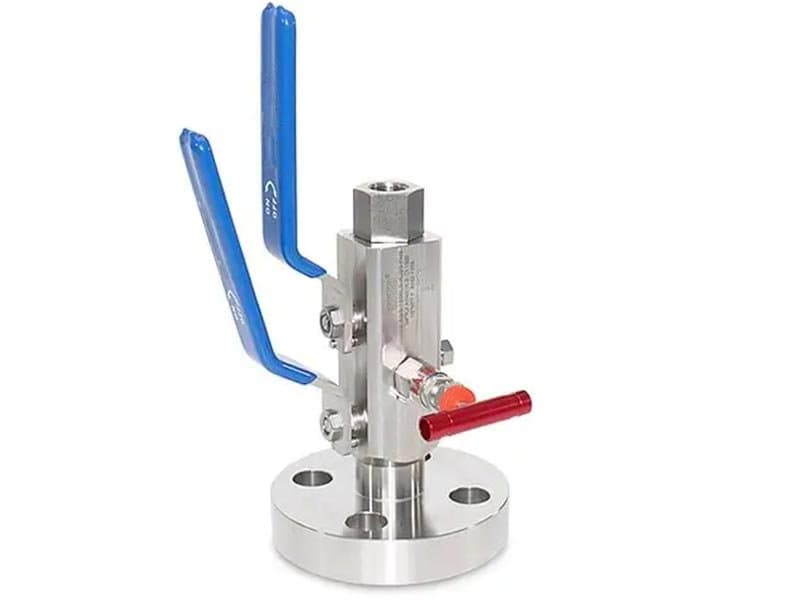
Flange To Screw Needle Type DBB
About
Quick Specs 1/2" - 1" (DN15 - DN25) up to 10,000 psi (Class 150 - 2500 equivalent) API 6D, API 607, ASME B16.34, ISO 15848 A182 F316, A182 F51, A182 F53 PTFE, PEEK, metal-to-metal (Stellite 6) Flanged process-side connection + threaded (NPT) instrument-side connection, needle-type DBB with compact body, double block & bleed with single bleed port
Flange on One End, Screw on the Other——Where the Pipeline Is Flanged but the Instrument Is Threaded
Process piping at the instrument connection point often has a flanged isolation valve on the pipeline side and a threaded (NPT) connection at the gauge or transmitter side——the pipeline specification calls for flanged connections above 1" bore for structural integrity and maintenance accessibility, but the instrument connection (gauge, transmitter, pressure switch) is almost always 1/2" NPT threaded because instruments don't have flanged process connections. That mismatch——flanged on one side, threaded on the other——is exactly what this valve addresses. The process-side (upstream) connection is a flanged end (RF or RTJ per ASME B16.5) that bolts directly to the pipeline flange. The instrument-side (downstream) connection is a threaded NPT port that the gauge or transmitter threads onto directly. Two blocking seats and a bleed cavity sit between the flanged upstream connection and the threaded downstream connection——the DBB isolation function spans the entire flow path from flanged pipeline interface to threaded instrument interface, with no additional fittings, adapters, or interconnection leak paths between them.
Without this flange-to-screw configuration, the installer has to cobble together a flanged isolation valve, a reducing fitting (flange-to-thread adapter), and a separate bleed valve——three components with two interconnection points (flanged-to-adapter, adapter-to-instrument) that are both potential external leak paths. Each interconnection adds a gasket or thread seal that has to be maintained independently. The flange-to-screw needle-type DBB eliminates both interconnection points——the flanged end bolts directly to the pipeline, the threaded end accepts the instrument directly, and the DBB isolation is inside the single body between them. No adapter. No extra fitting. No interconnection leak paths. One valve body spans the entire connection mismatch.
Needle-Type——Compact Body for High-Pressure Instrumentation Taps
The needle-type designation means the blocking seats are needle-valve trim rather than ball-valve trim——a tapered needle plug that seats into a matching cone-shaped seat ring, rather than a rotating ball that seals against flat or contoured seat rings. Needle trim has two practical advantages at small bore sizes and high pressures:
First: the needle-and-cone seating geometry seals progressively——the needle seats deeper into the cone as closing force increases, creating a line-contact seal that tightens with additional stem torque. That progressive seating behavior gives needle-type valves a mechanical advantage at high pressures where ball-valve seats (which rely on surface-to-surface contact at a defined seat geometry) can struggle to maintain bubble-tight shutoff at pressures above Class 1500. The needle's tapered geometry creates a wedging effect——the more closing torque you apply, the tighter the needle wedges into the cone, and the seal gets progressively tighter rather than reaching a limit defined by the seat's elastic deformation.
Second: the needle trim's compact geometry fits inside a body that's smaller than a ball-valve body at the same bore size——the needle assembly (stem, tapered plug, seat cone) occupies less internal volume than a ball assembly (ball, two seat rings, trunnion pins) at 1/2" bore. That compact geometry keeps the overall body dimensions shorter and lighter——critical for instrumentation installations where space allocation at the pipeline tap is limited, and where the weight on the flanged connection has to stay within the flange's structural capacity.
The two blocking seats in the needle-type DBB are two independent needle-valve assemblies——one upstream (process-side) needle and one downstream (instrument-side) needle, each with its own stem, seat cone, and operating handle. The bleed port sits between the two needle seats——a third, smaller needle valve that vents the cavity between the two blocking needles. Three stems, three handles, one body. Each needle operates independently——close the upstream needle first, open the bleed needle to verify zero, then close the downstream needle. The sequence is the same as any DBB operation, but the seating mechanism is needle-and-cone rather than ball-and-ring.
Two Needles and a Bleed——Independent Sealing, Independent Verification
The upstream needle blocks process pressure from the flanged pipeline connection. The downstream needle blocks any pressure that might leak...
Technical Specifications
| Size Range | 1/2"-4" |
| Pressure Class | Class 150 - 2500 |
| Design Standard | EEMUA PUB NO182 |
| Body Materials | A105、SS304、SS316、F51, F55, F53, Hastelloy C、Monel 400 |
| Parent Standards | API 6D, API 607, API 608, ASME B16.34, ISO 15848 |
| Parent Size Range | 2" - 24" |
| Parent Pressure Class | Class 150 - 1500 |
Product Downloads
| Size Range | 1/2"-4" |
| Pressure Class | Class 150 - 2500 |
| Design Standard | EEMUA PUB NO182 |
| Body Materials | A105、SS304、SS316、F51, F55, F53, Hastelloy C、Monel 400 |
Need a quote?
Contact our engineering team for pricing and technical support on Flange To Screw Needle Type DBB.
Request a QuoteLooking for more options?
Explore our complete range of industrial valves or contact us for custom solutions.
Ball Valves
FLOWKS offers floating ball valve, trunnion mounted ball valve and top entry ball valve for oil & gas, petrochemical and power generation. Designed per API 6D, API 608 and ASME B16.34.
Gate Valves
FLOWKS gate valves for isolation service in piping systems. Flexible wedge, solid wedge, slab and expanding gate designs per API 600, API 602 and ASME B16.34.
Globe Valves
FLOWKS globe valves for throttling and isolation. Standard, angle, Y-pattern and bellows seal configurations per API 602 and BS 1868.
Check Valves
FLOWKS check valves prevent reverse flow. Dual plate, swing, tilting disc and lift check designs per API 594 and BS 1868.