Gauge Block NonoFlange SBB
About
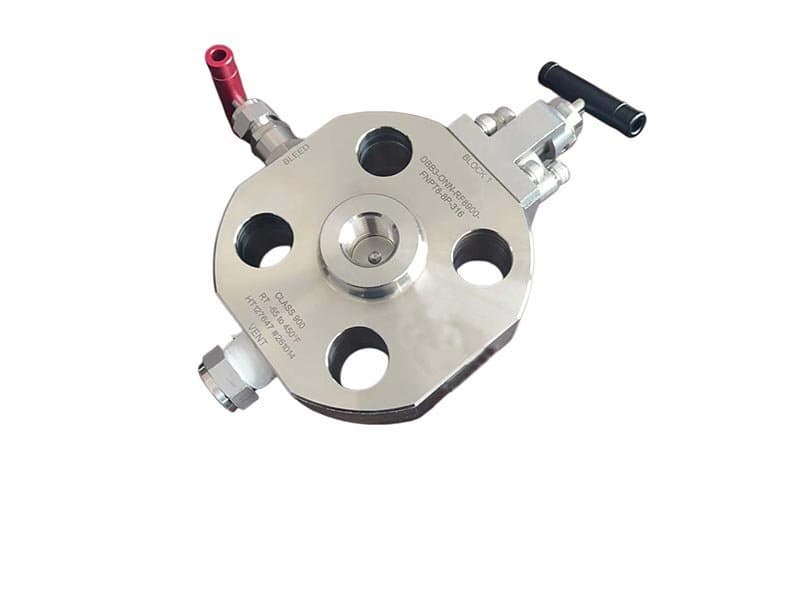
1/2" - 2" (DN15 - DN50) Class 150 - 1500 / up to 10,000 psi (needle-type configurations) API 6D, API 607, ASME B16.34, ISO 15848 A182 F316, A182 F51, A182 F53 PTFE, PEEK, metal-to-metal (Stellite 6) Gauge block body with nonoflange connection, single block & bleed with bleed verification port, compact instrumentation valve
SBB vs DBB——One Seat or Two, and When One Is Enough
Double Block and Bleed (DBB) provides two independent sealing boundaries with a verified zero-pressure cavity between them——the maximum isolation assurance available in a single valve body. But not every instrument isolation application needs maximum assurance. Some applications need verified isolation with a bleed check, but the process conditions don't demand two independent blocking boundaries: low-pressure utility lines, non-hazardous media (water, air, nitrogen), instrument taps on non-flammable service where the consequence of a single seat leak is a gauge reading error, not a safety incident. For those applications, Single Block and Bleed (SBB) provides one blocking seat and one bleed verification port——enough isolation to remove the instrument safely (the seat blocks process pressure, the bleed port verifies the seat is holding before the instrument side gets opened), but with only one sealing boundary instead of two. The trade-off is straightforward: one seat instead of two means fewer components, shorter assembly length, lower cost, and simpler operation——but only one blocking boundary, not two independent ones. If that single seat fails, there's no backup seat to maintain isolation. The bleed port reveals the failure (process pressure appears at the bleed), but the isolation is gone until the seat gets repaired.
FLOWKS gauge block SBB valves use the same compact body geometry as the DBB version——nonoflange thread-on mounting, direct NPT connection to the instrument tap, minimum assembly height——but with one blocking seat instead of two. The bleed port sits on the downstream side of the single blocking seat, providing the verification function that distinguishes SBB from simple single-block isolation without bleed capability. With the blocking seat closed and the bleed valve open, zero pressure at the bleed port confirms the single seat is holding. If process pressure appears at the bleed, the seat has failed——the isolation is compromised and the instrument side gets exposed to live process pressure. That verification capability (bleed-check before opening the instrument side) is what makes SBB a safer isolation method than a simple single-block valve without bleed——the technician doesn't assume the seat is holding, the technician verifies it through the bleed port. But it's still only one seat——if the verification reveals a failure, there's no backup.
When SBB Is the Right Specification——and When It Isn't
The decision between SBB and DBB isn't about preference or cost optimization——it's about consequence analysis. What happens if the single blocking seat leaks or fails? If the consequence is a gauge reading error or a transmitter calibration drift on a non-hazardous utility line——SBB is adequate. The bleed port reveals the failure, maintenance replaces the seat, and the process continues. If the consequence is exposure to toxic, flammable, or high-pressure media that would create a safety incident or environmental release——DBB is mandatory. The single seat in SBB provides verified isolation when it's holding, but it provides no backup when it fails. On hazardous service, that's unacceptable——the second seat in DBB provides the backup that maintains isolation even when the first seat fails, and the bleed cavity reveals which seat has failed without losing overall isolation capability.
Regulatory frameworks and industry standards increasingly default to DBB for process isolation on hydrocarbon, chemical, and high-pressure pipelines——the API 6D definition of Double Block and Bleed is the baseline specification for new installations on flammable and toxic service. SBB remains appropriate for non-hazardous utility service (instrument air, nitrogen blanketing, low-pressure water, HVAC systems) where the isolation consequence is operational inconvenience, not safety risk. On those applications, SBB's simpler architecture (one seat, one bleed, fewer components, shorter assembly) provides verified isolation with adequate safety margin——the cost and complexity reduction of eliminating the second seat is justified by the lower consequence of a single-seat failure.
The Bleed Port——Same Verification Function, Positioned After One Seat Instead of Two
In a DBB valve, the bleed port sits between two blocking seats——it vents the cavity between them and verifies that both upstream and downstream seats are holding simultaneously. In an SBB valve, the bleed port sits downstream of the single blocking seat——it vents the space...
Technical Specifications
| Size Range | 1/2"-2" |
| Pressure Class | Class 150 - 2500 |
| Design Standard | EEMUA PUB NO182 |
| Body Materials | A105、SS304、SS316、F51, F55, F53, Hastelloy C、Monel 400 |
| Parent Standards | API 6D, API 607, API 608, ASME B16.34, ISO 15848 |
| Parent Size Range | 2" - 24" |
| Parent Pressure Class | Class 150 - 1500 |
Product Downloads
| Size Range | 1/2"-2" |
| Pressure Class | Class 150 - 2500 |
| Design Standard | EEMUA PUB NO182 |
| Body Materials | A105、SS304、SS316、F51, F55, F53, Hastelloy C、Monel 400 |
Need a quote?
Contact our engineering team for pricing and technical support on Gauge Block NonoFlange SBB.
Request a QuoteLooking for more options?
Explore our complete range of industrial valves or contact us for custom solutions.
Ball Valves
FLOWKS offers floating ball valve, trunnion mounted ball valve and top entry ball valve for oil & gas, petrochemical and power generation. Designed per API 6D, API 608 and ASME B16.34.
Gate Valves
FLOWKS gate valves for isolation service in piping systems. Flexible wedge, solid wedge, slab and expanding gate designs per API 600, API 602 and ASME B16.34.
Globe Valves
FLOWKS globe valves for throttling and isolation. Standard, angle, Y-pattern and bellows seal configurations per API 602 and BS 1868.
Check Valves
FLOWKS check valves prevent reverse flow. Dual plate, swing, tilting disc and lift check designs per API 594 and BS 1868.