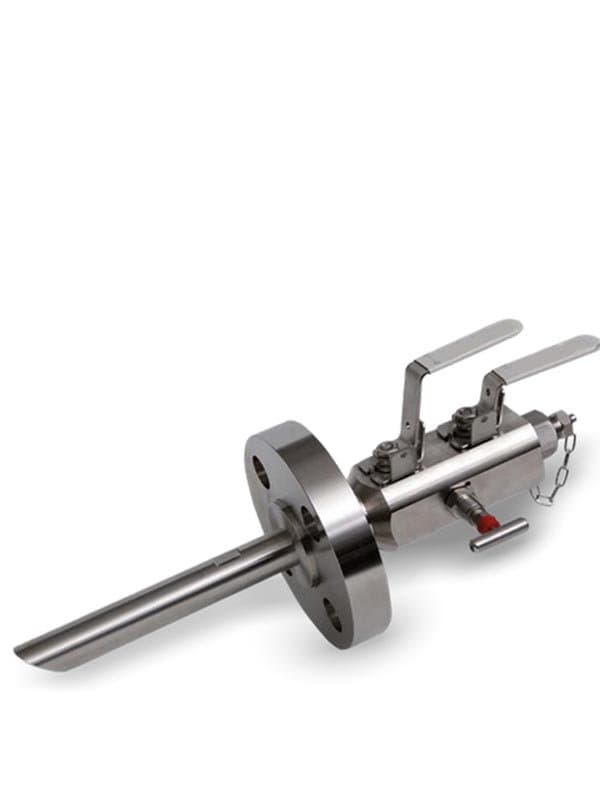
Sampling DBB Needle Valve
About
Quick Specs 1/4" - 1/2" (DN8 - DN15) up to 10,000 psi / Class 150 - 2500 equivalent API 6D, ISO 15848, NACE MR0175 (sour service configurations) A182 F316, A182 F51, A182 F53, Monel (NACE sour service) PTFE, PEEK, metal-to-metal (Stellite 6) Sampling needle valve with DBB isolation, compact body, threaded connections (NPT/BSP), sample port with double block protection
Sampling from Live Process Lines——and Why the Sample Tap Needs DBB Protection
A sampling valve extracts a small volume of process fluid from a live pipeline for laboratory analysis, quality verification, or regulatory compliance testing——the sample has to be representative (same composition, same pressure, same temperature as the main process stream), and the extraction has to be safe (the technician drawing the sample shouldn't get exposed to the full pipeline pressure, and the pipeline shouldn't lose containment through the sample tap). A simple single-block sampling valve provides one isolation boundary——when the valve is closed, the sample port is isolated from the pipeline. But that isolation is single-point: if the single seat leaks, pipeline pressure reaches the sample port and the sample container simultaneously——the technician gets hit with live process pressure while handling a sample bottle that's supposed to be at atmospheric pressure. On hydrocarbon, chemical, and sour gas sampling applications where the process media is flammable, toxic, or high-pressure, that single-point isolation failure is a safety incident——not just a sample contamination issue.
FLOWKS sampling DBB needle valves provide double block and bleed isolation at the sample connection point——two independent needle-valve blocking seats with a bleed cavity between them, in a compact body that mounts directly at the pipeline sample tap. The upstream needle blocks pipeline pressure from the bleed cavity. The downstream needle blocks any pressure leaking past the upstream needle from reaching the sample port. The bleed cavity between the two needles vents to atmosphere or closed drain——zero pressure at the bleed confirms both blocking needles are holding before the sample port gets opened for sample extraction. The DBB architecture provides the same verified isolation logic at the sample tap that it provides at gauge and transmitter isolation points: you verify isolation through the bleed before you open the downstream side to atmosphere. On process sampling, that verification step is critical because the technician is about to open a sample container that's designed for atmospheric pressure——you don't expose an atmospheric-pressure sample bottle to even a trace amount of live pipeline pressure without verifying that the isolation is intact.
Needle Trim——The Right Seating Mechanism for Small-Bore Sample Extraction
Sample extraction volumes are small——a few milliliters to a few hundred milliliters, drawn through a 1/4" or 1/2" bore sampling port. The bore size is small because the sample volume is small and the extraction rate needs to be controlled precisely (fast sample draw pulls non-representative fluid; slow, controlled draw gives representative composition). Needle trim at 1/4"-1/2" bore provides the flow control precision that sampling requires——the tapered needle plug modulates the flow area incrementally as the stem rotates, giving the technician fine control over the extraction rate rather than an on/off open-or-closed binary. That modulation capability is built into the needle geometry——the needle doesn't just open and close, it throttles at partial positions where the flow area between the needle tip and the seat cone is precisely controlled by the stem rotation angle.
For the DBB blocking seats (upstream and downstream), the same needle geometry provides progressive wedging sealing——tighter shutoff with additional stem torque, same as the flange-to-screw needle-type DBB. For the sampling extraction port (the downstream connection where the sample container attaches), the needle's throttling capability gives controlled extraction rate management——the technician doesn't open the sample port fully and let the process media rush into the container at pipeline velocity. Instead, the needle is opened incrementally, the sample flows at a controlled rate, the container fills slowly and steadily, and the composition stays representative because the extraction rate doesn't create turbulence or preferential-phase separation in the sample stream.
Sample Extraction Procedure——DBB Verification Before Opening to Atmosphere
The sampling procedure with a DBB needle valve follows a defined sequence that the three-stem architecture enforces physically:
1. Close both blocking needles (upstream and downstream)——the sample port is fully isolated from the pipeline.
2. Open the bleed needle——vent any residual pressure in the cavity between the two blocking needles. Check...
Technical Specifications
| Size Range | 1/2"-2" |
| Pressure Class | Class 150 - 2500 |
| Design Standard | EEMUA PUB NO182 |
| Body Materials | A105、SS304、SS316、F51, F55, F53, Hastelloy C、Monel 400 |
| Parent Standards | API 6D, API 607, API 608, ASME B16.34, ISO 15848 |
| Parent Size Range | 2" - 24" |
| Parent Pressure Class | Class 150 - 1500 |
Product Downloads
| Size Range | 1/2"-2" |
| Pressure Class | Class 150 - 2500 |
| Design Standard | EEMUA PUB NO182 |
| Body Materials | A105、SS304、SS316、F51, F55, F53, Hastelloy C、Monel 400 |
Need a quote?
Contact our engineering team for pricing and technical support on Sampling DBB Needle Valve.
Request a QuoteLooking for more options?
Explore our complete range of industrial valves or contact us for custom solutions.
Ball Valves
FLOWKS offers floating ball valve, trunnion mounted ball valve and top entry ball valve for oil & gas, petrochemical and power generation. Designed per API 6D, API 608 and ASME B16.34.
Gate Valves
FLOWKS gate valves for isolation service in piping systems. Flexible wedge, solid wedge, slab and expanding gate designs per API 600, API 602 and ASME B16.34.
Globe Valves
FLOWKS globe valves for throttling and isolation. Standard, angle, Y-pattern and bellows seal configurations per API 602 and BS 1868.
Check Valves
FLOWKS check valves prevent reverse flow. Dual plate, swing, tilting disc and lift check designs per API 594 and BS 1868.