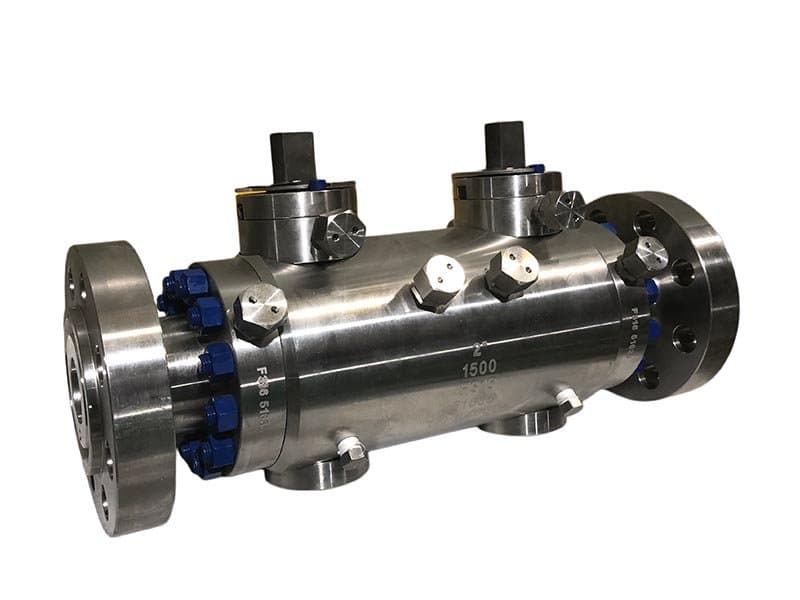
Trunnion Double Block & Bleed DBB
About
2" - 24" (DN50 - DN600)
API 6D, API 607, ASME B16.34, ISO 15848
A216 WCB, A351 CF8M, A182 F51, A182 F53
PTFE, Nylon, PEEK, metal-to-metal (Stellite 6)
Trunnion-mounted ball with spring-loaded seats, double block & bleed in single body, side-entry or top-entry maintenance access
Pipeline Isolation That Doesn't Trust One Seat——Because Pipeline Consequences Don't Allow It
A pipeline isolation valve sits between sections of process piping carrying hydrocarbon, chemical, or high-pressure gas——media where the consequence of isolation failure isn't a gauge reading error, it's a safety incident, an environmental release, or a regulatory violation. On those applications, one blocking seat isn't sufficient even when it's holding——because the consequence of that one seat failing is unacceptable. A single-block valve provides isolation from one sealing boundary; if that boundary leaks, the media reaches the downstream section that was supposed to be isolated. A trunnion DBB valve provides isolation from two independent sealing boundaries with a verified zero-pressure cavity between them——the upstream seat blocks pressure from the active pipeline section, the downstream seat blocks pressure toward the isolated section, and the bleed cavity between the two seats gives you a verified zero-pressure zone that confirms both seats are holding before the downstream section gets opened for maintenance, inspection, or hot-tap operations. Two independent seats, two independent failure modes, one verified isolation status visible through the bleed port.
The trunnion-mounted ball architecture provides the structural platform for two independent spring-loaded seats within a single valve body. The ball is anchored by upper and lower trunnion pins——it doesn't float under pressure differential like a floating ball valve. The two seat rings sit on opposite sides of the ball, each independently spring-loaded against the ball surface. When the ball rotates to the closed position, both seats seal simultaneously——the upstream seat against upstream pressure, the downstream seat against downstream pressure, both independent, both verifiable through the bleed cavity. That trunnion architecture is what makes DBB feasible at larger bore sizes——a floating ball valve has one sealing direction (the ball pushes against the downstream seat under upstream pressure), but a trunnion valve has two independent sealing directions (each spring-loaded seat pushes against the ball from its own side). Two seats. Two springs. Two independent sealing forces. One verified isolation cavity between them.
Why Trunnion DBB Replaces the Old Three-Valve Assembly
Before single-body DBB valves became the standard pipeline isolation specification, the industry used three separate valves to achieve double block and bleed: two isolation valves (one upstream, one downstream) and one bleed valve in a tee fitting between them. That three-valve assembly works——it provides two blocking boundaries and a bleed verification port——but it has four inherent problems that a single-body trunnion DBB eliminates.
First: multiple potential leak paths. Three valves means three valve bodies, three sets of body-to-piping connections, three bonnet-to-body gaskets, and the tee fitting connections between the three valves——each connection is a potential external leak path. A single-body DBB eliminates all the inter-valve connections——both blocking seats and the bleed port are inside one body, with no external connections between the blocking and bleeding functions except the single bleed port to atmosphere or drain. Fewer external connections means fewer potential leak paths.
Second: larger installation envelope. Three separate valves with a tee fitting occupy significantly more pipe rack space than a single-body DBB——the three-valve assembly length is the combined length of two isolation valves plus the tee fitting, while the single-body DBB fits within a single valve body length. On congested pipe rack installations where space allocation is a constraint, the single-body DBB's compact footprint is a practical advantage that goes beyond aesthetics.
Third: higher total weight. Three valve bodies plus a tee fitting weigh more than one DBB body——more steel in the pipe rack, more weight on pipe supports, more structural loading. Weight reduction isn't just a convenience——on large-bore pipeline installations, the weight difference between a three-valve assembly and a single-body DBB can affect pipe support design and stress analysis calculations.
Fourth: sequential operation complexity. Operating three separate valves requires a specific sequence: close the upstream isolation valve, open the bleed valve, verify zero pressure at the bleed, close the downstream isolation valve, then proceed with the downstream work. That sequence has to be executed correctly...
Technical Specifications
| Size Range | 2"-24" |
| Pressure Class | Class 150 - 2500 |
| Design Standard | API 6D,EEMUA PUB NO182 |
| Body Materials | A105、SS304、SS316、F51, F55, F53, Hastelloy C、Monel 400 |
| Parent Standards | API 6D, API 607, API 608, ASME B16.34, ISO 15848 |
| Parent Size Range | 2" - 24" |
| Parent Pressure Class | Class 150 - 1500 |
Product Downloads
| Size Range | 2"-24" |
| Pressure Class | Class 150 - 2500 |
| Design Standard | API 6D,EEMUA PUB NO182 |
| Body Materials | A105、SS304、SS316、F51, F55, F53, Hastelloy C、Monel 400 |
Need a quote?
Contact our engineering team for pricing and technical support on Trunnion Double Block & Bleed DBB.
Request a QuoteLooking for more options?
Explore our complete range of industrial valves or contact us for custom solutions.
Ball Valves
FLOWKS offers floating ball valve, trunnion mounted ball valve and top entry ball valve for oil & gas, petrochemical and power generation. Designed per API 6D, API 608 and ASME B16.34.
Gate Valves
FLOWKS gate valves for isolation service in piping systems. Flexible wedge, solid wedge, slab and expanding gate designs per API 600, API 602 and ASME B16.34.
Globe Valves
FLOWKS globe valves for throttling and isolation. Standard, angle, Y-pattern and bellows seal configurations per API 602 and BS 1868.
Check Valves
FLOWKS check valves prevent reverse flow. Dual plate, swing, tilting disc and lift check designs per API 594 and BS 1868.