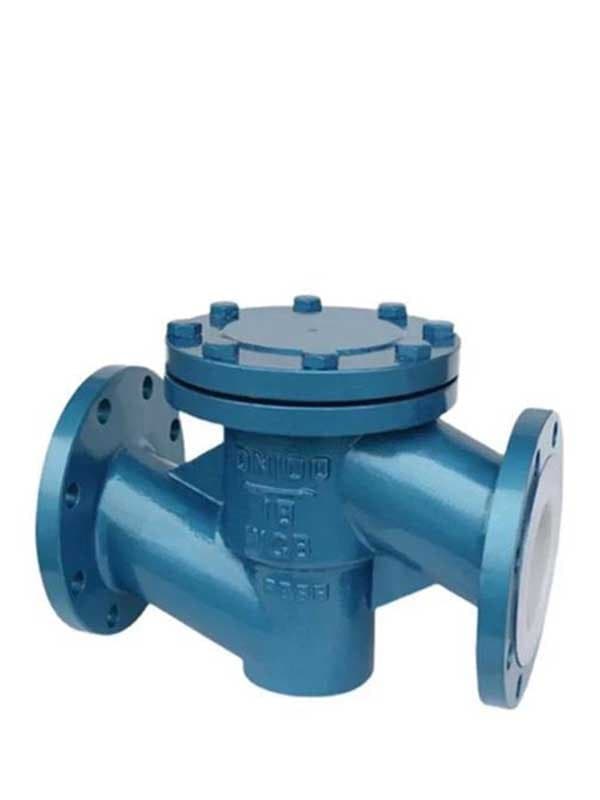
FEP Lined Check Valve
About
Size: 1" - 12" (DN25 - DN300)
Pressure: Class 150 - 300 / PN 10-40
Standard: MSS SP-111, manufacturer-specific
Body Materials: Carbon steel (A216 WCB) or ductile iron outer body; FEP (fluorinated ethylene propylene) full-body liner (2-4mm) covering all wetted surfaces — body bore, seat area, disc contact surface, hinge pin housing
Check mechanism: Swing check (disc swings on hinge pin) or lift check (disc lifts vertically off seat); disc and hinge pin are FEP-encapsulated — metal core for strength, FEP shell for corrosion isolation; no exposed metal on any wetted component
Design: Check valve body with FEP liner; one-way flow prevention; swing or lift disc inside FEP-lined bore; disc opens with forward flow, closes with reverse flow
The Surface Finish Advantage
FEP lining for check valves isn't about chemical resistance — PTFE and FEP cover the same corrosive media profile, and both work. It's about mechanical dynamics. The surface finish.
Check valves live or die by how cleanly the disc opens and closes. A swing check disc swings on a hinge pin inside the body bore. Every time forward flow pushes the disc open, the hinge rotates. Every time reverse flow pushes the disc closed, the disc swings back against the seat. The friction at those two contact points — hinge rotation and seat re-contact — determines whether the valve opens at the right flow velocity and closes at the right reverse-flow pressure.
FEP melt-molding produces a surface finish that's noticeably smoother than compression-molded PTFE. That smooth surface reduces friction at the hinge pin housing and at the disc-to-seat contact zone. The disc swings open with less resistance — it opens earlier at lower forward flow velocity, which means less pressure drop across the valve during normal flow. And it seats more cleanly on closure — the disc hits the FEP liner seat with less drag, so it closes faster and tighter against reverse flow.
For check valves where opening and closing dynamics are part of the performance spec — acid pump discharge protection, chemical reactor reverse-flow prevention, corrosive cooling water return isolation — that smoother surface is a functional advantage, not a cosmetic one.
Lighter Shell, Better Dynamics
FEP is slightly less dense than PTFE — roughly 2.15 g/cm³ versus 2.2 g/cm³. On a check valve disc with a metal core, the difference in total disc weight is small but measurable. Swing check discs need enough mass to close reliably against reverse flow, but excess mass means the disc requires more forward flow velocity to open. FEP encapsulation gives you a disc that's marginally lighter at the shell, marginally easier to lift with forward flow, and still heavy enough at the metal core to seat against reverse pressure. It's a small optimization, but check valve dynamics are a small-margin game — the disc mass and surface friction together determine whether the valve works or water-hammers.
FEP vs PTFE — The Same Chemistry, Better Mechanics
Both materials resist the same corrosive media. Concentrated acids. Halogens. Oxidizers. Organic solvents. Pharmaceutical process chemicals. If the process attacks metal, FEP stops it just like PTFE stops it. The choice between them in check valve service is mechanical, not chemical. FEP's smoother surface finish and marginally lower density make the disc dynamics better — opens cleaner, closes cleaner, less friction at the hinge and seat. PTFE works. FEP works slightly better where check valve mechanics matter.
The tradeoff: FEP liner material costs more than PTFE, and FEP's maximum continuous service temperature (200°C) is lower than PTFE's (260°C). If your corrosive service runs above 200°C, PTFE is the only option. If it runs below 200°C and check valve dynamics are part of your performance requirements, FEP lining is the better choice.
Every Wetted Component, Covered
The disc, the hinge pin, the seat area, the body bore, the bonnet interior — FEP covers all of it. No metal surface inside the flow path. The hinge pin is FEP-encapsulated, not just coated. The disc is FEP-encapsulated over its entire surface, not just at the seat face. Full isolation means the corrosive media never reaches metal, never attacks the hinge mechanism, never contaminates the process with metal ions from the disc core. That's the same isolation principle as every lined valve in this family — just applied to the check valve's specific moving components.
A: Swing check handles larger sizes and lower pressure drops more effectively. Lift check provides faster closure and tighter shutoff but has higher pressure drop and is limited to smaller sizes. For acid pump discharge lines at 4" and above, swing check is standard. For small-diameter reactor isolation, lift check works.
A: Pulsating flow causes rapid disc cycling — open-close-open-close with every pump stroke. That...
Technical Specifications
| Size Range | 1" - 12" |
| Pressure Class | Class 150 |
| Design Standard | API 594, MSS SP-69 |
| Body Materials | PTFE(F4), FEP(F46), PFA, PVDF(F2) |
| Parent Standards | API 607, ASME B16.34, MSS SP-69, DIN 3356 |
| Parent Size Range | 1/2" - 24" |
| Parent Pressure Class | Class 150 - 300 / PN10 - PN16 |
Product Downloads
| Size Range | 1" - 12" |
| Pressure Class | Class 150 |
| Design Standard | API 594, MSS SP-69 |
| Body Materials | PTFE(F4), FEP(F46), PFA, PVDF(F2) |
Need a quote?
Contact our engineering team for pricing and technical support on FEP Lined Check Valve.
Request a QuoteLooking for more options?
Explore our complete range of industrial valves or contact us for custom solutions.
Ball Valves
FLOWKS offers floating ball valve, trunnion mounted ball valve and top entry ball valve for oil & gas, petrochemical and power generation. Designed per API 6D, API 608 and ASME B16.34.
DBB Valves
FLOWKS Double Block & Bleed (DBB) valves provide dual isolation with bleed verification in a single compact body. Replacing traditional multi-valve installations, FLOWKS DBB valves reduce weight, space and potential leak paths. Available in bolted bonnet, all-welded and expanding gate designs per API 6D and API 607.
Gate Valves
FLOWKS gate valves for isolation service in piping systems. Flexible wedge, solid wedge, slab and expanding gate designs per API 600, API 602 and ASME B16.34.
Globe Valves
FLOWKS globe valves for throttling and isolation. Standard, angle, Y-pattern and bellows seal configurations per API 602 and BS 1868.