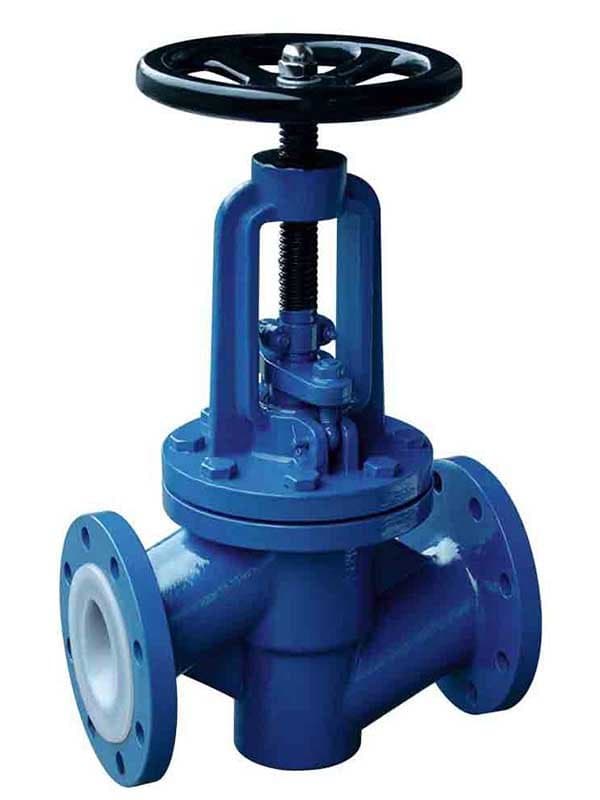
PFA Lined Globe Valve
About
Size: 1/2" - 8" (DN15 - DN200)
Pressure: Class 150 - 300 / PN 10-40
Standard: MSS SP-111, manufacturer-specific
Body Materials: Carbon steel (A216 WCB) or ductile iron outer body; PFA (perfluoroalkoxy) full-body liner (3-5mm) covering all wetted surfaces — body bore, seat ring area, disc contact surface, bonnet interior up to packing area
Seat: PFA liner extends to seat ring area for disc shutoff contact; disc is PFA-encapsulated — metal core for structural strength, PFA shell for corrosion isolation
Design: Globe valve body with PFA liner; disc lifts off seat for throttling and shutoff; PFA covers every wetted surface — no exposed metal in the flow path
Why PFA, Not PTFE, for Globe Valves
Both materials are chemically inert to the same range of corrosive media. PTFE is cheaper, proven, and it works. Most lined valves in the industry use PTFE liners. So why specify PFA for a globe valve?
It comes down to how globe valves operate. They throttle. The disc doesn't just snap open and closed like a ball valve — it modulates flow, sliding across the seat surface on every cycle. Hundreds of cycles. Thousands of cycles. And every time that disc contacts the PTFE liner at the seat, two problems show up.
First: cold flow. PTFE creeps under sustained mechanical load. The seating force compresses the PTFE at the disc-seat contact zone. Over hundreds of cycles, that compression thins the liner until it can't hold shutoff pressure. You see it as increasing seat leakage over time — the liner is literally being squeezed thinner with every close cycle.
Second: surface finish. PTFE liners are compression-molded or paste-extruded. The surface isn't as smooth as it could be. Rougher surface means higher friction at the disc-to-seat sliding contact, which accelerates wear on both the disc encapsulation and the seat liner area.
PFA solves both. It has roughly 10x less creep under load compared to PTFE — the seat area holds its dimensional shape through thousands of throttling cycles. And PFA's melt-processability produces a smoother, more uniform liner surface that reduces sliding friction at the disc-seat interface.
The tradeoff is cost. PFA liner material runs 30-50% more than PTFE. But for a throttling globe valve in corrosive service where the disc-seat pair cycles thousands of times, that cost difference buys you a liner that survives more cycles before seat leakage forces replacement. That's the calculation — not which material is cheaper per kilogram, but which material keeps the valve in service longer between liner replacements.
The Disc Is Part of the Lining System
The globe disc isn't just PFA-lined on the contact face. It's PFA-encapsulated — metal core, PFA shell covering the entire disc surface. The disc lives inside the process fluid just like the body bore does. A disc with PFA only on the seat face would leave metal exposed to corrosive media everywhere else. That's not full isolation. PFA encapsulation means the disc is as chemically isolated as the body liner — no metal, no corrosion, no contamination from the disc either.
Throttling Where Nothing Else Survives
PFA lined globe valves sit in corrosive throttling service where metal-seated globe valves can't operate — acid concentration control, caustic flow modulation, pharmaceutical solvent metering, chemical reactor feed regulation. The service demands both corrosion resistance and throttling precision. PFA on the liner and disc gives you the corrosion barrier. The globe disc-to-seat geometry gives you the throttling control. Together they handle the job that neither a lined ball valve (great isolation, poor throttling) nor a metal globe valve (great throttling, zero corrosion resistance) can do alone.
A: You can, but it's over-specified for that role. If you need shutoff only in corrosive service, a PTFE lined ball valve is simpler and costs less. Globe valves earn their place when throttling is part of the requirement.
A: It depends on the seating force, disc travel distance, and process temperature. In typical acid throttling service at ambient to moderate temperatures, PFA liners hold dimensional stability through several thousand full cycles. Monitor seat leakage — when it trends upward beyond Class IV, the liner at the seat zone is thinning and replacement is due.
A: Essentially yes. PFA and PTFE resist the same range of corrosive media — strong acids, oxidizers, halogens, organic solvents. PFA's maximum continuous service temperature is slightly lower than PTFE's (260°C vs 280°C), but within that range the chemical resistance profile is equivalent.
A: PTFE or PFA packing above the bonnet liner zone, with a corrosion-resistant stem that's also PFA-covered where it passes through the bonnet bore. The packing zone is the transition point — the liner covers the bonnet interior up to the packing area, and packing seals...
Technical Specifications
| Size Range | 2" - 24" |
| Pressure Class | Class 150 / PN16 |
| Design Standard | ASME B16.34, DIN 3356 |
| Body Materials | PTFE(F4), FEP(F46), PFA, PVDF(F2) |
| Parent Standards | API 607, ASME B16.34, MSS SP-69, DIN 3356 |
| Parent Size Range | 1/2" - 24" |
| Parent Pressure Class | Class 150 - 300 / PN10 - PN16 |
Product Downloads
| Size Range | 2" - 24" |
| Pressure Class | Class 150 / PN16 |
| Design Standard | ASME B16.34, DIN 3356 |
| Body Materials | PTFE(F4), FEP(F46), PFA, PVDF(F2) |
Need a quote?
Contact our engineering team for pricing and technical support on PFA Lined Globe Valve.
Request a QuoteLooking for more options?
Explore our complete range of industrial valves or contact us for custom solutions.
Ball Valves
FLOWKS offers floating ball valve, trunnion mounted ball valve and top entry ball valve for oil & gas, petrochemical and power generation. Designed per API 6D, API 608 and ASME B16.34.
DBB Valves
FLOWKS Double Block & Bleed (DBB) valves provide dual isolation with bleed verification in a single compact body. Replacing traditional multi-valve installations, FLOWKS DBB valves reduce weight, space and potential leak paths. Available in bolted bonnet, all-welded and expanding gate designs per API 6D and API 607.
Gate Valves
FLOWKS gate valves for isolation service in piping systems. Flexible wedge, solid wedge, slab and expanding gate designs per API 600, API 602 and ASME B16.34.
Globe Valves
FLOWKS globe valves for throttling and isolation. Standard, angle, Y-pattern and bellows seal configurations per API 602 and BS 1868.