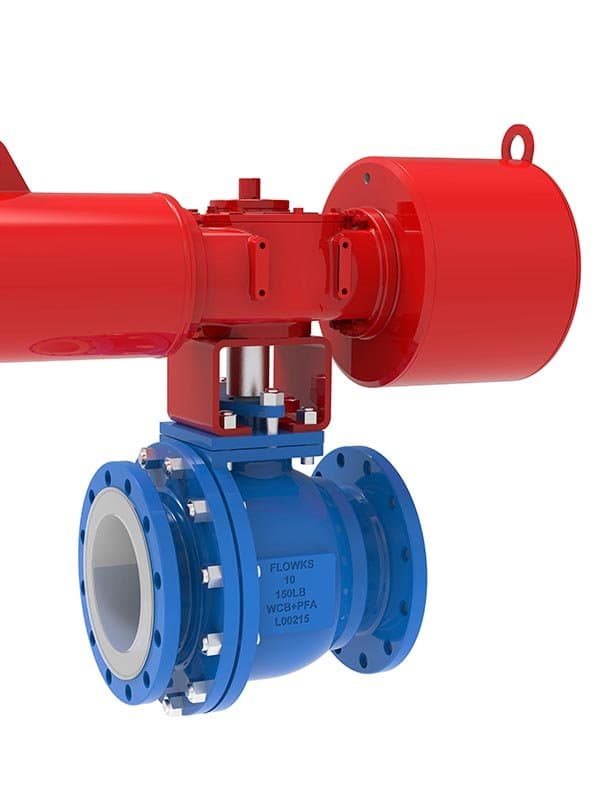
PTFE Lined Ball Valve
About
Size: 1/2" - 12" (DN15 - DN300)
Pressure: Class 150 - 300 / PN 10-40
Standard: MSS SP-111 (plastic-lined), manufacturer-specific for lined valves
Body Materials: Ductile iron (GGG40) or carbon steel (A216 WCB) outer body; PTFE full-body liner (3-5mm) covering all wetted surfaces — body bore, seat faces, ball contact area
Seat: PTFE liner serves as both body lining and seat material — lining extends to seat faces for ball shutoff contact; no separate metal seat rings exposed to process fluid
Design: Full-body PTFE lining — continuous PTFE sleeve molded/inserted into body cavity; ball rotates against PTFE liner at seat area; flanged ends; bolted body cover (two-piece or three-piece body); zero metal contact with corrosive media
When Stainless Steel Runs Out of Answers
You've been there. The spec sheet says 316L. The process fluid says concentrated hydrochloric acid. The engineer says "that won't work." And suddenly you're staring at a material selection problem that stainless, Hastelloy, and titanium all walk away from.
PTFE lined ball valves exist for exactly that moment. The design separates what standard ball valves try to do in one material — pressure containment and corrosion resistance — into two dedicated layers. The outer body, ductile iron or carbon steel, holds the line pressure. That's its job and it does it well. The PTFE liner, thick at 3-5mm, wraps every surface the process fluid touches. Body bore. Seat faces. The zone where the ball seats for shutoff. Nothing gets through to the metal shell underneath.
That separation matters more than most spec sheets admit. Zero metal exposure means zero corrosion attack on the body. Zero metal ions contaminating your process media. Zero galvanic corrosion concerns between dissimilar metals in the same piping run. You don't have to think about any of it — the PTFE liner handles the chemistry, the metal body handles the physics.
The Chemistry PTFE Covers
PTFE is chemically inert to virtually every industrial corrosive media you'll encounter. Concentrated hydrochloric at any temperature. Sulfuric acid up past 70%. Chlorine gas. Most strong oxidizers. Organic solvents across the pharmaceutical spectrum. The exceptions are exotic — molten alkali metals and elemental fluorine at elevated temperatures. If your process involves either of those, you need a different conversation. For everything else that eats metal, PTFE is the last-line barrier that actually works.
The Liner Is Not a Coating
Call it a lining, not a coating. Coatings are thin — measured in microns, applied by spray or dip. They chip. They pinhole. They fail at mechanical stress points like seat contacts. A PTFE liner in these valves is 3-5mm thick, molded as a continuous sleeve that fills the body cavity. That thickness gives you real mechanical durability at the seat area where the ball compresses the liner on every cycle. The liner doesn't just resist corrosion — it holds up under repeated seating force without thinning to failure.
Full-Bore Isolation, Not Partial Protection
The PTFE liner covers all wetted surfaces inside the body. Not just the flow path — the body cavity behind the ball, the seat contact zone, the area where process fluid sits when the valve is closed. The ball itself rotates against PTFE, not metal. There is no wetted metal component in this valve. That's the definition of full isolation, and it's why chemical processors, pharmaceutical manufacturers, and aggressive-media service engineers specify PTFE lined ball valves when the alternative is accepting that every metal option will eventually fail.
A: Not recommended. PTFE begins to soften above 200°C and loses mechanical strength at sustained temperatures above 260°C. Steam service, especially saturated steam at pressure, exceeds PTFE's thermal capability. Use metal-seated valves for steam.
A: The outer body never touches the process fluid. Its job is structural strength and pressure containment, both of which ductile iron and carbon steel deliver cost-effectively. You don't need a corrosion-resistant outer shell when the PTFE liner provides complete isolation.
A: Liner damage at the flange face or gasket area can create a direct path for corrosive media to reach the metal body. Inspect liner faces before bolting up. Use torque-controlled flange assembly — over-compression can crush the liner at the gasket zone.
A: PTFE liners can handle vacuum, but the liner may deform inward under sustained vacuum if the body cavity design doesn't provide adequate liner support. Check with the manufacturer for vacuum-rated designs — body geometry matters.
A: PTFE lined seats typically achieve Class IV or better shutoff. The PTFE liner compresses under ball seating force, creating a soft-seat seal that's tighter than hard metal-to-metal seats in most conditions. Leakage increases if the liner thins from repeated cycling — that's when replacement is due.
Technical Specifications
| Size Range | 1/2" - 12" |
| Pressure Class | Class 150 |
| Design Standard | API 607, ASME B16.34, MSS SP-69 |
| Body Materials | PTFE(F4), FEP(F46), PFA, PVDF(F2) |
| Parent Standards | API 607, ASME B16.34, MSS SP-69, DIN 3356 |
| Parent Size Range | 1/2" - 24" |
| Parent Pressure Class | Class 150 - 300 / PN10 - PN16 |
Product Downloads
| Size Range | 1/2" - 12" |
| Pressure Class | Class 150 |
| Design Standard | API 607, ASME B16.34, MSS SP-69 |
| Body Materials | PTFE(F4), FEP(F46), PFA, PVDF(F2) |
Need a quote?
Contact our engineering team for pricing and technical support on PTFE Lined Ball Valve.
Request a QuoteLooking for more options?
Explore our complete range of industrial valves or contact us for custom solutions.
Ball Valves
FLOWKS offers floating ball valve, trunnion mounted ball valve and top entry ball valve for oil & gas, petrochemical and power generation. Designed per API 6D, API 608 and ASME B16.34.
DBB Valves
FLOWKS Double Block & Bleed (DBB) valves provide dual isolation with bleed verification in a single compact body. Replacing traditional multi-valve installations, FLOWKS DBB valves reduce weight, space and potential leak paths. Available in bolted bonnet, all-welded and expanding gate designs per API 6D and API 607.
Gate Valves
FLOWKS gate valves for isolation service in piping systems. Flexible wedge, solid wedge, slab and expanding gate designs per API 600, API 602 and ASME B16.34.
Globe Valves
FLOWKS globe valves for throttling and isolation. Standard, angle, Y-pattern and bellows seal configurations per API 602 and BS 1868.