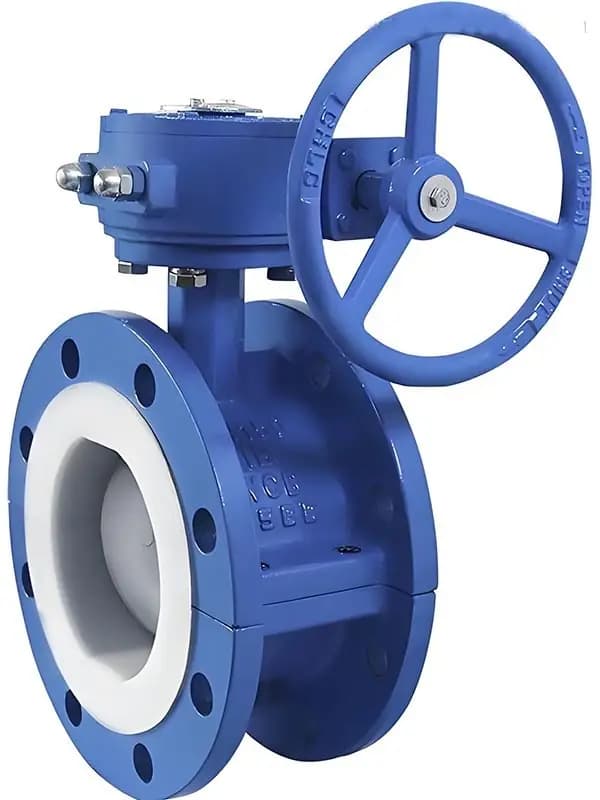
PTFE Lined Butterfly Valve
About
Size: 2" - 24" (DN50 - DN600)
Pressure: Class 150 / PN 10-16
Standard: API 609 (butterfly), MSS SP-111
Body Materials: Ductile iron or carbon steel outer body; PTFE full-body sleeve liner wrapping the body bore surface and extending to disc seating area; disc is metal (stainless or ductile iron) with PTFE encapsulation on sealing edge, or disc edge seats directly against PTFE body liner
Design: Centerline butterfly disc with PTFE body liner; disc rotates 90° inside PTFE-lined bore; PTFE liner wraps entire bore surface — disc edge compresses against liner for shutoff; wafer or lug body format
Big Pipe, Corrosive Media, Realistic Cost
Here's the economics problem in corrosive service at large diameters. A 10" PTFE lined ball valve works — it isolates the process, it holds the chemistry, it shuts off clean. It also costs three times what a 10" PTFE lined butterfly valve costs, because lining a ball valve body cavity is expensive. The ball valve body has a complex internal geometry — bore, cavity behind the ball, seat pockets, body cover interface. PTFE has to fill all of it as a continuous liner. At 10" diameter, that's a lot of PTFE molding into a lot of complex shape.
A butterfly valve body is simpler. Short straight-through bore. Rotating disc. The PTFE liner wraps the bore surface as a sleeve — simpler geometry, easier to mold and install, less material, less labor, lower cost. The tradeoff is pressure rating and shutoff precision, not corrosion isolation. You get the same PTFE chemical barrier at the bore surface. You get the same zero-metal-contact isolation for process fluid. You get it at a cost that makes large-diameter corrosive service economically viable.
Class 150 — The Limit Is Real
PTFE lined butterfly valves top out at Class 150. That's not a conservative rating or a marketing limitation — it's the physical limit of what the PTFE liner can hold under disc seating pressure. At Class 300, the disc edge compresses the PTFE liner at the seating zone with enough force that the liner deforms beyond its elastic recovery. PTFE is flexible, not rigid. It seals at Class 150 because the seating force stays within the range where PTFE compresses and rebounds. Above that range, it compresses and stays compressed — the seat area thins, the disc edge digs into the liner, and shutoff degrades fast.
For Class 150 corrosive chemical service, that limit isn't a problem. Acid transfer lines, chlorine distribution, caustic circulation, pharmaceutical solvent systems — these run at Class 150 or lower. The PTFE lined butterfly valve handles them all at a price point that makes lining large-diameter piping realistic.
The Disc Sealing Strategy
The disc sealing edge either has PTFE encapsulation as a shell around the metal disc edge, or the bare disc edge seats directly against the PTFE body liner. PTFE-encapsulated disc edges provide a softer, more compliant seal — the PTFE shell compresses against the PTFE liner, creating a double-soft-seat contact that's tighter at lower seating force. Direct metal disc edge against PTFE liner works too — the metal edge cuts a clean seal line into the PTFE surface. Both approaches seal. The encapsulated version is gentler on the liner surface over more cycles. The direct-contact version is simpler and slightly tighter on first closure.
Where This Valve Makes Sense
Chemical plant acid distribution headers at 8", 10", 12" diameters. Pharmaceutical solvent transfer mains. Chlorine processing plant circulation loops. Any corrosive service at Class 150 where the pipe diameter makes a lined ball valve cost prohibitive. That's the PTFE lined butterfly valve's territory — large bore, corrosive media, moderate pressure, cost-effective isolation.
A: Limited throttling is possible, but butterfly valves in corrosive lined service are primarily isolation valves. Throttling at partial disc angles means the disc edge sits against the PTFE liner in a compressed position for extended periods — that sustained compression accelerates liner thinning at the contact zone. Use lined globe valves for continuous throttling.
A: Wafer bodies are lighter and cheaper, sandwiched between flanges with through-bolts. Lug bodies have threaded lugs for each flange side, allowing one-side flange disconnection without breaking the opposite side. For maintenance-accessible installations where you might need to isolate one side, specify lug. For simple isolation between two fixed flanges, wafer works.
A: PTFE liner material handles continuous service up to 200°C, with peak exposure up to 260°C for short periods. Above 200°C sustained, PTFE begins to soften and the liner's ability to hold seating force at the disc edge degrades. Stay below 200°C for rated pressure service.
A: The PTFE liner extends to the flange face. You still use gaskets between the valve flange face and the piping...
Technical Specifications
| Size Range | 2" - 24" |
| Pressure Class | Class 150 / PN10 |
| Design Standard | API 609, MSS SP-69 |
| Body Materials | PTFE(F4), FEP(F46), PFA, PVDF(F2) |
| Parent Standards | API 607, ASME B16.34, MSS SP-69, DIN 3356 |
| Parent Size Range | 1/2" - 24" |
| Parent Pressure Class | Class 150 - 300 / PN10 - PN16 |
Product Downloads
| Size Range | 2" - 24" |
| Pressure Class | Class 150 / PN10 |
| Design Standard | API 609, MSS SP-69 |
| Body Materials | PTFE(F4), FEP(F46), PFA, PVDF(F2) |
Need a quote?
Contact our engineering team for pricing and technical support on PTFE Lined Butterfly Valve.
Request a QuoteLooking for more options?
Explore our complete range of industrial valves or contact us for custom solutions.
Ball Valves
FLOWKS offers floating ball valve, trunnion mounted ball valve and top entry ball valve for oil & gas, petrochemical and power generation. Designed per API 6D, API 608 and ASME B16.34.
DBB Valves
FLOWKS Double Block & Bleed (DBB) valves provide dual isolation with bleed verification in a single compact body. Replacing traditional multi-valve installations, FLOWKS DBB valves reduce weight, space and potential leak paths. Available in bolted bonnet, all-welded and expanding gate designs per API 6D and API 607.
Gate Valves
FLOWKS gate valves for isolation service in piping systems. Flexible wedge, solid wedge, slab and expanding gate designs per API 600, API 602 and ASME B16.34.
Globe Valves
FLOWKS globe valves for throttling and isolation. Standard, angle, Y-pattern and bellows seal configurations per API 602 and BS 1868.