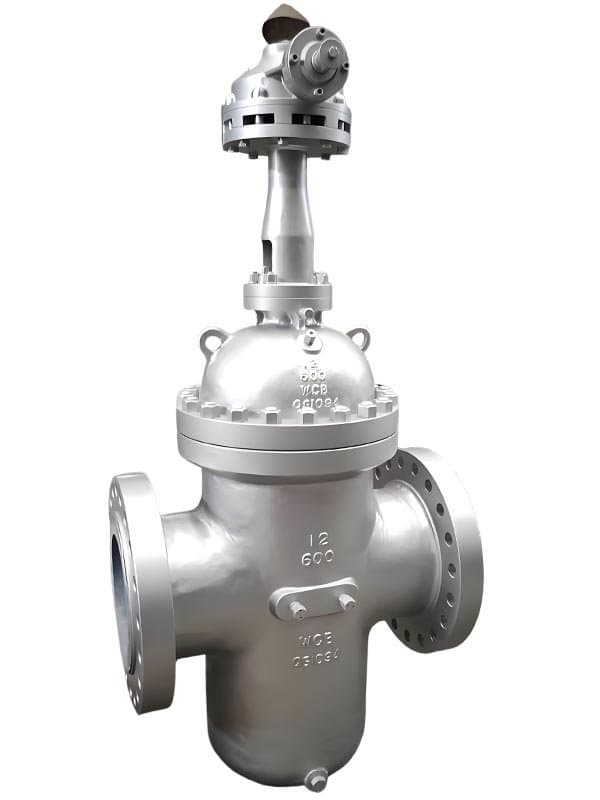
Flat Gate Valve
About
Size: 2" - 48" (DN50 - DN1200)
Pressure: Class 150 - 900 / PN 10-150
Standard: API 6D, manufacturer-specific for flat/slab gate designs
Body Materials: A216 WCB, A351 CF8M, forged steel (A182 F316/F22), all-welded body available
Gate: Flat slab gate (single plate) or expanding gate (two-plate mechanical seal)
Seat: Metal-to-metal (parallel seat rings) or soft-seated (elastomer/PTFE insert)
Bonnet: Bolted bonnet or pressure-seal
Design: Through-conduit full-bore — gate has bore-sized hole aligning with pipe when open
Full Bore Means the Pig Goes Through
Flat gate valves — also called through-conduit slab gate valves — exist for a reason that wedge gate valves can't address. When the valve is open, the gate plate has a hole that matches the pipe bore diameter exactly. That hole aligns with the pipeline bore, and the gate becomes part of the unobstructed flow path. No reduction in cross-section, no pocket areas where debris collects, no flow restriction that costs pumping energy over years of continuous operation.
That full-bore passage is why flat gate valves dominate pipeline isolation. Pipelines get inspected by sending pigs through the line — inspection tools, cleaning tools, smart pigs that measure wall thickness and detect corrosion. The pig travels through the pipe bore pushed by product flow at line velocity. If a gate valve restricts the bore even slightly, the pig hits the restriction and stops. Or it gets damaged. Or it gets stuck inside the valve body, which is the kind of problem that shuts down a pipeline section for days and costs hundreds of thousands of dollars in lost throughput.
Solid wedge gate valves at some sizes have reduced-port bodies — the bore through the body is smaller than the nominal pipe diameter. That reduction doesn't matter for most process isolation where you're just blocking flow, not running pigs. But for pipeline service, reduced bore is unacceptable. The through-conduit flat gate valve has zero bore reduction in the open position. The pig passes through the valve body as if the valve weren't there. Full diameter, full flow area, no obstruction.
The second reason full bore matters — crude oil and natural gas pipelines operate continuously for years. Pressure drop through a partially restricted valve accumulates pumping energy cost over that operating period. A reduced-port gate valve on a 36-inch natural gas transmission line might create a pressure drop of 2-3 psi at operating flow rates. That doesn't sound like much, but across a 200-mile pipeline with dozens of isolation valves, the cumulative pressure drop adds compressor fuel cost that runs into six figures annually. Through-conduit flat gates eliminate that restriction entirely.
Slab Gate vs Expanding Gate — Two Ways to Seal
The slab gate is a single flat plate that slides vertically between two parallel seat rings. When the plate drops between the seats, the solid section blocks the bore. When the plate rises, the bore-sized hole in the plate aligns with the pipeline and flow passes through unobstructed. Simple design, few moving parts, reliable operation in pipeline service.
The sealing mechanism for a slab gate relies on line pressure pushing the gate plate against the downstream seat ring. The upstream seat is in contact with the plate, but the primary seal happens on the downstream side where line pressure forces the plate against the seat face. That pressure-activated seal works well at normal operating pressures. At low differential pressure — near-zero line pressure during startup, or pressure equalization across the valve during bypass operation — the sealing force is minimal and the slab gate may not achieve bubble-tight shutoff.
The expanding gate solves that low-pressure sealing limitation. Two plates connected by a wedge mechanism — as the gate descends to the closed position, the internal wedge pushes the two plates outward against the parallel seat rings. The plates expand mechanically, independent of line pressure. When the gate reaches full closure, both plates are pressed firmly against their respective seat rings by the wedge mechanism, creating a seal that doesn't depend on line pressure to function. Bubble-tight shutoff at any pressure, including zero.
The expanding gate costs more and adds mechanical complexity — two plates, a wedge mechanism, more seal surfaces to maintain. But for pipeline isolation where bubble-tight shutoff is a regulatory requirement — natural gas transmission lines, hazardous liquid pipelines subject to DOT compliance — the expanding gate provides the sealing certainty that slab gates can't guarantee at low or zero differential pressure.
Parallel Seats — Not Tapered
All flat gate valve designs use parallel seat rings, not tapered wedge seats. The seat rings are parallel to each other and the gate plate slides between them in a straight...
Technical Specifications
| Size Range | 2"-48" |
| Pressure Class | Class150-2500 |
| Design Standard | API 6D |
| Body Materials | WCB, WC6, WC9, LCB, CF8, CF8M, CF3, CF3M, duplex stainless steel |
| Parent Standards | API 600, API 602, ASME B16.34, API 607 Fire Safe |
| Parent Size Range | 2" - 48" |
| Parent Pressure Class | Class 150 - 2500 |
Product Downloads
| Size Range | 2"-48" |
| Pressure Class | Class150-2500 |
| Design Standard | API 6D |
| Body Materials | WCB, WC6, WC9, LCB, CF8, CF8M, CF3, CF3M, duplex stainless steel |
Need a quote?
Contact our engineering team for pricing and technical support on Flat Gate Valve.
Request a QuoteLooking for more options?
Explore our complete range of industrial valves or contact us for custom solutions.
Ball Valves
FLOWKS offers floating ball valve, trunnion mounted ball valve and top entry ball valve for oil & gas, petrochemical and power generation. Designed per API 6D, API 608 and ASME B16.34.
DBB Valves
FLOWKS Double Block & Bleed (DBB) valves provide dual isolation with bleed verification in a single compact body. Replacing traditional multi-valve installations, FLOWKS DBB valves reduce weight, space and potential leak paths. Available in bolted bonnet, all-welded and expanding gate designs per API 6D and API 607.
Globe Valves
FLOWKS globe valves for throttling and isolation. Standard, angle, Y-pattern and bellows seal configurations per API 602 and BS 1868.
Check Valves
FLOWKS check valves prevent reverse flow. Dual plate, swing, tilting disc and lift check designs per API 594 and BS 1868.