Flexible Wedge Gate Valve
About
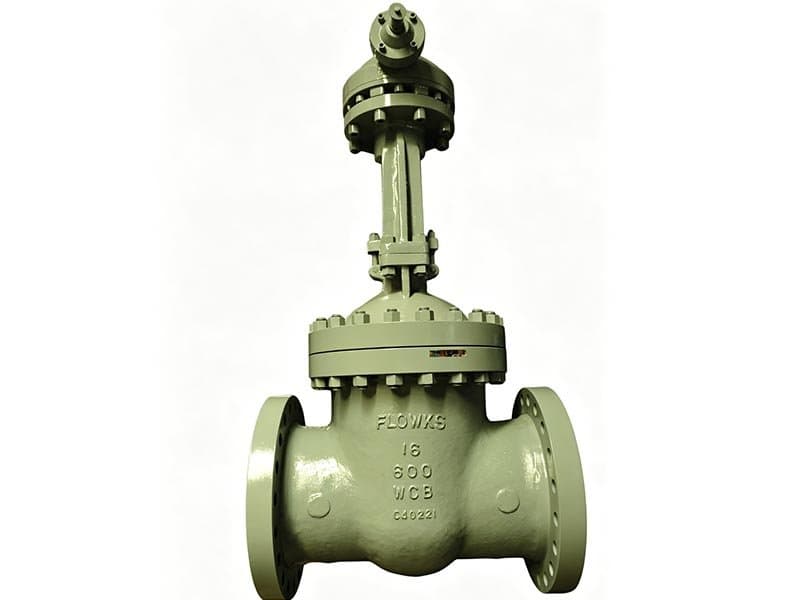
Size: 2" - 24" (DN50 - DN600)
Pressure: Class 150 - 600 / PN 10-100 (cast), Class 600 - 2500 / PN 100-420 (forged, pressure-seal)
Standard: API 600 (cast), API 602 (forged), ASME B16.34
Body Materials: A216 WCB, A351 CF8M, A351 CF8 (cast, Class 150-600); A182 F22/F91/F316/F304 (forged, Class 600-2500)
Wedge: Flexible wedge — central hub with deflectable wings
Bonnet: Bolted bonnet (Class 150-600) or pressure-seal (Class 600-2500)
Stem: OS&Y rising stem with handwheel
Ends: Flanged or butt weld
The Wedge That Bends Instead of Binding
The flexible wedge solves one specific problem — thermal binding. It's a focused solution, not a general upgrade. If your service conditions don't cause thermal expansion mismatch, a solid wedge works just as well and costs less. But if your valve operates in steam above 350°F, hot oil processing, or any service where the temperature swings between hot and cold during startup, shutdown, or cycling operation, the flexible wedge is the design that keeps the valve functional when the solid wedge would lock up.
Here's what happens without the flexibility. The valve body heats up. The seat rings — machined into or inserted into the body — expand outward because they're thermally coupled to the body metal. The wedge also expands, but the seating faces on the wedge may have a different overlay material than the body seats. Stainless overlay on carbon steel seats, stellite hard-facing on alloy seats — the overlay material has a different coefficient of thermal expansion than the base metal. The wedge grows at one rate, the seat rings spread at another. When the seats spread wider than the wedge can reach, the wedge drops into the gap and can't seal. When the seats spread wider than the wedge can fit, the wedge gets trapped and can't move at all.
The flexible wedge prevents both failures. The central hub connects two wing sections that are thinner than the hub — that reduced thickness gives each wing a small amount of spring deflection. Each wing can move independently toward or away from its corresponding seat ring by about 0.5 to 1mm. When the left seat ring expands more than the right (asymmetric heating from uneven steam distribution or pipe orientation), the left wing deflects outward to follow the expanded seat while the right wing stays in position. The hub holds the two wings together mechanically, but the wings aren't rigidly locked to each other — they flex independently within the deflection range.
That same flexibility handles pipe stress. When the piping system loads the valve body with bending forces from thermal expansion of the pipe runs, the body distorts slightly. The seat rings shift out of their original parallel alignment. A solid wedge fights the distortion — it's trying to seat against rings that are no longer parallel, and it can't conform. The flexible wings adjust to the distorted geometry, each wing angling slightly to maintain seat contact across the full seating face width.
When You Need It — and When You Don't
Steam service above 350°F — yes, specify flexible wedge. That's the primary application, and it's where the thermal binding risk is highest. Power stations, industrial steam distribution, process heating systems — all of it runs on flexible wedge gate valves because the operating temperatures and the temperature cycling during startup create expansion conditions that solid wedges can't handle.
Hot oil and gas processing where the fluid temperature exceeds 350°F — yes. Refinery process lines, crude oil heating systems, high-temperature chemical processing — the same expansion mismatch applies, even though the fluid isn't steam.
Cycling operation where the valve goes from ambient to operating temperature repeatedly — yes. Startup and shutdown cycles create the worst conditions for solid wedges because the expansion differential changes direction during each cycle. The wedge seats at operating temperature, then the valve cools and the seats contract. If the wedge stays in the closed position during cooling, it can bind on the contracting seats. The flexible wedge accommodates that contraction without losing seat contact.
General water, oil, and gas service at moderate temperatures below 350°F — you don't need the flexible wedge. A solid wedge handles those conditions without binding. The cost difference between solid and flexible wedge at cast sizes is minimal — about 5-10% on the valve price. But if the service conditions don't require it, that extra cost is unnecessary. Specify flexible wedge when the service demands it, not as a default upgrade.
At forged sizes for Class 600-2500, flexible wedges are the default — not an option. Thermal binding at those operating temperatures and pressures isn't a risk you accept for cost savings on the wedge.
Cast or Forged — the Body Matches the Pressure
This valve comes in two body...
Technical Specifications
| Size Range | 2"-48" |
| Pressure Class | Class150-2500 |
| Design Standard | API 600,B16.34,API 6D |
| Body Materials | WCB, WC6, WC9, LCB, CF8, CF8M, CF3, CF3M, duplex stainless steel |
| Parent Standards | API 600, API 602, ASME B16.34, API 607 Fire Safe |
| Parent Size Range | 2" - 48" |
| Parent Pressure Class | Class 150 - 2500 |
Product Downloads
| Size Range | 2"-48" |
| Pressure Class | Class150-2500 |
| Design Standard | API 600,B16.34,API 6D |
| Body Materials | WCB, WC6, WC9, LCB, CF8, CF8M, CF3, CF3M, duplex stainless steel |
Need a quote?
Contact our engineering team for pricing and technical support on Flexible Wedge Gate Valve.
Request a QuoteLooking for more options?
Explore our complete range of industrial valves or contact us for custom solutions.
Ball Valves
FLOWKS offers floating ball valve, trunnion mounted ball valve and top entry ball valve for oil & gas, petrochemical and power generation. Designed per API 6D, API 608 and ASME B16.34.
DBB Valves
FLOWKS Double Block & Bleed (DBB) valves provide dual isolation with bleed verification in a single compact body. Replacing traditional multi-valve installations, FLOWKS DBB valves reduce weight, space and potential leak paths. Available in bolted bonnet, all-welded and expanding gate designs per API 6D and API 607.
Globe Valves
FLOWKS globe valves for throttling and isolation. Standard, angle, Y-pattern and bellows seal configurations per API 602 and BS 1868.
Check Valves
FLOWKS check valves prevent reverse flow. Dual plate, swing, tilting disc and lift check designs per API 594 and BS 1868.