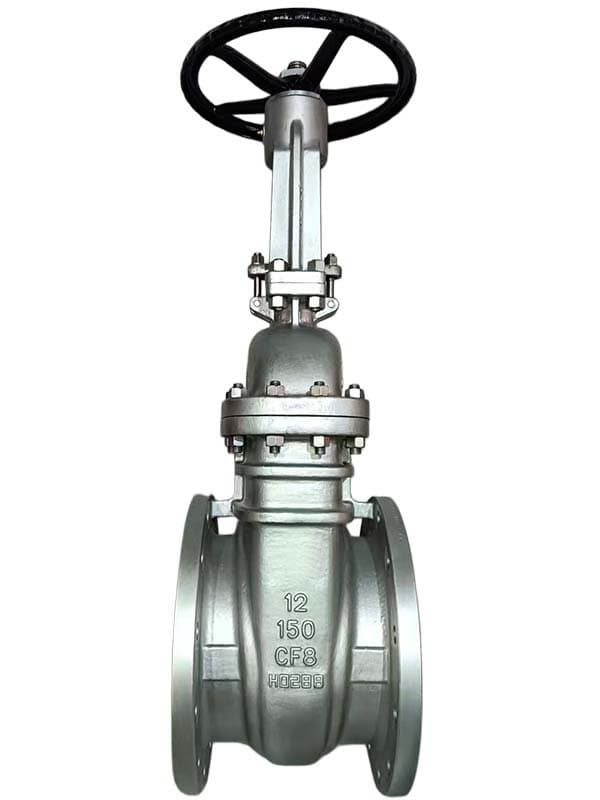
Handwheel Gate Valve
About
Size: 2" - 24" (DN50 - DN600)
Pressure: Class 150 - 600 / PN 10-100
Standard: API 600, ASME B16.34, ASME B16.10, ASME B16.5
Body Materials: A216 WCB, A351 CF8M, A351 CF8
Wedge: Solid wedge (one-piece cast)
Stem: OS&Y rising stem
Bonnet: Bolted bonnet
Ends: Flanged (ASME B16.5 RF or RTJ)
The Valve You See Everywhere
Walk through any refinery, any petrochemical plant, any power station — count the gate valves on the piping. Most of them look exactly like this one. Solid wedge. Rising stem. Bolted bonnet. Handwheel on top. This configuration isn't the most technically advanced gate valve design, and it's not the best choice for every service condition. But it's the one that gets specified over and over because three things matter more than sophistication: proven performance, availability, and cost.
You need an isolation valve on a Class 150 water line — this is the one. You need to block off a section of Class 300 oil piping for maintenance — same valve. Steam below 350°F, general process shutdown points, utility headers — all of it runs on the solid wedge handwheel gate valve. It's the workhorse, not the thoroughbred.
Why the Rising Stem Tells You Everything
The OS&Y stem does one thing that engineers appreciate in the field — it shows you the valve position without any indicator, any actuator feedback, or any tag. Stem up above the handwheel means open. Stem down at the handwheel level means closed. You can walk down a pipe rack at 6 AM, glance at the stem height on each valve, and know the line status before you check the control room display.
That visual indication is why OS&Y dominates over rising-stem-with-rising-handwheel designs where the handwheel climbs the stem as the valve opens. When the handwheel moves with the stem, you can't tell the stem position independently — the wheel could be partway up and you'd have no way to distinguish quarter-open from fully open. OS&Y separates the handwheel from the stem movement. The wheel stays in place, the stem moves through it. Clear, unambiguous, no interpretation required.
The handwheel itself is the simplest actuation you can put on a valve. No air supply, no electricity, no actuator mounting bracket. You grab the wheel and turn it. The stem nut rotates inside the yoke, the stem threads through the nut, and the wedge travels up or down. Direct mechanical operation — the kind that still works when the power goes out and the instrument air compressor trips.
What the Solid Wedge Can't Do
Here's the limitation, and it's important enough that you should think about it before specifying this valve for steam or high-temperature cycling service. The solid wedge is one piece of cast metal — no flexibility, no expansion compensation. When the valve body heats up, the seat rings expand outward because they're part of the body. The wedge expands too, but if the body and wedge seating surfaces use different materials or overlays, the expansion rates don't match. The body seats spread wider than the wedge can accommodate, and the wedge gets trapped between them. The valve won't close, or it closes but won't re-open without forcing the handwheel until something breaks.
This binding doesn't happen at moderate temperatures because the expansion difference is small — a few thousandths of an inch that the machining tolerances absorb. But at steam temperatures above 350°F, or in services where the valve cycles between hot and cold repeatedly, the cumulative expansion mismatch exceeds the clearance between the wedge and seats. That's when you need a flexible wedge — each wing deflects independently to compensate for the differential expansion.
For water, oil, gas, and moderate-temperature steam at Class 150-300, the solid wedge handles the service conditions without problems. The majority of isolation points in a typical process plant fall into that category, which is why this valve remains the default specification.
Bolted Bonnet — Proven and Maintainable
The bolted bonnet is the standard closure for Class 150-600. The bonnet bolts to the body with a gasket between them. When you need to access the internals — replace the seat rings, re-machine the wedge seating faces, change the stem packing — you unbolt the bonnet, lift it off, and the valve is open for maintenance. Simple procedure, standard tools, no special training required.
The gasket between bonnet and body is the pressure boundary seal. It compresses under bolt preload and maintains the seal across the full operating pressure range. At Class 150-300, the bolt forces are manageable and the gasket design is straightforward. At Class 600, the bolts get larger and the gasket needs more compression, but the design still works — it just requires careful bolt torquing during assembly.
A: Not recommended. The solid wedge doesn't compensate for thermal expansion mismatch between body...
Technical Specifications
| Size Range | 2" - 48" |
| Pressure Class | Class 150 - 2500 |
| Design Standard | API 6D,API 600 |
| Body Materials | A216 WCB, A351 CF8M |
| Parent Standards | API 600, API 602, ASME B16.34, API 607 Fire Safe |
| Parent Size Range | 2" - 48" |
| Parent Pressure Class | Class 150 - 2500 |
Product Downloads
| Size Range | 2" - 48" |
| Pressure Class | Class 150 - 2500 |
| Design Standard | API 6D,API 600 |
| Body Materials | A216 WCB, A351 CF8M |
Need a quote?
Contact our engineering team for pricing and technical support on Handwheel Gate Valve.
Request a QuoteLooking for more options?
Explore our complete range of industrial valves or contact us for custom solutions.
Ball Valves
FLOWKS offers floating ball valve, trunnion mounted ball valve and top entry ball valve for oil & gas, petrochemical and power generation. Designed per API 6D, API 608 and ASME B16.34.
DBB Valves
FLOWKS Double Block & Bleed (DBB) valves provide dual isolation with bleed verification in a single compact body. Replacing traditional multi-valve installations, FLOWKS DBB valves reduce weight, space and potential leak paths. Available in bolted bonnet, all-welded and expanding gate designs per API 6D and API 607.
Globe Valves
FLOWKS globe valves for throttling and isolation. Standard, angle, Y-pattern and bellows seal configurations per API 602 and BS 1868.
Check Valves
FLOWKS check valves prevent reverse flow. Dual plate, swing, tilting disc and lift check designs per API 594 and BS 1868.