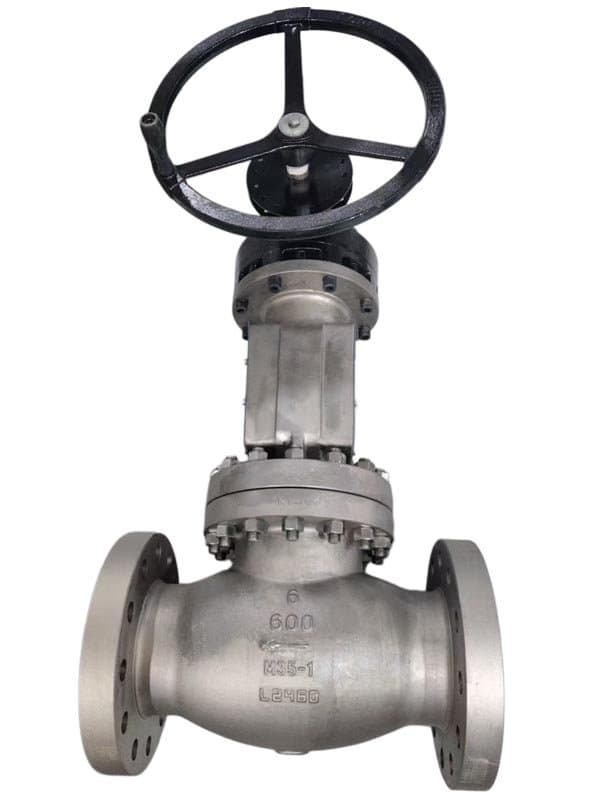
Standard Globe Valve
About
2" - 12" (DN50 - DN300)
Class 150 - 600 / PN 10-100
ASME B16.34, API 600, MSS SP-42 (stainless), manufacturer-specific
A216 WCB (cast carbon steel), A351 CF8M (cast stainless 316), A351 CF8 (cast stainless 304), ductile iron (GGG40)
Metal seat ring welded or threaded into body. Disc contacts seat ring for shutoff. Stellite overlay available for erosive service or high-cycling throttling.
Plug disc (flat or conical face) — lifts vertically off seat ring. Slides against seat surface during closing.
OS&Y rising stem with handwheel
Bolted bonnet with packing gland
T-pattern body (Z-body). Flanged ends.
What This Valve Actually Does
Globe valves throttle. Gate valves isolate. Ball valves isolate fast. That's the division line in process valve selection — and picking the wrong type costs money.
The disc lifts off and presses onto a seat ring. It can sit at any position between full-open and full-closed, regulating flow with precision. A gate valve wedge slides between two seats — fully open or fully closed, nothing in between. Partially open, the wedge sits in the flow stream, vibrating and eroding. Same problem with ball valves.
At 50% open, the disc sits stable on the stem, throttling flow through the gap between disc face and seat ring. That's what this valve is built for.
Why the Pressure Drop Is Not a Problem
T-pattern flow enters horizontally, drops through the seat, rises through the disc, exits horizontally — two direction changes. Pressure drop runs 3-5x higher than a gate or ball valve at the same size.
And that drop is exactly the point. Higher pressure drop means more flow regulation authority — the disc position controls how much throttling energy gets applied. You specify globe valves on recirculation lines, bypass lines, pump minimum-flow protection, and anywhere you need to reduce flow, not just block it.
On a full-flow line, don't use a globe valve. The drop costs pumping energy on continuous runs. Gate or ball for isolation. Globe for throttling.
The Seat and Disc Story
Metal seat ring welded or threaded into the body — hard metal on hard metal, not a soft elastomer. Disc slides against the seat surface during closing, pressing down for shutoff. That sliding contact is what makes throttling work — the disc holds intermediate positions without flutter.
Erosive service or high cycling? Specify Stellite overlay on the seat surface. Cobalt-chromium alloy survives where bare metal would gall and wear.
Body Material Choices
A216 WCB cast carbon steel — steam, water, non-corrosive hydrocarbons. A351 CF8M (316) and CF8 (304) — corrosive streams, chemical service. Ductile iron (GGG40) — utility water and HVAC where steel body cost isn't justified.
Cast bodies are standard at Class 150-600. Casting integrity holds at these pressures. Class 600+? Forged bodies take over — different product.
T-pattern pressure drop at full-open runs 3-5x higher than gate or ball. Need on/off blocking? Use gate or ball. Globe valves belong on throttling service.
Cobalt-chromium hard-facing alloy on the seat surface. Needed for erosive service or constant throttling cycling — bare metal galls and wears.
Visible position from across the plant — stem up means open. Practical for throttling where operators adjust disc position.
Partially-open balls sit in the flow stream. High-velocity flow erodes seats. Ball valves isolate — they don't throttle.
Technical Specifications
| Size Range | 2" - 24" |
| Pressure Class | Class 150 - 1500 |
| Design Standard | API 602, ASME B16.34 |
| Body Materials | A216 WCB, A351 CF8M |
| Parent Standards | API 602, BS 1868, ASME B16.34 |
| Parent Size Range | 2" - 24" |
| Parent Pressure Class | Class 150 - 2500 |
Product Downloads
| Size Range | 2" - 24" |
| Pressure Class | Class 150 - 1500 |
| Design Standard | API 602, ASME B16.34 |
| Body Materials | A216 WCB, A351 CF8M |
Need a quote?
Contact our engineering team for pricing and technical support on Standard Globe Valve.
Request a QuoteLooking for more options?
Explore our complete range of industrial valves or contact us for custom solutions.
Ball Valves
FLOWKS offers floating ball valve, trunnion mounted ball valve and top entry ball valve for oil & gas, petrochemical and power generation. Designed per API 6D, API 608 and ASME B16.34.
DBB Valves
FLOWKS Double Block & Bleed (DBB) valves provide dual isolation with bleed verification in a single compact body. Replacing traditional multi-valve installations, FLOWKS DBB valves reduce weight, space and potential leak paths. Available in bolted bonnet, all-welded and expanding gate designs per API 6D and API 607.
Gate Valves
FLOWKS gate valves for isolation service in piping systems. Flexible wedge, solid wedge, slab and expanding gate designs per API 600, API 602 and ASME B16.34.
Check Valves
FLOWKS check valves prevent reverse flow. Dual plate, swing, tilting disc and lift check designs per API 594 and BS 1868.