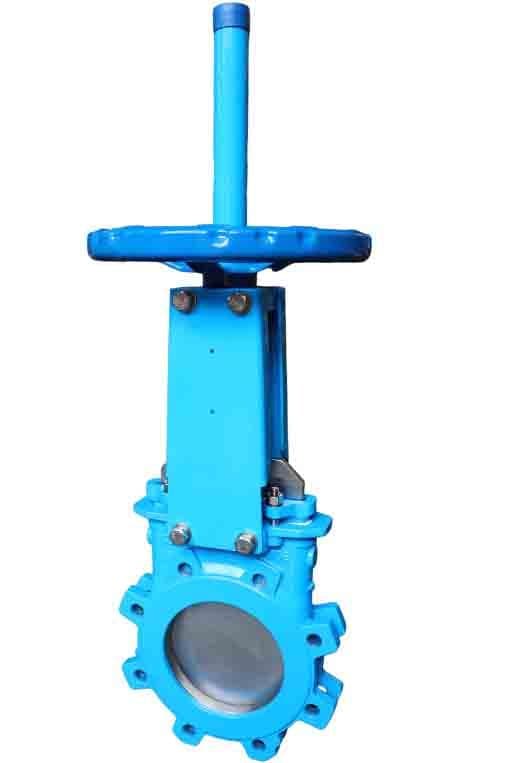
Wafer Knife Gate Valve
About
2" - 24" (DN50 - DN600)
Class 150 (up to 10 bar / 150 psi)
MSS SP-81, ASME B16.34
A216 WCB, A351 CF8M, A351 CF8
Soft rubber (EPDM/NBR), PTFE-lined, metal-to-metal
Wafer (lug) body, bonnetless, single-piece gate, unidirectional sealing, thin body profile between flanges
Why Wafer? Because Space Costs Money
Some plants pack pipe into tunnels so tight you can barely reach your hand between two flanges. That's where the wafer knife gate valve earns its spot. No flange ends on the body—it sandwiches straight between your pipeline flanges, held in place by the bolting that runs through the lug holes. The result? A face-to-face dimension that's barely wider than the gate itself.
I've seen installation crews drop a 12-inch wafer knife gate into a paper mill's digester feed line in under twenty minutes. Same size flanged body? They'd still be wrestling with bolting and alignment. The slim profile isn't just convenient—it's the reason this valve exists.
The Price Advantage Is Not A Marketing Line
A wafer body costs 30-40% less than a flanged equivalent at the same diameter. That's not a rounding error. The body casting is smaller, the machining is simpler, there are fewer surfaces to finish. If you're buying twenty valves for a water treatment plant upgrade, that difference adds up to real budget room.
But—and this matters—the savings come with a trade-off. Wafer knife gates seal in one direction only. The gate pushes against a single seat. Flow comes from the upstream side, pressure drives the gate into the seat pocket, and you get a tight seal. Reverse that flow direction, and the seat can't hold. If your process needs bidirectional shutoff, this isn't your valve. Walk over to the dual-seat designs instead.
What The Seat Options Mean In Practice
EPDM seats handle clean water and dilute chemical service. NBR is your pick for oils and hydrocarbon traces. PTFE-lined seats step up when you need chemical resistance that rubber can't provide—think acid lines or solvent service. Metal-to-metal seats exist on the spec sheet, but honestly, if you're buying a wafer knife gate, you're usually in soft-seated territory. Metal seats belong on the high-pressure side of the family.
Installation Notes From The Field
Always confirm flow direction before you bolt a wafer knife gate into the line. The body is marked—usually an arrow cast into the casting or a tag on the bonnet area—but I've seen more than one plant run media backward through a unidirectional valve and then complain about leakage. That's not a valve failure. That's an installation error.
Lug-style wafer bodies let you remove one side of the piping while the valve stays in place, which is handy for maintenance access on dead-end lines. Standard wafer (no lugs) requires both flanges to stay bolted to hold the valve. Know which one you're ordering.
A: No. Class 150 rating and soft seats don't belong on steam service. Use a high-pressure knife gate with metal seats and a pressure seal bonnet for that application.
A: Light slurry, yes—pulp stock, dilute mine tailings, wastewater with suspended solids. Heavy abrasive slurry will eat through soft rubber seats fast. Consider a polyurethane-lined knife gate for that duty.
A: Lug wafer bodies have threaded holes that accept bolts from each flange independently. Standard wafer bodies have plain through-holes—bolts pass through the entire assembly. Lug style allows single-side pipe removal.
A: Yes. Pneumatic and electric actuators mount to the valve bonnet area. Keep in mind that actuation adds height above the valve—check your vertical clearance in tight installations.
A: The single-seat design only seals when flow pressure pushes the gate into the seat. Reverse flow lifts the gate off the seat. Any process line with potential backflow needs a bidirectional sealing design.
Technical Specifications
| Size Range | 2" - 36" |
| Pressure Class | PN10 / Class 150 |
| Design Standard | MSS SP-81, TAPPI TIS 405 |
| Body Materials | GG25, WCB, CF8M |
| Parent Standards | MSS SP-81, TAPPI TIS 405, ASME B16.5 |
| Parent Size Range | 2" - 48" |
| Parent Pressure Class | PN10 - PN25 / Class 150 |
Product Downloads
| Size Range | 2" - 36" |
| Pressure Class | PN10 / Class 150 |
| Design Standard | MSS SP-81, TAPPI TIS 405 |
| Body Materials | GG25, WCB, CF8M |
Need a quote?
Contact our engineering team for pricing and technical support on Wafer Knife Gate Valve.
Request a QuoteLooking for more options?
Explore our complete range of industrial valves or contact us for custom solutions.
Ball Valves
FLOWKS offers floating ball valve, trunnion mounted ball valve and top entry ball valve for oil & gas, petrochemical and power generation. Designed per API 6D, API 608 and ASME B16.34.
DBB Valves
FLOWKS Double Block & Bleed (DBB) valves provide dual isolation with bleed verification in a single compact body. Replacing traditional multi-valve installations, FLOWKS DBB valves reduce weight, space and potential leak paths. Available in bolted bonnet, all-welded and expanding gate designs per API 6D and API 607.
Gate Valves
FLOWKS gate valves for isolation service in piping systems. Flexible wedge, solid wedge, slab and expanding gate designs per API 600, API 602 and ASME B16.34.
Globe Valves
FLOWKS globe valves for throttling and isolation. Standard, angle, Y-pattern and bellows seal configurations per API 602 and BS 1868.