About
Size: Custom-fitted to pipe inside diameter — manufactured to match specific pipe ID. Common range covers 2" - 24" pipe sizes.
Pressure: Class 150 - 300 / PN 10-40 (temporary service only — not rated for permanent installation. Design pressure matches line pressure for startup/commissioning period only)
Standard: No industry standard governs temporary strainer geometry — project-specific fabrication items per project piping specifications. MSS SP-89 covers permanent strainers only.
Body Materials: A240 304 (stainless 304 plate), A240 316 (stainless 316 plate). No cast body — fabricated from rolled plate.
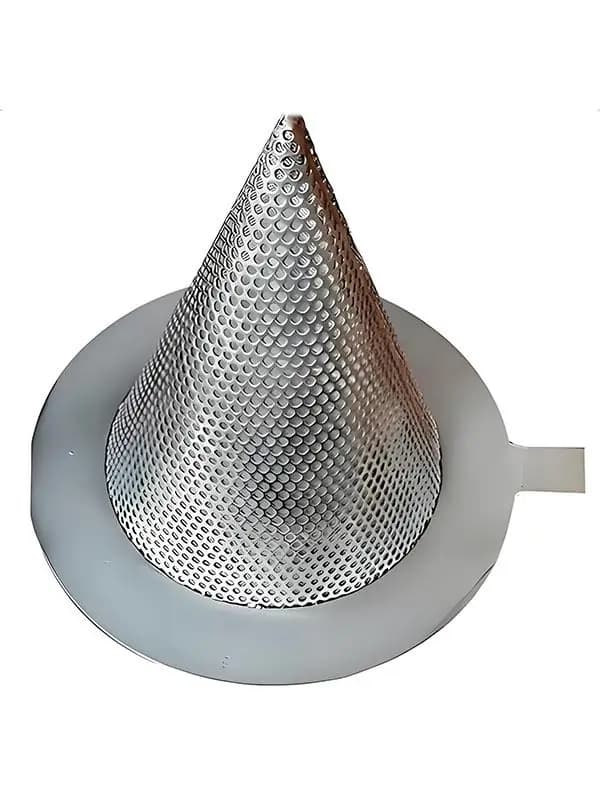
Straining Element: Perforated cone surface. Perforation 1mm - 6mm, mesh lining optional (20 - 100 mesh). The cone shape is the straining element — flow passes through perforated cone wall from outside to inside.
Design: Cone-shaped perforated screen installed between pipeline flanges during commissioning. Apex points downstream. Removed after 2-4 weeks when initial debris is cleared. Flange-mounted or welded-tab installation.
What's Inside a New Pipeline
Every new piping system has debris inside it. No matter how carefully the construction crew works — welding, cutting, grinding, fitting — the inside of a newly assembled pipe system contains material that shouldn't be there. Welding slag drops inside the pipe from root-pass welding. Cutting chips from pipe preparation with saws or grinding tools. Gasket fragments from alignment and bolting. Dirt and dust that entered during storage and handling. Rust scale forming on carbon steel pipe surfaces during the weeks or months between fabrication and commissioning.
This debris load during startup is ten to a hundred times heavier than the normal operating debris that permanent strainers handle. Permanent strainers — basket strainers, Y-strainers, duplex strainers — have screens sized for ongoing operational conditions. Sand particles, corrosion products, biological growth, process contaminants. Those screens run at 0.5mm perforation or 40-mesh lining or finer. If you put that fine screen into a line during startup, it clogs in hours. Sometimes in minutes. The startup debris is larger, more varied, and far more abundant than anything the permanent strainer was designed to catch.
Conical temporary strainers exist to handle this startup load. Larger perforations — 1mm to 6mm — pass the volume of startup debris without immediate clogging while still catching the big pieces that damage downstream equipment. Welding slag, cutting chips, gasket fragments, large rust flakes. The cone strainer catches what matters during commissioning and lets the smaller particles pass through to be flushed or handled by the permanent strainer once it's installed after startup.
Why a Cone, Not a Flat Screen
The cone shape does two things that a flat screen can't.
Surface area. A cone sitting inside a pipe has more perforated surface than a flat disc at the same pipe diameter — roughly 1.5 to 2 times more depending on cone length. More surface area means more open area for flow to pass through. More open area means lower pressure drop per unit of debris collected on the surface. During startup, when debris loading is heavy and continuous, that extra surface area keeps the strainer functional longer before it needs cleaning or removal. Flat screens load up fast because all the debris collects on a small surface and blocks the perforations quickly.
Flow distribution. The cone shape spreads incoming flow across the perforated surface. Flow enters from upstream, hits the cone apex first, and spreads outward along the cone wall toward the base. The velocity distributes across the full cone surface rather than concentrating at the center. Flat screens create a different flow pattern — the highest velocity core stream hits the screen center and debris loads there first while the outer edges see lower velocity and slower loading. Localized clogging at the center blocks a disproportionate share of the open area. The cone shape avoids this concentration effect by geometry alone.
Temporary Means Temporary
Conical temporary strainers are not permanent piping components. The perforation sizes are too coarse for ongoing operational straining — 1mm to 6mm perforation won't catch the fine particles that your permanent strainer handles. The fabricated plate construction — rolled and welded perforated sheet — doesn't have the structural durability for years of continuous pressure service. Cast strainer bodies with machined seating surfaces and rated cover assemblies are built for permanent installation. Conical temporary strainers are built for a commissioning window.
After two to four weeks of service, pull the conical strainer out of the line. Open the flange joint, remove the strainer and its gaskets, inspect the pipe interior for remaining debris. If the system is clean — no...
Technical Specifications
| Body Materials | A105、SS304、SS316、F51, F55, F53, Hastelloy C、Monel 400 |
| Parent Standards | ASME B16.34, API 602, MSS SP-89 |
| Parent Size Range | 2" - 36" |
| Parent Pressure Class | Class 150 - 900 |
Product Downloads
| Body Materials | A105、SS304、SS316、F51, F55, F53, Hastelloy C、Monel 400 |
Need a quote?
Contact our engineering team for pricing and technical support on Conical Temporary Strainer.
Request a QuoteLooking for more options?
Explore our complete range of industrial valves or contact us for custom solutions.
Ball Valves
FLOWKS offers floating ball valve, trunnion mounted ball valve and top entry ball valve for oil & gas, petrochemical and power generation. Designed per API 6D, API 608 and ASME B16.34.
DBB Valves
FLOWKS Double Block & Bleed (DBB) valves provide dual isolation with bleed verification in a single compact body. Replacing traditional multi-valve installations, FLOWKS DBB valves reduce weight, space and potential leak paths. Available in bolted bonnet, all-welded and expanding gate designs per API 6D and API 607.
Gate Valves
FLOWKS gate valves for isolation service in piping systems. Flexible wedge, solid wedge, slab and expanding gate designs per API 600, API 602 and ASME B16.34.
Globe Valves
FLOWKS globe valves for throttling and isolation. Standard, angle, Y-pattern and bellows seal configurations per API 602 and BS 1868.