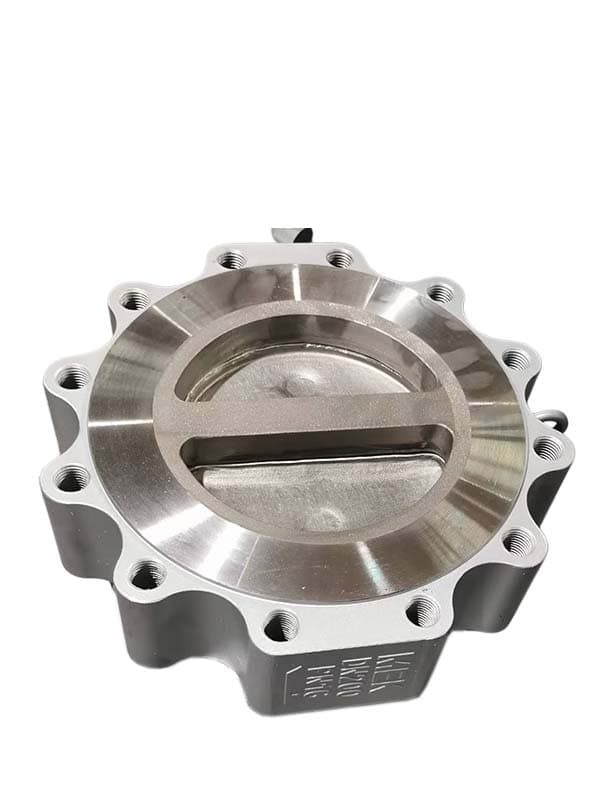
About Lug Type Dual Plate Check Valve
Size: 2" - 48" (DN50 - DN1200)
Pressure: Class 150 - 600 / PN 10-100
Standard: API 6D, ASME B16.34, MSS SP-126 (dual plate check), AWWA C508 (waterworks)
Body Materials: A216 WCB, A351 CF8M, A351 CF8, ductile iron (GGG40)
Seat: Metal-to-metal or soft seated—dual plate check valves commonly use a combination: metal body seat ring + elastomer or PTFE seal on the plate edge for bubble-tight shutoff. Metal-to-metal plates available for high-temperature service.
Plates: Two semicircular plates (half-discs) hinged on a central hinge pin inside the body bore. Plates open by rotating away from the seat surface with forward flow—each plate swings to approximately 60-80° open position. A torsion spring on the hinge pin assists plate closure when forward flow velocity drops. Plates close in a spring-assisted, near-simultaneous motion.
Design: Lug body—threaded lug holes on both sides of the body flange. Lug format allows installation between two flanges with bolts through the lug holes, or as a line terminus with one flange blanked off. Short face-to-face dimension (API 6D pattern). Spring-assisted closing.
Compact and Fast-Closing — Two Half-Discs Beat One Full Disc
The dual plate design splits the check function between two semicircular plates instead of one full-disc swing. Each plate is lighter than a full disc. Each plate swings through a shorter arc to reach the closed position. That lighter mass and shorter travel translate directly to faster closing—roughly 0.2-0.5 seconds with spring assist, compared to 0.5-1.0 seconds for a gravity-closing full-disc swing check.
Faster closing means less reverse flow volume passes through the valve before it shuts. On pump discharge protection, that matters. Even a small reverse flow volume can spin the pump backward—reverse rotation causes mechanical damage to the pump impeller, bearings, and shaft. The dual plate check closes fast enough to limit reverse flow to a volume that won't establish sustained reverse rotation. A standard swing check closing in 0.5-1.0 seconds allows more reverse flow through the valve before the disc seats, and on some pump installations that extra volume is enough to start the pump spinning backward.
The torsion spring adds closing force beyond gravity. When forward flow velocity drops below the threshold that holds the plates open, the spring drives the plates toward the closed position even if there's no backpressure pushing them shut. That spring assist is essential for vertical installations—flow upward—where gravity doesn't help the plates close. In a vertical pipe, a gravity-closure swing check disc hangs open and relies entirely on reverse flow to push it shut. The dual plate spring closes the plates regardless of orientation.
Soft Seated for Bubble-Tight — Metal for High Temperature
Dual plate check valves commonly run a hybrid seating arrangement: metal body seat ring with an elastomer or PTFE seal on the plate edge. The metal seat ring provides structural integrity in the body bore. The soft seal on the plate edge compresses against the seat ring when the plates close, creating a bubble-tight shutoff that metal-to-metal seating can't consistently achieve at low backpressure.
If your process line needs zero leakage in the closed direction—chemical dosing lines, closed-loop heating systems, applications where even微量 backflow contaminates the upstream process—soft seated dual plates give you that bubble-tight seal under normal backpressure conditions. The elastomer or PTFE seal is replaceable during maintenance without re-machining the seat ring.
For high-temperature service where elastomer and PTFE seals degrade—steam above 400°F, hot oil service, fired heater feed lines—metal-to-metal plates are the specification. The plate edge contacts the metal seat ring directly, no soft seal. Shutoff isn't bubble-tight at low backpressure, but the metal seating survives the temperature where soft seals would harden, crack, or lose sealing compression.
Lug Body — Dead-End Service and Between-Flanges Installation
The lug body has threaded holes on both sides of the body flange. That lug format gives you two installation options that wafer-body check valves don't provide.
Option one: dead-end service. Install the valve at the end of a pipeline with one flange blanked off. The threaded lug holes on the blanked side accept bolts that secure the blind flange. Wafer-body check valves can't do this—they have no threaded holes and rely on being sandwiched between two flanges with through-bolts. If you need a check valve at a line terminus, lug is the format that works.
Option two: between-flanges installation without a separate spacer ring. The lug body bolts directly to the upstream and downstream flanges with bolts through the threaded lug holes. No spacer. No additional gaskets beyond the two flange-to-valve joints. Simple installation, few components, straightforward bolting pattern.
The short face-to-face dimension—API 6D pattern—means the valve occupies less pipeline length than a full-body swing check. On retrofit projects where you're replacing a swing check with a dual plate in an existing pipe run, the shorter face-to-face usually fits within the same pipe spacing without cutting and re-welding the line.
The Trade-Off — Slightly Higher Pressure Drop
The hinge pin and torsion spring sit inside the body bore on a dual plate check. They occupy space in the flow path. At full open position, the plates swing to 60-80°, but the hinge pin and spring assembly remain in the stream. That's a slightly higher pressure drop than a full-bore swing check where the disc at 80° open leaves the bore nearly unrestricted.
For most pump discharge and process line check applications, the pressure drop difference between a dual plate and a swing check at the same size is negligible—a fraction of psi that doesn't materially affect pump performance or process flow rates. On large-diameter, low-velocity lines where pressure drop matters more, or on lines where you're already operating close to the pump's head limit, that difference becomes relevant. In those cases, specify the swing check for minimum pressure drop and accept the slower closing speed.
Roughly 0.2-0.5 seconds with spring assist, versus 0.5-1.0 seconds for a gravity-closure swing check. The two lighter half-discs with shorter swing travel close faster than one full disc relying on gravity alone. Less reverse flow passes through before the valve shuts.
Yes. The lug body has threaded holes on both flange sides, allowing dead-end installation with one flange blanked off. Wafer-body check valves can't do this—they require two through-bolts sandwiching the valve between flanges.
Soft seated plates have an elastomer or PTFE seal on the plate edge that compresses against the metal body seat ring for bubble-tight shutoff. Metal-to-metal plates contact the seat ring directly—no soft seal—for high-temperature service where elastomers degrade. Soft seats give better sealing at low backpressure; metal seats survive higher temperatures.
Yes. The torsion spring drives the plates closed when forward flow velocity drops, regardless of installation orientation. In vertical upward flow, gravity doesn't help close the plates, but the spring provides the closing force. Standard gravity-closure swing checks don't work reliably in this orientation.
Slightly higher. The hinge pin and torsion spring sit inside the flow path, creating a small obstruction even at full open position. The difference is typically a fraction of psi aQuick Specs
Size: 2" - 48" (DN50 - DN1200)
Pressure: Class 150 - 600 / PN 10-100
Standard: API 6D, ASME B16.34, MSS SP-126 (dual plate check), AWWA C508 (waterworks)
Body Materials: A216 WCB, A351 CF8M, A351 CF8, ductile iron (GGG40)
Seat: Metal-to-metal or soft seated—dual plate check valves commonly use a combination: metal body seat ring + elastomer or PTFE seal on the plate edge for bubble-tight shutoff. Metal-to-metal plates available for high-temperature service.
Plates: Two semicircular plates (half-discs) hinged on a central hinge pin inside the body bore. Plates open by rotating away from the seat surface with forward flow—each plate swings to approximately 60-80° open position. A torsion spring on the hinge pin assists plate closure when forward flow velocity drops. Plates close in a spring-assisted, near-simultaneous motion.
Design: Lug body—threaded lug holes on both sides of the body flange. Lug format allows installation between two flanges with bolts through the lug holes, or as a line terminus with one flange blanked off. Short face-to-face dimension (API 6D pattern). Spring-assisted closing.
Compact and Fast-Closing — Two Half-Discs Beat One Full Disc
The dual plate design splits the check function between two semicircular plates instead of one full-disc swing. Each plate is lighter than a full disc. Each plate swings through a shorter arc to reach the closed position. That lighter mass and shorter travel translate directly to faster closing—roughly 0.2-0.5 seconds with spring assist, compared to 0.5-1.0 seconds for a gravity-closing full-disc swing check.
Faster closing means less reverse flow volume passes through the valve before it shuts. On pump discharge protection, that matters. Even a small reverse flow volume can spin the pump backward—reverse rotation causes mechanical damage to the pump impeller, bearings, and shaft. The dual plate check closes fast enough to limit reverse flow to a volume that won't establish sustained reverse rotation. A standard swing check closing in 0.5-1.0 seconds allows more reverse flow through the valve before the disc seats, and on some pump installations that extra volume is enough to start the pump spinning backward.
The torsion spring adds closing force beyond gravity. When forward flow velocity drops below the threshold that holds the plates open, the spring drives the plates toward the closed position even if there's no backpressure pushing them shut. That spring assist is essential for vertical installations—flow upward—where gravity doesn't help the plates close. In a vertical pipe, a gravity-closure swing check disc hangs open and relies entirely on reverse flow to push it shut. The dual plate spring closes the plates regardless of orientation.
Soft Seated for Bubble-Tight — Metal for High Temperature
Dual plate check valves commonly run a hybrid seating arrangement: metal body seat ring with an elastomer or PTFE seal on the plate edge. The metal seat ring provides structural integrity in the body bore. The soft seal on the plate edge compresses against the seat ring when the plates close, creating a bubble-tight shutoff that metal-to-metal seating can't consistently achieve at low backpressure.
If your process line needs zero leakage in the closed direction—chemical dosing lines, closed-loop heating systems, applications where even微量 backflow contaminates the upstream process—soft seated dual plates give you that bubble-tight seal under normal backpressure conditions. The elastomer or PTFE seal is replaceable during maintenance without re-machining the seat ring.
For high-temperature service where elastomer and PTFE seals degrade—steam above 400°F, hot oil service, fired heater feed lines—metal-to-metal plates are the specification. The plate edge contacts the metal seat ring directly, no soft seal. Shutoff isn't bubble-tight at low backpressure, but the metal seating survives the temperature where soft seals would harden, crack, or lose sealing compression.
Lug Body — Dead-End Service and Between-Flanges Installation
The lug body has threaded holes on both sides of the body flange. That lug format gives you two installation options that wafer-body check valves don't provide.
Option one: dead-end service. Install the valve at the end of a pipeline with one flange blanked off. The threaded lug holes on the blanked side accept bolts that secure the blind flange. Wafer-body check valves can't do this—they have no threaded holes and rely on being sandwiched between two flanges with through-bolts. If you need a check valve at a line terminus, lug is the format that works.
Option two: between-flanges installation without a separate spacer ring. The lug body bolts directly to the upstream and downstream flanges with bolts through the threaded lug holes. No spacer. No additional gaskets beyond the two flange-to-valve joints. Simple installation, few components, straightforward bolting pattern.
The short face-to-face dimension—API 6D pattern—means the valve occupies less pipeline length than a full-body swing check. On retrofit projects where you're replacing a swing check with a dual plate in an existing pipe run, the shorter face-to-face usually fits within the same pipe spacing without cutting and re-welding the line.
The Trade-Off — Slightly Higher Pressure Drop
The hinge pin and torsion spring sit inside the body bore on a dual plate check. They occupy space in the flow path. At full open position, the plates swing to 60-80°, but the hinge pin and spring assembly remain in the stream. That's a slightly higher pressure drop than a full-bore swing check where the disc at 80° open leaves the bore nearly unrestricted.
For most pump discharge and process line check applications, the pressure drop difference between a dual plate and a swing check at the same size is negligible—a fraction of psi that doesn't materially affect pump performance or process flow rates. On large-diameter, low-velocity lines where pressure drop matters more, or on lines where you're already operating close to the pump's head limit, that difference becomes relevant. In those cases, specify the swing check for minimum pressure drop and accept the slower closing speed.
Roughly 0.2-0.5 seconds with spring assist, versus 0.5-1.0 seconds for a gravity-closure swing check. The two lighter half-discs with shorter swing travel close faster than one full disc relying on gravity alone. Less reverse flow passes through before the valve shuts.
Yes. The lug body has threaded holes on both flange sides, allowing dead-end installation with one flange blanked off. Wafer-body check valves can't do this—they require two through-bolts sandwiching the valve between flanges.
Soft seated plates have an elastomer or PTFE seal on the plate edge that compresses against the metal body seat ring for bubble-tight shutoff. Metal-to-metal plates contact the seat ring directly—no soft seal—for high-temperature service where elastomers degrade. Soft seats give better sealing at low backpressure; metal seats survive higher temperatures.
Yes. The torsion spring drives the plates closed when forward flow velocity drops, regardless of installation orientation. In vertical upward flow, gravity doesn't help close the plates, but the spring provides the closing force. Standard gravity-closure swing checks don't work reliably in this orientation.
Slightly higher. The hinge pin and torsion spring sit inside the flow path, creating a small obstruction even at full open position. The difference is typically a fraction of psi and negligible for most applications, but it can matter on large-diameter low-velocity lines or systems operating close to pump head limits.nd negligible for most applications, but it can matter on large-diameter low-velocity lines or systems operating close to pump head limits.
Technical Specifications
| Parent Standards | API 594, BS 1868, ASME B16.34 |
| Parent Size Range | 2" - 48" |
| Parent Pressure Class | Class 150 - 2500 |
Product Downloads

Need a Quote?
Contact our engineering team for pricing and technical support on Lug Type Dual Plate Check Valve.
Request a QuoteLooking for More Solutions?
Discover our range of products built for your industry's challenges.
Ball Valves
FLOWKS offers floating ball valve, trunnion mounted ball valve and top entry ball valve for oil & gas, petrochemical and power generation. Designed per API 6D, API 608 and ASME B16.34.
DBB Valves
FLOWKS Double Block & Bleed (DBB) valves provide dual isolation with bleed verification in a single compact body. Replacing traditional multi-valve installations, FLOWKS DBB valves reduce weight, space and potential leak paths. Available in bolted bonnet, all-welded and expanding gate designs per API 6D and API 607.
Gate Valves
FLOWKS gate valves for isolation service in piping systems. Flexible wedge, solid wedge, slab and expanding gate designs per API 600, API 602 and ASME B16.34.
Globe Valves
FLOWKS globe valves for throttling and isolation. Standard, angle, Y-pattern and bellows seal configurations per API 602 and BS 1868.