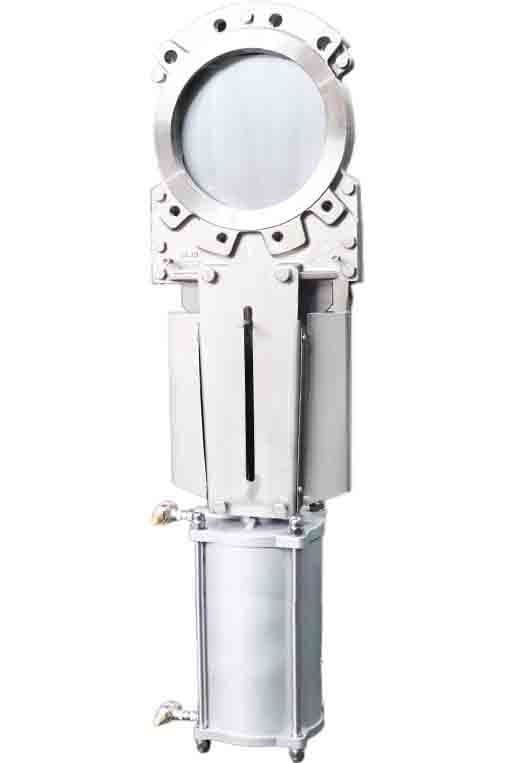
Giới thiệu Van Cổng Dao Kín Hai Chiều Khí Nén
2" - 24" (DN50 - DN600)
Class 150 - 300 (lên đến 20 bar / 300 psi)
MSS SP-81, thiết kế hai chiều theo tiêu chuẩn nhà sản xuất
A216 WCB, A351 CF8M, A351 CF8, gang dẻo
Bố trí hai đế van (thượng lưu + hạ lưu), elastomer (EPDM/NBR/Viton) hoặc kim loại phủ Stellite
Thân van hai mảnh bắt bu lông, túi đế van hai chiều dạng U hoặc chu vi, xi lanh khí nén (tác động đơn lò xo hồi vị hoặc tác động kép), đóng kín hai chiều không rò rỉ
Bịt kín hai chiều—Và tại sao bạn cần nó
Hầu hết van cổng dao bịt kín theo một chiều. Dòng chảy đẩy cổng vào đế van, đế van nén lại, và bạn có độ kín chặt. Đảo chiều dòng chảy và cổng tách khỏi đế van. Áp suất thoát ra ngoài. Trên các đường ống quy trình chỉ chảy một chiều, điều đó không sao.
Nhưng nhiều đường ống quy trình thực tế có áp suất ở cả hai phía của van. Xét van cách ly bồn chứa khi áp suất đỉnh bồn đẩy một chiều và áp suất đường ống đẩy chiều khác. Xét đường ống bypass bơm khi bạn cần cách ly chống lại áp suất ngược từ hệ thống hạ lưu. Xét bất kỳ mạch vòng nào nơi hướng dòng chảy đảo ngược tùy thuộc vào bơm nào đang chạy. Trong tất cả các trường hợp này, van cổng dao một chiều rò rỉ khi dòng chảy ngược—không phải vì van bị lỗi, mà vì thiết kế một đế van về mặt vật lý không thể giữ áp suất từ hướng ngược lại.
Bịt kín hai chiều giải quyết điều này bằng hai bố trí đế van độc lập. Một đế van bịt kín khi dòng chảy đẩy cổng về phía trước. Đế van kia bịt kín khi dòng chảy đẩy cổng về phía sau. Không hướng nào được miễn trừ.
Đế van dạng U bao quanh mép cổng
Thiết kế đế van hai chiều phổ biến nhất là túi đế van dạng U hoặc chu vi. Đế van elastomer hoặc kim loại tạo thành rãnh bao quanh mép dưới của cổng—cả hai mặt, cả hai bề mặt. Khi cổng đi vào túi đế van, nó nén vật liệu đế van trên mặt thượng lưu và mặt hạ lưu đồng thời. Hình dạng U tạo tiếp xúc bịt kín bất kể áp suất đến từ phía nào.
Điều này khác với hai đế van phẳng riêng biệt xếp chồng ở hai phía đối diện của cổng. Hai đế van phẳng có thể tạo khe hở dưới chu kỳ nhiệt hoặc mài mòn không đều. Hình dạng U duy trì tiếp xúc liên tục quanh chu vi cổng, mang lại hiệu suất bịt kín ổn định hơn trong suốt tuổi thọ van.
Truyền động khí nén—Nhanh, lặp lại chính xác, tự động
Xi lanh khí nén dẫn động tấm chắn qua toàn bộ hành trình trong vài giây. Xi lanh tác động đơn có lò xo hồi vị sử dụng áp suất khí để mở van và lò xo cơ khí để đóng van—đóng an toàn khi mất khí, đây là lựa chọn mặc định cho các nhiệm vụ cách ly. Xi lanh tác động kép sử dụng áp suất khí cho cả hành trình mở và đóng—chu kỳ nhanh hơn, lực đóng lớn hơn, nhưng không có vị trí an toàn khi mất khí nếu không có logic bên ngoài.
Thời gian đóng mở van có tính lặp lại cao. Mỗi chu kỳ đều mất cùng một khoảng thời gian, tác dụng cùng một lực đóng van và cho ra cùng một kết quả. Tính nhất quán đó rất quan trọng trên các dây chuyền sản xuất tự động, nơi hệ thống điều khiển lập lịch vận hành van dựa trên thời gian cố định. Vận hành bằng tay quay không thể đảm bảo tính lặp lại đó – tốc độ của người vận hành thay đổi, lực của người vận hành thay đổi, và kết quả cũng thay đổi theo.
Ghế Elastomer Hoặc Ghế Kim Loại—Chọn Dựa Trên Môi Chất
Ghế EPDM cho nước và hóa chất loãng. NBR cho dầu và dấu vết hydrocarbon. Viton cho dung môi ăn mòn mạnh và nhiệt độ cao hơn. Ghế kim loại với lớp phủ Stellite cho hơi nước, hydrocarbon nhiệt độ cao, hoặc các ứng dụng nơi elastomer bị phân hủy. Cấu trúc ghế kép hoạt động với bất kỳ loại nào trong số này—hình dạng giống nhau, vật liệu thay đổi.
A: Có, trên cấu hình ghế elastomer. Hốc ghế hình chữ U tạo tiếp xúc bịt kín nén trên cả hai mặt của tấm chắn. Cấu hình ghế kim loại cung cấp rò rỉ gần như bằng không—chấp nhận được cho hầu hết các tiêu chuẩn cách ly quy trình, nhưng về mặt kỹ thuật không phải "bằng không" như ghế elastomer có thể đạt được.
A: Lò xo hồi vị (tác động đơn) nếu bạn cần đóng an toàn khi mất khí—van đóng khi mất nguồn khí cấp. Đây là lựa chọn tiêu chuẩn cho nhiệm vụ cách ly. Tác động kép nếu bạn cần chu kỳ nhanh theo cả hai hướng và hệ thống điều khiển của bạn xử lý logic an toàn bên ngoài.
A: Đúng vậy. Thiết kế hai chỗ ngồi đòi hỏi nhiều công đoạn gia công hơn, nhiều vật liệu làm chỗ ngồi hơn và thân van có hình dạng bên trong phức tạp hơn. Chi phí chênh lệch thường là 15-25% so với van cửa dao một chiều tương đương. Mức giá cao hơn đó mang lại khả năng cách ly dòng chảy ngược mà thiết kế một chiều không thể cung cấp.
A: Bộ truyền động van dao khí nén tiêu chuẩn hoạt động với áp suất cấp khí từ 4-7 bar (60-100 psi). Vui lòng chỉ định áp suất khí nén hiện có trong nhà máy khi đặt hàng — kích thước bộ truyền động phụ thuộc vào áp suất cấp khí để tạo ra lực đóng van thích hợp.
A: Không. Hình dạng khoang thân van, thiết kế hốc van và hình dạng cửa van khác nhau giữa cấu hình một chiều và hai chiều. Đây không phải là việc thay thế van mà là kiến trúc van khác nhau.
Thông Số Kỹ Thuật
| Parent Standards | MSS SP-81, TAPPI TIS 405, ASME B16.5 |
| Parent Size Range | 2" - 48" |
| Parent Pressure Class | PN10 - PN25 / Class 150 |
Tải xuống sản phẩm
Cần Báo Giá?
Contact our engineering team for pricing and technical support on Van Cổng Dao Kín Hai Chiều Khí Nén.
Request a QuoteTìm Kiếm Thêm Giải Pháp?
Khám phá dải sản phẩm được thiết kế cho thách thức ngành của bạn.
Ball Valves
FLOWKS offers floating ball valve, trunnion mounted ball valve and top entry ball valve for oil & gas, petrochemical and power generation. Designed per API 6D, API 608 and ASME B16.34.
DBB Valves
FLOWKS Double Block & Bleed (DBB) valves provide dual isolation with bleed verification in a single compact body. Replacing traditional multi-valve installations, FLOWKS DBB valves reduce weight, space and potential leak paths. Available in bolted bonnet, all-welded and expanding gate designs per API 6D and API 607.
Gate Valves
FLOWKS gate valves for isolation service in piping systems. Flexible wedge, solid wedge, slab and expanding gate designs per API 600, API 602 and ASME B16.34.
Globe Valves
FLOWKS globe valves for throttling and isolation. Standard, angle, Y-pattern and bellows seal configurations per API 602 and BS 1868.