About
Why C4 Steel Survives 98% Nitric Acid When Everything Else Fails
Concentrated nitric acid (above 95%, especially at 98%+) is an odd corrosion challenge: it's so aggressively oxidizing that it passivates most stainless steels — briefly. The problem comes from the transpassive zone. At production concentrations and temperatures, nitric pushes stainless past the passive region into transpassive dissolution, where the protective oxide film itself oxidizes and the metal corrodes at unacceptable rates. 304L and 316L fail in 98% HNO3 at production temperatures not because they can't form a passive film, but because that film dissolves in the extreme oxidizing potential.
C4 steel's 3–5% silicon content changes the game. Silicon forms a SiO2-enriched surface layer that's stable in transpassive conditions where Cr2O3 breaks down. That silicon oxide layer is chemically inert in concentrated nitric — it doesn't dissolve, doesn't oxidize further, and doesn't allow nitric to reach the underlying metal. The result: C4 steel's corrosion rate in 98% boiling nitric acid measures below 0.1 mm/year, where 304L measures in millimeters per year.
The Chinese nitric acid production industry developed C4 steel specifically for this application during the 1980s — it was a national-level R&D achievement that earned a Ministry of Defense science award. The magnesium nitrate method for concentrating nitric acid (the dominant process in Chinese nitric plants) runs at conditions that defeat every Western-standard stainless grade. C4 valves in those concentration loops run for 8–12 years. That's not anecdotal — it's the accumulated operating record across dozens of plants.
The other advantage over alternatives: pure aluminum handles concentrated nitric reasonably well, but its mechanical strength is so low that you can't make functional pressure valve bodies from it. High-silicon cast iron (Durcomet 5, similar chemistry concept) has good corrosion resistance but is brittle — impact resistance is poor, and thermal shock cracks the casting. C4 steel gives you both the corrosion resistance and the mechanical integrity to build a real pressure valve.
The Trade-offs That Limit C4 Steel's Broader Adoption
Not a universal corrosion alloy. C4's silicon-stabilized oxide layer excels in oxidizing acid conditions, specifically concentrated nitric. In reducing acid environments (dilute sulfuric, hydrochloric), it offers no advantage over standard stainless — and in fluoride-containing environments, it's vulnerable just like every other silicon-containing alloy. C4 is a niche specialist, not a general upgrade.
No established ASTM/UNS designation. This is the practical problem for international specifiers. C4 steel originated in Chinese metallurgical development and is standardized under GB (Chinese national standards). Western engineering firms working on Chinese nitric acid projects can specify it by GB designation, but there's no ASTM equivalent to reference for non-Chinese projects. That limits global adoption despite the material's proven performance.
International sourcing is difficult. Most C4 steel production and valve manufacturing happens in Chinese specialty foundries. Procurement teams in Europe or North America face limited supplier options and long logistics chains. Quality verification requires either on-site inspection or established relationships with Chinese suppliers who understand Western documentation expectations.
Welding requires specific filler. Standard stainless fillers (308, 316) don't match C4's high silicon content. The recommended practice is using奥0.12 silicon welding electrodes (Chinese designation) — essentially a matching high-silicon austenitic filler. Finding this filler outside China is difficult. ER309Si (AWS designation) is a reasonable Western approximation, but the silicon content is lower than optimal. Post-weld solution annealing at 1050°C is required to restore full corrosion resistance.
Machining difficulty. The 3–5% silicon content makes C4 steel harder and more abrasive than standard austenitic stainless. Tool life is roughly 40–50% shorter than on 304/316 machining operations. Carbide inserts with proper geometry are mandatory. Shops accustomed to standard stainless will underestimate the tooling cost and dimensional drift.
Specifying C4 Valves for Nitric Acid Service
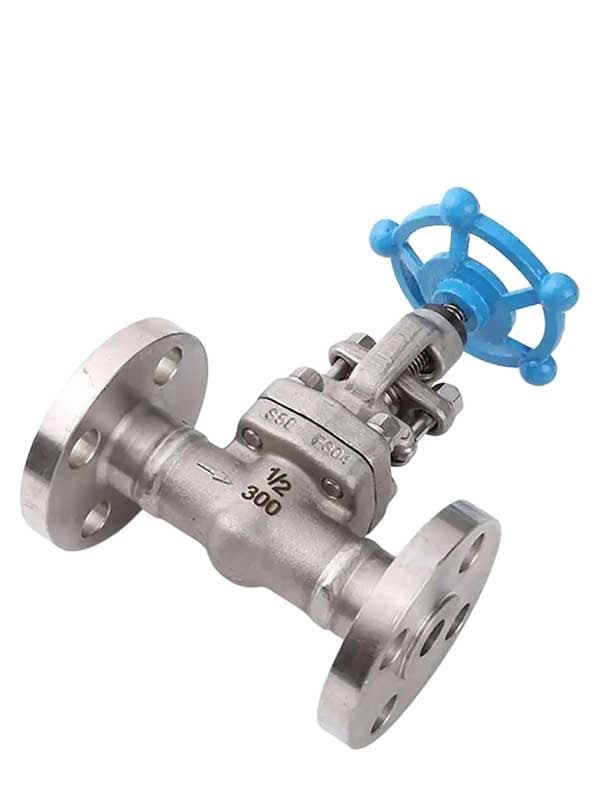
For concentrated nitric acid (95–98%) production: C4 steel gate or globe valve, Class 150–300, per GB 2100 casting specification. This is the proven application. Verify the supplier's track record in actual nitric acid concentration plants — not just lab corrosion data.
For nitric acid tank farm and transfer: C4 works, but 304L also handles ambient-temperature concentrated nitric adequately in transfer and storage applications where the acid isn't hot. Use C4 at points where the acid is at or near process temperature...
Technical Specifications
| Parent Standards | ASME B16.34, NACE MR0175 |
| Parent Size Range | 2" - 24" |
| Parent Pressure Class | Class 150 - 1500 |
Product Downloads
Need a quote?
Contact our engineering team for pricing and technical support on C4-00Cr14Ni14Si4-Valve.
Request a QuoteLooking for more options?
Explore our complete range of industrial valves or contact us for custom solutions.
Ball Valves
FLOWKS offers floating ball valve, trunnion mounted ball valve and top entry ball valve for oil & gas, petrochemical and power generation. Designed per API 6D, API 608 and ASME B16.34.
DBB Valves
FLOWKS Double Block & Bleed (DBB) valves provide dual isolation with bleed verification in a single compact body. Replacing traditional multi-valve installations, FLOWKS DBB valves reduce weight, space and potential leak paths. Available in bolted bonnet, all-welded and expanding gate designs per API 6D and API 607.
Gate Valves
FLOWKS gate valves for isolation service in piping systems. Flexible wedge, solid wedge, slab and expanding gate designs per API 600, API 602 and ASME B16.34.
Globe Valves
FLOWKS globe valves for throttling and isolation. Standard, angle, Y-pattern and bellows seal configurations per API 602 and BS 1868.