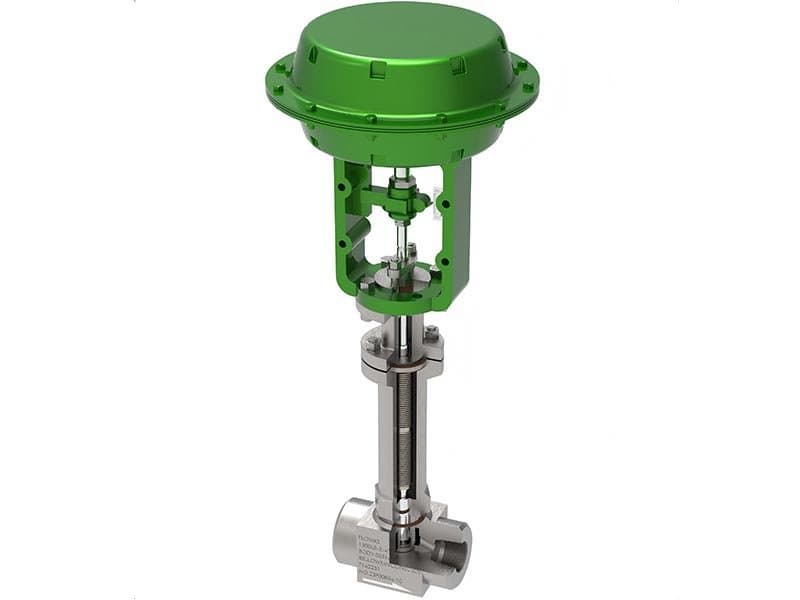
Bellows Low Flow Regulating Valve
About
Size: 1/2" - 1" (DN15 - DN25) Pressure: Class 150 - 600 Standard: IEC 60534, ASME B16.34, ISO 15848 (fugitive emission) Body Materials: A216 WCB, A351 CF8M, A182 F316 Trim Materials: 316 SS, 17-4PH SS, Stellite 6, V-port micro-trim Sealing: Metal bellows stem seal + PTFE/graphite packing backup
Design: Linear stroke, micro-plug trim, pneumatic/electric actuated, zero external leakage
Two Problems at Once——Tiny Flow and Zero Leakage——and This Valve Solves Both
A low flow regulating valve handles the first problem: precise flow modulation at Cv values below what standard trim can effectively control. A bellows-sealed valve handles the second: zero external leakage through the stem packing——the bellows creates a flexible metal barrier between the process media inside the valve and the atmosphere outside, eliminating the stem-to-packing leakage path that conventional packing designs can never fully eliminate. A bellows low flow regulating valve combines both solutions into a single assembly——micro-trim for precise small-flow regulation, and bellows sealing for zero fugitive emission. This is the valve you specify when the process demands both: toxic media that can't leak even a trace amount past the stem (hydrogen sulfide, chlorine, phosgene, vinyl chloride——anything that triggers environmental emission regulations or poses acute toxicity risk to personnel), and flow rates too small for standard trim to modulate effectively. Two separate specifications that converge on the same valve——you can't achieve one with a standard packing design and the other with standard trim. You need both capabilities simultaneously, and that's exactly what this product delivers.
The Bellows——How It Seals What Packing Can't
Conventional stem packing relies on compression——the packing rings are squeezed around the stem by a gland follower, creating a mechanical seal that blocks the media from leaking through the stem-to-body gap. That compression seal works well at moderate pressures and temperatures——but it's never truly zero leakage. Packing tolerates a defined leakage rate per the applicable standard (ISO 15848, EPA Method 21). Over time, packing compression relaxes, the stem surface wears, and the leakage rate increases until the packing gets re-torqued or replaced. For non-hazardous media (water, steam, general process fluids), that controlled leakage rate is acceptable——a few ppm of fugitive emission from a water valve doesn't trigger regulatory action or safety protocols.
For toxic, carcinogenic, pyrophoric, or environmentally regulated media——that same controlled leakage rate is unacceptable. H₂S at 100 ppm exposure threshold. Chlorine gas at 1 ppm IDLH. Phosgene at 0.1 ppm. Vinyl chloride (a confirmed carcinogen with strict emission limits). These media don't have "acceptable" leakage rates——any detectable external leak is a safety incident, a regulatory violation, and a process hazard. Packing can't guarantee zero——it guarantees a rate. Bellows guarantees zero.
The metal bellows is a formed, welded, multi-ply stainless (or Inconel for high-temperature service) flexible tube that connects the valve stem to the body bonnet——the bellows moves with the stem as the plug strokes up and down, flexing at each travel position while maintaining a continuous metal barrier between the process cavity and the external atmosphere. There's no packing gap for the media to leak through——the bellows wall is solid metal. The media stays inside the bellows cavity. The atmosphere stays outside. The only way for media to reach the atmosphere through the stem path is through a bellows rupture——and bellows rupture is a detectable, visible failure mode with clear maintenance response, not a gradual leakage increase that accumulates undetected over months.
A backup packing set sits above the bellows——not as the primary seal, but as a secondary containment layer in case the bellows ruptures. If the bellows fails, the backup packing provides interim containment until the valve can be taken offline for bellows replacement. The packing isn't there to handle normal operation——it's there for the single failure scenario that the bellows design anticipates and manages rather than ignoring. That dual-seal philosophy (primary bellows + backup packing) is standard practice in bellows-sealed valve design for hazardous media service——it's not an optional extra, it's a mandatory safety architecture feature.
Micro-Trim——Same Low Flow Precision as the Standard Low Flow Valve
The trim geometry in the bellows low flow valve follows the same micro-plug design philosophy as the standard FLOWKS low flow regulating valve: restricted plug profile, narrow cage windows, V-port micro-trim options, and Cv ratings scaled to the actual flow range the process requires rather than borrowed from a larger trim size throttled near closed. The bellows doesn't...
Technical Specifications
| Size Range | 1/2”-2” |
| Pressure Class | Class150-2500 |
| Design Standard | ISA 75, IEC 60534 |
| Body Materials | A105, F11, F22, F304, F316, F304L, F316L, Aluminum Bronze, Stellite Alloy, Inconel 718, PTFE, RPTFE, PEEK, Flexible Graphite |
| Parent Standards | ISA 75, IEC 60534 |
| Parent Size Range | 1" - 24" |
| Parent Pressure Class | Class 150 - 1500 |
Product Downloads
| Size Range | 1/2”-2” |
| Pressure Class | Class150-2500 |
| Design Standard | ISA 75, IEC 60534 |
| Body Materials | A105, F11, F22, F304, F316, F304L, F316L, Aluminum Bronze, Stellite Alloy, Inconel 718, PTFE, RPTFE, PEEK, Flexible Graphite |
Need a quote?
Contact our engineering team for pricing and technical support on Bellows Low Flow Regulating Valve.
Request a QuoteLooking for more options?
Explore our complete range of industrial valves or contact us for custom solutions.
Ball Valves
FLOWKS offers floating ball valve, trunnion mounted ball valve and top entry ball valve for oil & gas, petrochemical and power generation. Designed per API 6D, API 608 and ASME B16.34.
DBB Valves
FLOWKS Double Block & Bleed (DBB) valves provide dual isolation with bleed verification in a single compact body. Replacing traditional multi-valve installations, FLOWKS DBB valves reduce weight, space and potential leak paths. Available in bolted bonnet, all-welded and expanding gate designs per API 6D and API 607.
Gate Valves
FLOWKS gate valves for isolation service in piping systems. Flexible wedge, solid wedge, slab and expanding gate designs per API 600, API 602 and ASME B16.34.
Globe Valves
FLOWKS globe valves for throttling and isolation. Standard, angle, Y-pattern and bellows seal configurations per API 602 and BS 1868.