About
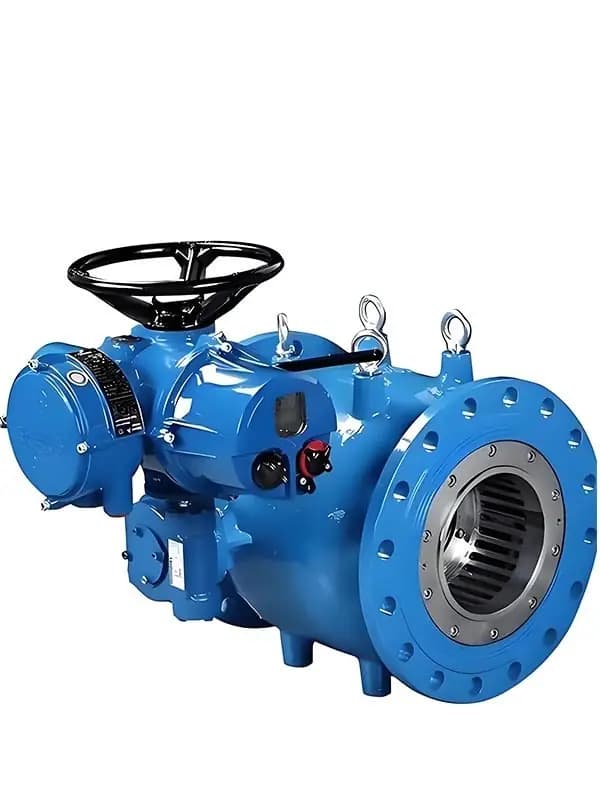
Quick Specs Size: 6" - 48" (DN150 - DN1200) Pressure: Class 150 - 300 Standard: IEC 60534, AWWA C504 (waterworks configurations), ASME B16.34 Body Materials: A216 WCB, A351 CF8M (stainless for corrosive water treatment) Seat Materials: EPDM, NBR, PTFE, metal hard seat (abrasive water service) Trim Design: Large-bore disc or cylinder trim, equal-percentage or linear flow characteristic
Design: Rotary or linear stroke, pneumatic/electric/hydraulic actuated, optimized for high-Cv large-flow regulation
Not Precision Dosing——Raw Volume Control at Scale
A flow regulating valve for water treatment isn't trying to meter 0.01 gallons per minute into a reactor——it's managing hundreds or thousands of gallons per minute across treatment basins, distribution mains, and discharge channels where the flow rate matters for process performance but the regulation precision requirement is fundamentally different from chemical process control. Water treatment plants don't operate at ±0.5% flow tolerance——they operate at ±3-5% tolerance bands where the treatment chemistry works within a range, not at a point. The valve needs to move large volumes through large bore sizes, modulate the flow rate within the treatment process's acceptable range, and do it reliably under conditions that look nothing like a petrochemical refinery——municipal water supply at varying demand rates, wastewater treatment at fluctuating influent volumes, cooling water circulation at seasonal load variations, reservoir discharge at controlled release rates. These are high-Cv, large-flow applications where the valve's job is volume management, not precision chemistry.
FLOWKS flow regulating valves are designed for this specific service category——large bore sizes (6" through 48"), high Cv values (the flow coefficient ratings that matter when you're moving 500 to 5000+ gallons per minute), and regulation accuracy appropriate for water treatment process requirements rather than chemical process loop tolerances. The trim geometry, the actuator sizing, and the flow characteristic profiles are all optimized for high-volume flow modulation——not borrowed from a smaller control valve design and scaled up hoping the proportions still work at DN600 bore size.
The Trim——Disc or Cylinder, Depending on the Bore Size and the Regulation Requirement
At smaller bore sizes within the flow regulating valve range (6"-12"), the trim uses a modified disc geometry——a contoured disc profile that provides defined flow characteristic behavior as the disc rotates through its modulating range. The disc isn't a flat butterfly plate swinging through the flow passage——it's a shaped element with a profile optimized for flow modulation, providing equal-percentage or linear characteristic behavior across the disc's rotational arc. The disc approach keeps the body compact and the actuator torque manageable at bore sizes where the disc's flow area at each rotational position can deliver the required Cv range without requiring excessive disc travel.
At larger bore sizes (12"-48"), cylinder or cage-type trim becomes more practical——a cylindrical plug that moves axially within a cage to modulate flow through cage windows, similar in principle to the linear stroke control valve's plug-and-cage assembly but scaled to the larger bore dimensions and higher Cv ratings that water treatment applications demand. The cage windows define the flow area at each plug position, and the plug profile defines the flow characteristic (equal-percentage or linear) as the plug strokes through its travel range. Cylinder trim at large bore sizes provides more precise flow modulation than disc geometry——the plug-to-cage flow area relationship is more controllable than the disc-to-bore flow area relationship at DN600 and above, where the disc's rotational arc produces large flow area changes per degree of rotation that make fine modulation difficult.
The trim selection (disc or cylinder) isn't arbitrary——it's determined by the bore size, the required Cv range, and the regulation precision the process demands. FLOWKS engineering specifies the trim type based on the customer's application parameters——you don't pick disc or cylinder from a catalog, you get the configuration that delivers the right flow characteristic behavior at the right bore size and Cv rating.
Water Treatment Media——Not Clean, Not Corrosive-Free, Not Easy on Valve Trim
Water treatment media isn't distilled water——it carries suspended solids, biological matter, chemical treatment residues, and occasionally abrasive particles from sediment load. Municipal raw water contains silt, organic debris, and seasonal sediment surges during storm events. Wastewater influent carries suspended solids, biological flocs, and chemical treatment precipitates. Cooling water circulates through systems that accumulate scale, corrosion products, and biological growth....
Technical Specifications
| Parent Standards | ISA 75, IEC 60534 |
| Parent Size Range | 1" - 24" |
| Parent Pressure Class | Class 150 - 1500 |
Product Downloads
Need a quote?
Contact our engineering team for pricing and technical support on Flow Regulating Valve.
Request a QuoteLooking for more options?
Explore our complete range of industrial valves or contact us for custom solutions.
Ball Valves
FLOWKS offers floating ball valve, trunnion mounted ball valve and top entry ball valve for oil & gas, petrochemical and power generation. Designed per API 6D, API 608 and ASME B16.34.
DBB Valves
FLOWKS Double Block & Bleed (DBB) valves provide dual isolation with bleed verification in a single compact body. Replacing traditional multi-valve installations, FLOWKS DBB valves reduce weight, space and potential leak paths. Available in bolted bonnet, all-welded and expanding gate designs per API 6D and API 607.
Gate Valves
FLOWKS gate valves for isolation service in piping systems. Flexible wedge, solid wedge, slab and expanding gate designs per API 600, API 602 and ASME B16.34.
Globe Valves
FLOWKS globe valves for throttling and isolation. Standard, angle, Y-pattern and bellows seal configurations per API 602 and BS 1868.