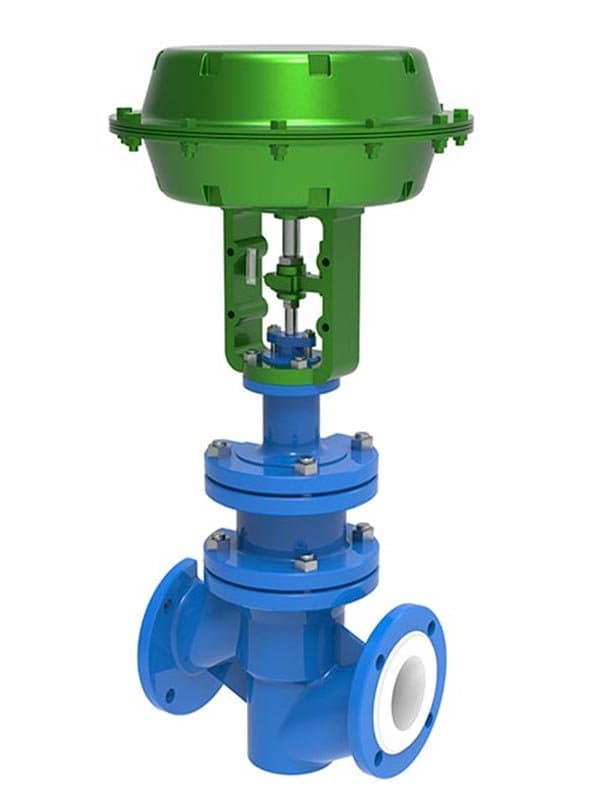
Fluorine-Lined Regulating Valve
About
Quick Specs Size: 1/2" - 8" (DN15 - DN200) Pressure: Class 150 - 300 Standard: IEC 60534, ASME B16.34 Body Materials:A216 WCB, A351 CF8M (external body——fluorine-lined internally)Lining Materials: PTFE, PFA, FEP Trim Materials: PTFE-lined plug, PFA-coated cage, 316 SS core structure with fluorine overlay
Design: Linear stroke, plug-type trim, pneumatic/electric actuated, full fluorine-lined flow passage
When Carbon Steel and Stainless Steel Both Fail——Fluorine Steps In Concentrated sulfuric acid at 98%. Hydrochloric acid at 30%. Chlorine gas. Hydrofluoric acid. Bromine. These are the media that destroy carbon steel in weeks, pit stainless steel in months, and challenge even high-nickel alloys over extended service. A fluorine-lined regulating valve puts a continuous barrier of PTFE, PFA, or FEP between the process media and the metal body——the fluoropolymer lining covers every surface the media touches: the body bore, the seat pocket, the plug surface, the cage windows, the stem shield. The metal body provides structural strength and pressure containment. The lining provides chemical resistance. You get both——rigid structural integrity from the steel shell, and near-universal corrosion resistance from the fluoropolymer barrier that the media can't penetrate, can't dissolve, and can't degrade under normal process temperatures.
FLOWKS fluorine-lined regulating valves are designed for precisely this service category
where the process chemistry is too aggressive for bare metal trim, but the flow regulation requirement demands control valve precision rather than simple on-off isolation. Most fluoropolymer valve offerings in the market are isolation valves——lined ball valves or lined butterfly valves that give you open or closed, not throttling control. A fluorine-lined regulating valve adds the plug and cage flow modulation capability to the corrosion-resistant lining system, giving you both chemical resistance and process control in a single valve assembly.
The Lining System——Not Just a coating, It's a Full Flow Passage Barrier
The fluoropolymer lining isn't applied as a thin spray coating——it's a molded lining that covers the complete internal flow passage as a continuous shell. PTFE is the baseline lining material—— chemically inert to virtually all industrial process fluids at temperatures up to its operational limit, with the lowest coefficient of friction in the lining material lineup (smooth internal surfaces that resist fouling and buildup from viscous or precipitating media). PFA offers higher temperature capability and better stress-crack resistance than PTFE——used where the process runs hotter than PTFE's comfort zone or where the lining sees repeated thermal cycling that could cause PTFE to develop micro-cracks over years of service. FEP provides excellent chemical resistance with easier processing characteristics than PTFE——used where the lining geometry requires tighter dimensional control during manufacturing.
The lining thickness is engineered for the application, not standardized to a minimum nominal value. High-velocity media with erosive particles requires thicker lining to compensate for gradual surface wear. Low-velocity clean service can run thinner lining without sacrificing service life. The lining thickness decision follows the same logic as trim material selection across the FLOWKS control valve series——match the barrier to what the media will do to it over the intended service duration.
Plug and Cage Trim——Fluorine-Coated, Not Bare Metal
The plug and cage assembly in a fluorine-lined valve can't use bare metal seating surfaces——the media would attack the trim directly at the sealing contact point. FLOWKS uses PTFE-lined plug surfaces and PFA-coated cage windows to maintain the chemical barrier across the full flow modulation path. The underlying core structure (plug body, cage frame) is 316 stainless steel——providing mechanical rigidity and dimensional stability. The fluoropolymer overlay on the seating surfaces provides the chemical isolation that keeps the metal core from ever touching the process media. The combination gives you trim that throttles precisely (metal core maintains plug profile accuracy under load) and resists corrosion (fluoropolymer overlay keeps the media away from the metal).
The trade-off: fluoropolymer seating surfaces are softer than metal hard seats. Soft seats deliver tighter shutoff in clean service——zero leakage class is achievable with PTFE seating under normal closing force. But under high-velocity flow, abrasive media, or frequent cycling between throttling and closed positions, the soft seating surfaces wear faster than Stellite or tungsten carbide hard-facing would. The valve design compensates where it can——lining thickness on the seating zones, optimized plug-to-cage contact geometry, and controlled closing force from the actuator to...
Technical Specifications
| Size Range | 1/2" - 24" |
| Pressure Class | Class150 300 |
| Design Standard | ISA 75, IEC 60534 |
| Body Materials | WCB, WC6, WC9, CF8, CF8M, CF3, CF3M,PTFE、FEP、PFA、ETFE、PVDF |
| Parent Standards | ISA 75, IEC 60534 |
| Parent Size Range | 1" - 24" |
| Parent Pressure Class | Class 150 - 1500 |
Product Downloads
| Size Range | 1/2" - 24" |
| Pressure Class | Class150 300 |
| Design Standard | ISA 75, IEC 60534 |
| Body Materials | WCB, WC6, WC9, CF8, CF8M, CF3, CF3M,PTFE、FEP、PFA、ETFE、PVDF |
Need a quote?
Contact our engineering team for pricing and technical support on Fluorine-Lined Regulating Valve.
Request a QuoteLooking for more options?
Explore our complete range of industrial valves or contact us for custom solutions.
Ball Valves
FLOWKS offers floating ball valve, trunnion mounted ball valve and top entry ball valve for oil & gas, petrochemical and power generation. Designed per API 6D, API 608 and ASME B16.34.
DBB Valves
FLOWKS Double Block & Bleed (DBB) valves provide dual isolation with bleed verification in a single compact body. Replacing traditional multi-valve installations, FLOWKS DBB valves reduce weight, space and potential leak paths. Available in bolted bonnet, all-welded and expanding gate designs per API 6D and API 607.
Gate Valves
FLOWKS gate valves for isolation service in piping systems. Flexible wedge, solid wedge, slab and expanding gate designs per API 600, API 602 and ASME B16.34.
Globe Valves
FLOWKS globe valves for throttling and isolation. Standard, angle, Y-pattern and bellows seal configurations per API 602 and BS 1868.