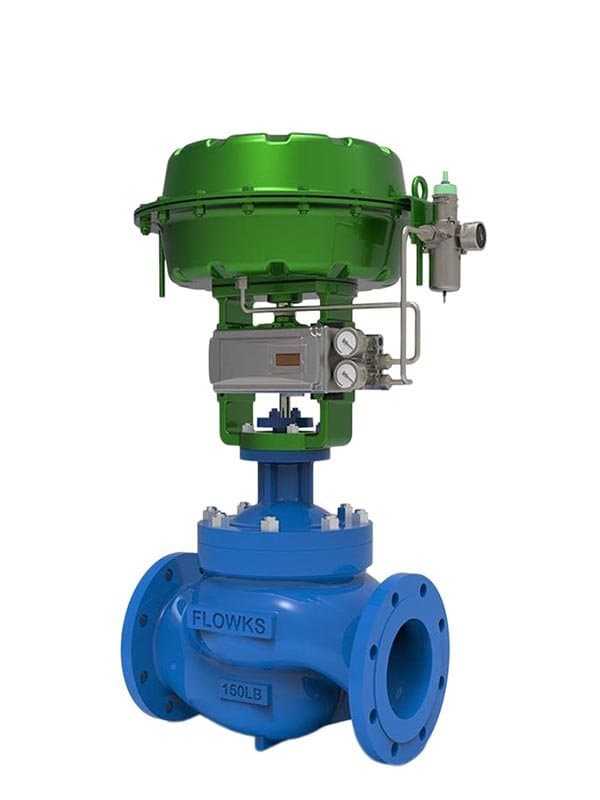
High Performance Linear Stroke Control Valve
About
Quick Specs Size: 1/2" - 12" (DN15 - DN300) Pressure: Class 150 - 600 Standard: IEC 60534, API 608, ASME B16.34 Body Materials: A216 WCB, A351 CF8M, A182 F316, A182 F51 Seat/Trim Materials: PTFE, PEEK, Stellite 6, 316 SS, 17-4PH SS
Design: Linear stroke, plug-type trim, pneumatic/electric actuated, equal-percentage or linear flow characteristic
What This Valve Is——and Why It’s the One Most Projects End Up Specifying A linear stroke control valve moves the plug straight up and down——a vertical stroke along the valve stem axis, rather than rotating a ball or disc through a quarter-turn arc. That linear motion gives you something rotary valves struggle with: precise, repeatable flow modulation across the full travel range, with a flow characteristic curve you can actually depend on for process loop tuning. This is the workhorse control valve——the one that shows up on the majority of process control specifications across oil & gas, petrochemical, chemical, and power generation applications. Comparable in design philosophy to the Japanese CV3000 series, the FLOWKS high performance linear stroke control valve covers the same functional territory: robust body construction, multiple trim options for different pressure drops and media conditions, and flow characteristics engineered to match what the control system needs rather than forcing the system to compensate for what the valve delivers.
The Plug and Cage——Where the Real Work Happens The trim assembly is what separates a functional control valve from a body with a hole in it. Inside the cage, the plug moves vertically through its travel range, and the gap between the plug profile and the cage windows defines the flow area at each position. FLOWKS offers two primary flow characteristics: equal-percentage and linear. Equal-percentage is the default choice for most process applications——small flow changes at low travel positions (stable control near minimum flow), progressively larger increments at higher positions (responsive control near maximum throughput). Linear characteristic delivers constant flow increment per unit of travel——straightforward, predictable, used where the process loop needs a direct proportional relationship between valve position and flow rate. The characteristic selection isn’t a guess——it’s determined by the process dynamics, the controller tuning requirements, and the installed gain curve the instrument engineer needs to achieve stable loop performance. Both plug profiles are available across the full size range; you specify what the control loop requires, not what happens to be in stock.
Trim Material Options——Match the Material to What the Process Will Do to It Trim material selection determines whether your valve runs reliably for five years or gets rebuilt after two seasons. Standard trim configurations include 316 stainless steel for general process service, 17-4PH precipitation-hardening stainless for higher mechanical strength and moderate corrosion resistance, and Stellite 6 hard-facing overlay on the plug and cage seating surfaces for applications where erosion, cavitation damage, or high-velocity impingement would wear through standard stainless in months. The Stellite overlay isn’t a thin cosmetic coating——it’s a functional wear layer applied to the critical sealing and flow-path surfaces, extending trim service life under conditions that destroy softer materials. For elevated temperature applications, FLOWKS provides extended bonnet designs that move the packing area away from the body heat zone, keeping the stem packing within its operating temperature range even when the process media runs at several hundred degrees.
Body Materials and Pressure Ratings A216 WCB carbon steel covers the majority of general-purpose applications——hydrocarbon lines, water service, steam distribution at moderate pressures and temperatures where carbon steel’s mechanical properties and corrosion resistance are adequate for the intended service duration. A351 CF8M stainless steps in for corrosive media containing chlorides, acids, and process chemicals that would attack carbon steel. A182 F316 handles higher-corrosion-resistance requirements where CF8M’s performance ceiling gets challenged. A182 F51 duplex provides both corrosion resistance and higher mechanical strength——used where the process demands both, typically in offshore and coastal installations where salt exposure adds an external corrosion dimension to the internal media challenge. Pressure ratings span Class 150 through Class 600——covering the range where linear stroke control valves deliver their best combination of flow control precision, sealing reliability, and cost efficiency.
Pneumatic or Electric——The Actuator Choice Depends on How Your Plant Runs FLOWKS linear stroke control valves accept both pneumatic and electric actuator mounting. Pneumatic actuators (diaphragm or...
Technical Specifications
| Size Range | 1/2" - 24" |
| Pressure Class | Class150~2500 |
| Design Standard | ISA 75, IEC 60534 |
| Body Materials | WCB, WC6, WC9, CF8, CF8M, CF3, CF3M, Aluminum Bronze, Stellite Alloy, 304, 316, Inconel 718, PTFE, RPTFE, PEEK, Flexible Graphite |
| Parent Standards | ISA 75, IEC 60534 |
| Parent Size Range | 1" - 24" |
| Parent Pressure Class | Class 150 - 1500 |
Product Downloads
| Size Range | 1/2" - 24" |
| Pressure Class | Class150~2500 |
| Design Standard | ISA 75, IEC 60534 |
| Body Materials | WCB, WC6, WC9, CF8, CF8M, CF3, CF3M, Aluminum Bronze, Stellite Alloy, 304, 316, Inconel 718, PTFE, RPTFE, PEEK, Flexible Graphite |
Need a quote?
Contact our engineering team for pricing and technical support on High Performance Linear Stroke Control Valve.
Request a QuoteLooking for more options?
Explore our complete range of industrial valves or contact us for custom solutions.
Ball Valves
FLOWKS offers floating ball valve, trunnion mounted ball valve and top entry ball valve for oil & gas, petrochemical and power generation. Designed per API 6D, API 608 and ASME B16.34.
DBB Valves
FLOWKS Double Block & Bleed (DBB) valves provide dual isolation with bleed verification in a single compact body. Replacing traditional multi-valve installations, FLOWKS DBB valves reduce weight, space and potential leak paths. Available in bolted bonnet, all-welded and expanding gate designs per API 6D and API 607.
Gate Valves
FLOWKS gate valves for isolation service in piping systems. Flexible wedge, solid wedge, slab and expanding gate designs per API 600, API 602 and ASME B16.34.
Globe Valves
FLOWKS globe valves for throttling and isolation. Standard, angle, Y-pattern and bellows seal configurations per API 602 and BS 1868.