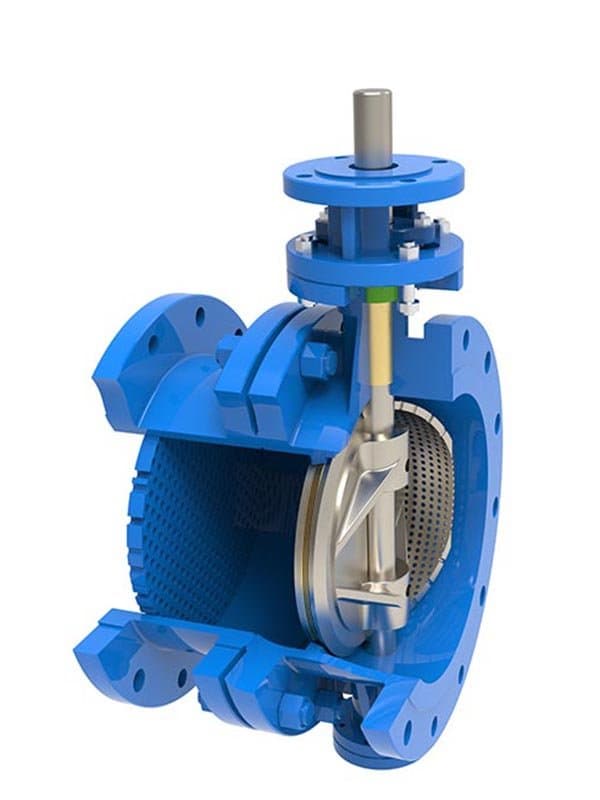
High Performance Triple Offset control Butterfly Valve
About
Quick Specs Size: 2" - 48" (DN50 - DN1200) Pressure: Class 150 - 900 Standard: API 609, API 607, ASME B16.34 Body Materials: A216 WCB, A351 CF8M, A182 F51, A182 F53 Seat Materials: Metal seat (laminated stainless + graphite, or solid metal alloy)
Design: Triple offset (eccentric shaft + eccentric center + conical seal geometry), torque-sealed, friction-free engagement, 90° quarter-turn
Three Offsets——and Why Two Isn't Enough
A concentric butterfly valve (zero offsets) seats the disc against the liner by compressing it——the disc rotates into the seat, pushes against it, and the rubber or elastomer liner deforms to create a seal. That compression seating works for low-pressure water and air service, but it has three fundamental limitations: the disc drags across the seat surface during every open-close cycle (friction wear that degrades the liner over time), the seat relies on elastomer elasticity (temperature limits, chemical compatibility limits, aging limits), and the sealing force depends on how hard the disc pushes (limited by the actuator's torque capability and the liner's compression tolerance).
A double-offset butterfly valve (also called high-performance) moves the shaft off-center in two directions——offset from the centerline of the disc face, and offset from the centerline of the pipe bore. Those two offsets let the disc lift off the seat immediately as it begins rotating——the disc cam motion separates it from the seat surface within the first few degrees of rotation, reducing friction contact to a single point at the closed position instead of dragging across the full seat face during every cycle. Better than concentric——but the seat is still an elastomer or PTFE liner, and the sealing mechanism is still compression-based. The disc presses the liner at closed position, the liner deforms to seal, and the elastomer's elasticity defines the sealing performance. You still have temperature limits, chemical compatibility limits, and aging limits.
Triple offset adds the third eccentricity: the seal geometry itself is conical rather than flat. The sealing surfaces are machined on a cone angle rather than on a flat plane perpendicular to the pipe axis. That conical geometry means the disc engages the seat along the conical surface——the contact point slides along the cone's axis during the final degrees of rotation, rather than pressing flat-on-flat like concentric and double-offset designs. The result: friction-free engagement. The disc doesn't drag across the seat surface during opening or closing——it lifts off immediately (from the first two offsets) and engages the seat along the cone axis (from the third offset) without any sliding friction contact. Zero friction means zero seat wear from cyclic operation. Zero friction means the sealing force is pure torque——the actuator's closing torque pushes the disc along the cone surface until it reaches the seat, and the cone geometry converts that torque into a radial sealing force that's proportional to the applied torque rather than limited by elastomer compression tolerance. You can increase sealing force by increasing actuator torque——the seat doesn't have a compression limit because it's metal, not elastomer. That torque-sealing mechanism is what makes triple offset butterfly valves suitable for high-pressure, high-temperature, and fire-safe applications where elastomer seats can't survive.
Metal Seating——No Elastomer, No Temperature Limit, No Aging
Triple offset valves use metal seats——laminated stainless steel with graphite layers (the most common configuration for general high-performance service), or solid metal alloy seats for extreme temperature and corrosive applications. The laminated seat consists of thin stainless steel sheets interleaved with graphite layers——the stainless provides structural rigidity and the sealing surface, the graphite provides a conformable layer that compensates for minor surface irregularities between the disc edge and the seat face. That conformability gives laminated metal seats tighter shutoff than solid metal seats——the graphite layer fills micro-gap irregularities that solid metal-to-metal contact would leave open. But the graphite layer also defines the seat's temperature ceiling——graphite oxidizes in air above approximately 450°C, so laminated seats with graphite are limited to applications below that threshold. For higher temperatures (steam service, hot oil, thermal process loops running above 450°C), solid metal alloy seats (typically Stellite-faced or Inconel-based) provide fire-safe, temperature-unlimited sealing——tighter than elastomer, not as tight as laminated with graphite, but capable of operating at temperatures where every non-metallic seat material has failed.
Fire-safe performance per API 607: the metal seating system maintains sealing integrity through fire exposure and returns to effective...
Technical Specifications
| Size Range | 2”-48” |
| Pressure Class | Class150-1500 |
| Design Standard | ISA 75, IEC 60534 |
| Body Materials | WCB, WC6, WC9, CF8, CF8M, CF3, CF3M, Aluminum Bronze, Stellite Alloy, 304, 316, Inconel 718, PTFE, RPTFE, PEEK, Flexible Graphite |
| Parent Standards | ISA 75, IEC 60534 |
| Parent Size Range | 1" - 24" |
| Parent Pressure Class | Class 150 - 1500 |
Product Downloads
| Size Range | 2”-48” |
| Pressure Class | Class150-1500 |
| Design Standard | ISA 75, IEC 60534 |
| Body Materials | WCB, WC6, WC9, CF8, CF8M, CF3, CF3M, Aluminum Bronze, Stellite Alloy, 304, 316, Inconel 718, PTFE, RPTFE, PEEK, Flexible Graphite |
Need a quote?
Contact our engineering team for pricing and technical support on High Performance Triple Offset control Butterfly Valve.
Request a QuoteLooking for more options?
Explore our complete range of industrial valves or contact us for custom solutions.
Ball Valves
FLOWKS offers floating ball valve, trunnion mounted ball valve and top entry ball valve for oil & gas, petrochemical and power generation. Designed per API 6D, API 608 and ASME B16.34.
DBB Valves
FLOWKS Double Block & Bleed (DBB) valves provide dual isolation with bleed verification in a single compact body. Replacing traditional multi-valve installations, FLOWKS DBB valves reduce weight, space and potential leak paths. Available in bolted bonnet, all-welded and expanding gate designs per API 6D and API 607.
Gate Valves
FLOWKS gate valves for isolation service in piping systems. Flexible wedge, solid wedge, slab and expanding gate designs per API 600, API 602 and ASME B16.34.
Globe Valves
FLOWKS globe valves for throttling and isolation. Standard, angle, Y-pattern and bellows seal configurations per API 602 and BS 1868.