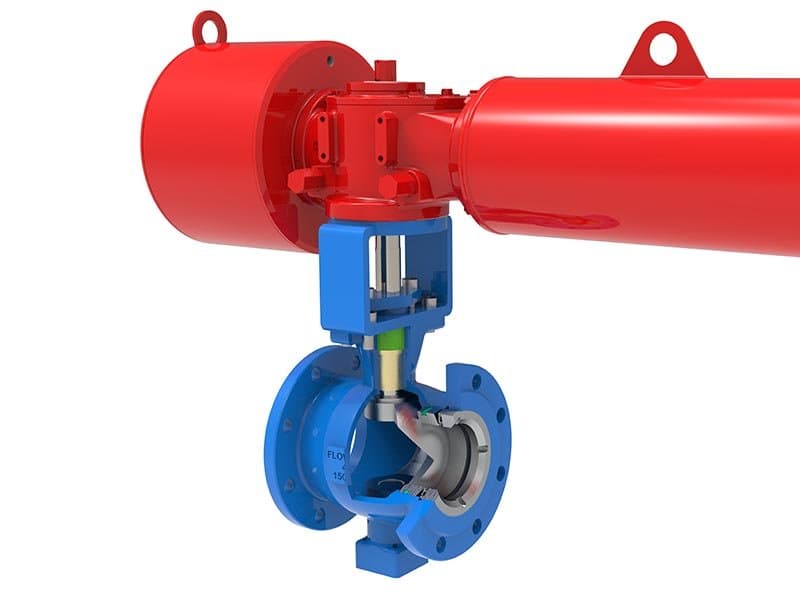
High Performance V-Ball Control Valve
About
Quick Specs Size:1" - 12" (DN25 - DN300) Pressure: Class 150 - 600 Standard: IEC 60534, API 608, ASME B16.34 Body Materials: A216 WCB, A351 CF8M, A182 F316, A182 F51 Seat Materials: PTFE, PEEK, Stellite 6, metal hard seat Trim Design: V-port ball, spring-loaded bidirectional seats, equal-percentage flow characteristic
Design:Rotary V-ball, pneumatic/electric actuated, 90° quarter-turn The V Does the Work——Cutting, Modulating, and Sealing in One Geometry
A V-ball control valve combines two capabilities that most control valve designs keep separate: precise flow modulation and reliable shutoff. The V-shaped notch in the ball bore creates an equal-percentage flow characteristic——small incremental area change at the beginning of the opening rotation (stable, fine control at low flow), progressively larger increments as the ball continues rotating toward full open (responsive control at high throughput). That characteristic profile matches what most process control loops need for stable operation——which is why equal-percentage has been the default specification for decades across the process industries. But unlike a linear plug valve that gives you equal-percentage modulation but requires a separate tight-shutoff mechanism, the V-ball achieves both in the same trim geometry. At full rotation (90° open), the V-notch provides the maximum flow area the bore allows. At zero rotation (closed position), the ball's solid hemisphere blocks the flow passage entirely, and the spring-loaded seats compress against the ball surface to create a metal-to-metal or soft-seat seal. One ball, two functions——modulation and isolation——without adding a separate seating system for shutoff.
Shear Cutting——What the V-Edge Does That Plug Valves Can't Fibrous media. Stringy process streams. Paper pulp. Viscous polymer with entrained solids. Wastewater with suspended fibrous debris. These media types plug linear plug valves——the fibers wrap around the plug tip and cage windows, accumulating until the flow passage gets blocked and the valve stops modulating. A V-ball doesn't accumulate fibers——it cuts them. The V-notch edge slices through fibrous material on every close cycle, the same way a pair of scissors cuts string rather than trying to push it aside. That shear-cutting action is inherent to the V-ball geometry——the V-edge is always in contact with the media during the closing rotation, and it physically shears anything that would otherwise accumulate in the notch opening. Plug valves don't have a cutting edge——they push the media aside, and if the media doesn't push cleanly (fibers, strings, polymer strands), the plug tip becomes an accumulation point. For any application where the process media contains fibrous or stringy contaminants, V-ball is the practical choice——not because of flow characteristic preference, but because the alternative (linear plug) gets plugged and stops working.
FLOWKS V-ball control valves use a precision-ground V-notch profile with a defined edge geometry optimized for shear cutting——the edge isn't just the boundary of the notch opening, it's a functional cutting surface designed to slice through process material cleanly on every cycle. The edge sharpness, the notch angle, and the ball surface finish are all specified to maintain effective cutting performance across the valve's service life——not just on the first hundred cycles when the edge is fresh, but after thousands of cycles where edge wear from the media would degrade cutting performance on a less carefully designed V-profile.
Bidirectional Sealing——Spring-Loaded Seats That Don't Care Which Way the Flow Runs
The ball is positioned between two spring-loaded seat rings——one upstream, one downstream. Each seat ring is independently pressed against the ball surface by its own spring preload. When the valve is closed, both seats seal against the ball simultaneously——the upstream seat seals against downstream pressure, the downstream seat seals against upstream pressure. That bidirectional sealing means the valve holds from both directions independently——a requirement for applications where flow direction reverses during process transients, or where double-block-and-bleed isolation needs both seats sealing before downstream work can proceed. In modulating service, the active seat (the one facing the higher-pressure side) carries the primary sealing load, while the opposite seat maintains backup contact. If the pressure direction reverses, the seat roles swap automatically——the previously backup seat becomes the primary sealing seat, and the former primary seat shifts to backup. No manual seat adjustment. No directional specification needed. The valve seals from both sides at every position, and the seats respond to whatever pressure direction the process imposes.
Seat material options follow the same application-matching logic as the FLOWKS ball valve...
Technical Specifications
| Size Range | 2”-24‘’ |
| Pressure Class | Class150-300 |
| Design Standard | ISA 75, IEC 60534 |
| Body Materials | WCB, WC6, WC9, CF8, CF8M, CF3, CF3M, Aluminum Bronze, Stellite Alloy, 304, 316, Inconel 718, PTFE, RPTFE, PEEK, Flexible Graphite |
| Parent Standards | ISA 75, IEC 60534 |
| Parent Size Range | 1" - 24" |
| Parent Pressure Class | Class 150 - 1500 |
Product Downloads
| Size Range | 2”-24‘’ |
| Pressure Class | Class150-300 |
| Design Standard | ISA 75, IEC 60534 |
| Body Materials | WCB, WC6, WC9, CF8, CF8M, CF3, CF3M, Aluminum Bronze, Stellite Alloy, 304, 316, Inconel 718, PTFE, RPTFE, PEEK, Flexible Graphite |
Need a quote?
Contact our engineering team for pricing and technical support on High Performance V-Ball Control Valve.
Request a QuoteLooking for more options?
Explore our complete range of industrial valves or contact us for custom solutions.
Ball Valves
FLOWKS offers floating ball valve, trunnion mounted ball valve and top entry ball valve for oil & gas, petrochemical and power generation. Designed per API 6D, API 608 and ASME B16.34.
DBB Valves
FLOWKS Double Block & Bleed (DBB) valves provide dual isolation with bleed verification in a single compact body. Replacing traditional multi-valve installations, FLOWKS DBB valves reduce weight, space and potential leak paths. Available in bolted bonnet, all-welded and expanding gate designs per API 6D and API 607.
Gate Valves
FLOWKS gate valves for isolation service in piping systems. Flexible wedge, solid wedge, slab and expanding gate designs per API 600, API 602 and ASME B16.34.
Globe Valves
FLOWKS globe valves for throttling and isolation. Standard, angle, Y-pattern and bellows seal configurations per API 602 and BS 1868.