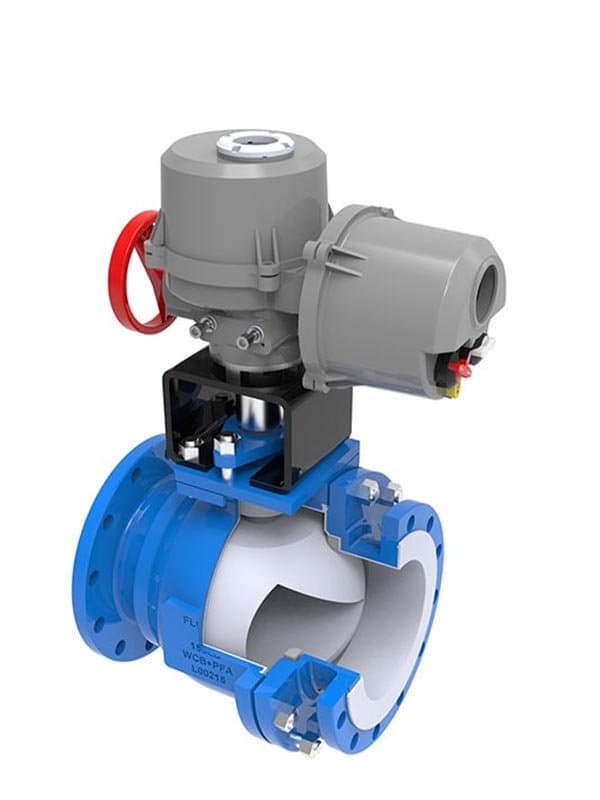
Lined Wear-Resistant V-Ball Control Valve
About
Quick Specs Size: 1" - 12" (DN25 - DN300) Pressure:Class 150 - 600 Standard:IEC 60534, API 608, ASME B16.34 Body Materials: A216 WCB, A351 CF8M, A182 F316 (with internal wear-resistant lining) Lining/Hard-facing Materials:Ceramic lining, TCC (tungsten carbide ceramic) spray coating, Stellite 6 overlay Trim Design: V-port ball with wear-resistant surface treatment, spring-loaded seats
Design:Rotary V-ball, pneumatic/electric actuated, equal-percentage flow characteristic V-Ball for Flow Control——Hard-Faced for Media That Destroys Soft Trim
V-ball control valve gives you equal-percentage flow characteristic, bidirectional sealing, and the shear-cutting action that handles fibrous and particulate media better than any linear plug design. But when the process media carries abrasive solids——mineral slurry, catalyst fines, coal wash tailings, phosphate sludge, ash-laden wastewater——the V-notch edge and the seat sealing surfaces get ground down by the media itself. Standard PTFE seats last weeks in slurry service. Standard stainless trim erodes to leakage within months. The V-ball geometry handles the flow control requirement, but the trim material can't survive what the process pumps through it. That's the gap this valve fills: V-ball flow regulation capability with wear-resistant lining and hard-facing systems that hold up under abrasive, erosive, and high-temperature conditions that destroy conventional soft-seat and standard metal trim.
Three Wear-Resistant Options——Ceramic, TCC, and Stellite——Each for Different Destruction Modes
FLOWKS lined wear-resistant V-ball control valves offer three distinct wear-resistant surface treatment systems, each targeting a specific destruction mechanism the process media imposes on the trim.
Ceramic lining covers the internal flow passage surfaces——the body bore, the seat pocket, and the ball surface contact zones——with a hard, chemically inert ceramic layer. Ceramic is the hardest lining option in the lineup——significantly harder than any metal alloy or carbide coating. It resists abrasive particle impingement (solid particles hitting the surface at flow velocity) and erosion from high-velocity slurry flow better than any alternative. The trade-off: ceramic is brittle. Impact loading from large solid objects (oversized rocks, metal debris in the slurry) can chip or crack the ceramic lining at the impact point. Ceramic lining is the correct choice for fine-particle abrasive slurry service where the erosive mechanism is sustained particle impingement at flow velocity——not where the media carries large impact-loaded objects that would fracture the ceramic layer.
TCC (tungsten carbide ceramic) spray coating applies a tungsten carbide-based ceramic composite coating to the ball surface, the seat sealing faces, and the high-velocity flow path zones through the V-notch area. TCC is not as hard as pure ceramic——but it's far harder than Stellite or any standard metal alloy, and it has better impact resistance than ceramic because the tungsten carbide matrix has some ductility that pure ceramic lacks. TCC handles both abrasive erosion and moderate impact loading——solid particles hitting at flow velocity, plus occasional larger objects that would chip pure ceramic. TCC also performs well at elevated temperatures——the tungsten carbide matrix maintains hardness and dimensional stability at temperatures where Stellite softens and where PTFE/PEEK seats would fail entirely. High-temperature abrasive service——hot ash slurry, high-temperature catalyst circulation, steam-containing erosive media——is TCC's primary application domain.
Stellite 6 overlay is the established hard-facing option——cobalt-based alloy welded onto the ball seating surface and the seat contact faces. Stellite is less hard than TCC and ceramic, but it has the best impact resistance of the three options——it can absorb large-object impacts without cracking or chipping. Stellite also has proven long-term service history across thousands of installations in erosive process service——the material behavior, wear rate progression, and failure mode characteristics are well-documented and well-understood by maintenance teams who've been working with Stellite-trimmed valves for decades. For applications where the media carries larger abrasive particles or occasional solid objects (mineral processing, mining slurry, coarse ash handling), Stellite's impact toughness makes it the safer choice despite its lower hardness rating compared to TCC and ceramic.
The V-Ball Geometry——Same Cutting Edge, Now Protected
The V-port ball profile operates identically to the standard FLOWKS V-ball control valve——equal-percentage characteristic, bidirectional sealing from spring-loaded seats, and the V-notch edge that cuts through fibrous and stringy media on every close cycle. The wear-resistant surface treatment doesn't change the V-ball's flow...
Technical Specifications
| Size Range | 2”-16” |
| Pressure Class | Class150-600 |
| Design Standard | ISA 75, IEC 60534 |
| Body Materials | PFA, FEP, PU polyurethane and high-performance ceramic lining |
| Parent Standards | ISA 75, IEC 60534 |
| Parent Size Range | 1" - 24" |
| Parent Pressure Class | Class 150 - 1500 |
Product Downloads
| Size Range | 2”-16” |
| Pressure Class | Class150-600 |
| Design Standard | ISA 75, IEC 60534 |
| Body Materials | PFA, FEP, PU polyurethane and high-performance ceramic lining |
Need a quote?
Contact our engineering team for pricing and technical support on Lined Wear-Resistant V-Ball Control Valve.
Request a QuoteLooking for more options?
Explore our complete range of industrial valves or contact us for custom solutions.
Ball Valves
FLOWKS offers floating ball valve, trunnion mounted ball valve and top entry ball valve for oil & gas, petrochemical and power generation. Designed per API 6D, API 608 and ASME B16.34.
DBB Valves
FLOWKS Double Block & Bleed (DBB) valves provide dual isolation with bleed verification in a single compact body. Replacing traditional multi-valve installations, FLOWKS DBB valves reduce weight, space and potential leak paths. Available in bolted bonnet, all-welded and expanding gate designs per API 6D and API 607.
Gate Valves
FLOWKS gate valves for isolation service in piping systems. Flexible wedge, solid wedge, slab and expanding gate designs per API 600, API 602 and ASME B16.34.
Globe Valves
FLOWKS globe valves for throttling and isolation. Standard, angle, Y-pattern and bellows seal configurations per API 602 and BS 1868.