Self-Actuated Pressure Regulating Valve
About
Quick Specs Size: 1/2" - 8" (DN15 - DN200) Pressure: Class 150 - 600 Standard: IEC 60534, ASME B16.34 Body Materials: A216 WCB, A351 CF8M, A182 F316 Seat/Trim Materials: PTFE, PEEK, Stellite 6, 316 SS
Design: Self-actuated, no external power source, valve-before-pressure (reducing) and valve-after-pressure (backpressure) configurations
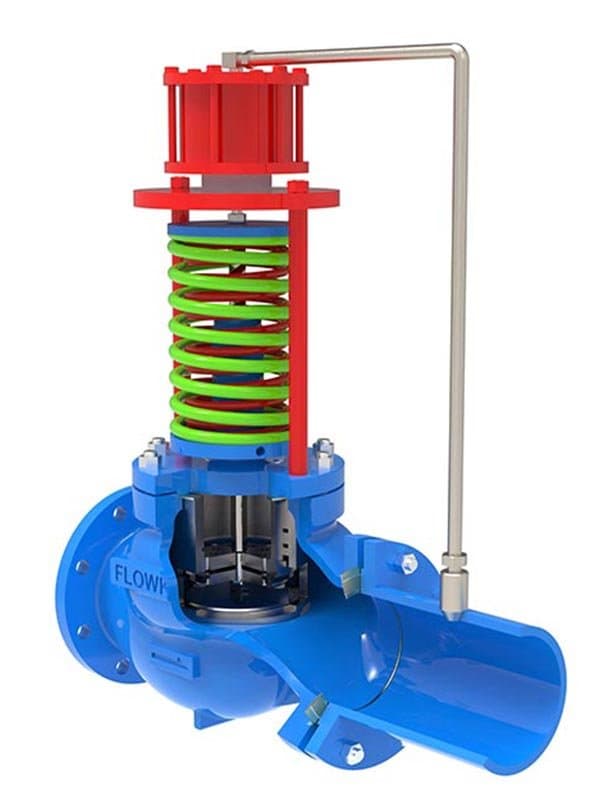
No Air Supply. No Electricity. No External Power Source at All. A self-actuated pressure regulating valve doesn't need instrument air, doesn't need a DCS signal, doesn't need an electric actuator——it regulates pressure using the process media's own energy. The valve senses downstream (or upstream) pressure through an internal sensing port, compares that pressure against a pre-loaded spring force, and adjusts the plug position to maintain the set pressure automatically. Higher downstream pressure than the setpoint——the plug moves toward closed, reducing flow and letting pressure drop back toward target. Lower downstream pressure——the spring pushes the plug toward open, allowing more flow and letting pressure climb back. That feedback loop runs continuously, mechanically, without any external intervention. On remote well sites where instrument air doesn't exist, on pipeline branch stations miles from the nearest control room, on utility distribution networks where the cost of installing and maintaining an automated control system per valve exceeds the cost of the valve itself——self-actuated regulation is the practical answer.
Two Configurations——Reducing Pressure or Maintaining Backpressure
FLOWKS self-actuated pressure regulating valves come in two functional configurations determined by the sensing direction. Valve-after-pressure (commonly called pressure reducing) senses downstream pressure and throttles the valve to maintain a target outlet pressure below the inlet. This is the configuration you use when a high-pressure supply line feeds a lower-pressure distribution system——steam mains feeding low-pressure heating circuits, gas transmission lines feeding distribution networks, hydraulic supply lines feeding lower-pressure actuators. The valve automatically reduces whatever inlet pressure it receives down to the setpoint you've dialed into the spring preload.
Valve-before-pressure (commonly called backpressure regulating) senses upstream pressure and throttles the valve to maintain a target inlet pressure above the outlet. This is the configuration you use when you need to hold pressure upstream of the valve——preventing a downstream pressure drop from pulling the upstream system below its minimum operating pressure, maintaining positive pressure on a tank blanketing system, or holding backpressure on a heat exchanger circuit to prevent flashing. The valve closes when upstream pressure drops below setpoint (restricting flow to hold pressure up), and opens when upstream pressure rises above setpoint (relieving excess pressure downstream).
The mechanical logic is the same in both configurations——the spring preload defines the setpoint, the sensing port provides the feedback signal, and the plug position responds to the pressure difference between sensed pressure and spring force. What changes is which side of the valve the sensing port reads.
How the Spring Sets the Pressure——and How You Adjust It
The setpoint is defined by the spring preload——the force the spring exerts against the plug when the sensed pressure is exactly at the target value. Adjusting the setpoint means adjusting the spring compression, which is done through an external adjustment screw or nut on the spring housing. Turn the adjuster clockwise——more spring compression——higher setpoint. Turn counterclockwise——less compression——lower setpoint. The adjustment is continuous within the spring's range, not stepwise——you can set the valve to any pressure value within the rated range, not just to a few preset options.
Spring selection matters because each spring covers a specific pressure range. A light spring handles low-pressure setpoints (a few psi to moderate ranges). A heavy spring handles high-pressure setpoints. The spring that ships with the valve is selected based on the setpoint the customer specifies——you don't get a generic spring and hope it covers your operating pressure. If the process requirements change and the setpoint needs to shift outside the original spring's range, the spring gets replaced——not the entire valve.
Self-Actuated vs. Automated——When Each Makes Sense
Self-actuated regulation trades precision for independence. The valve holds pressure within a band around the setpoint——not at an exact value. The regulation accuracy depends on the spring's linearity, the plug's flow characteristic, and the process flow conditions at the operating point. Typical self-actuated regulation accuracy falls in the ±1-5% range depending on configuration and process dynamics——adequate for...
Technical Specifications
| Design Standard | ISA 75, IEC 60534 |
| Body Materials | WCB, WC6, WC9, CF8, CF8M, CF3, CF3M |
| Parent Standards | ISA 75, IEC 60534 |
| Parent Size Range | 1" - 24" |
| Parent Pressure Class | Class 150 - 1500 |
Product Downloads
| Design Standard | ISA 75, IEC 60534 |
| Body Materials | WCB, WC6, WC9, CF8, CF8M, CF3, CF3M |
Need a quote?
Contact our engineering team for pricing and technical support on Self-Actuated Pressure Regulating Valve.
Request a QuoteLooking for more options?
Explore our complete range of industrial valves or contact us for custom solutions.
Ball Valves
FLOWKS offers floating ball valve, trunnion mounted ball valve and top entry ball valve for oil & gas, petrochemical and power generation. Designed per API 6D, API 608 and ASME B16.34.
DBB Valves
FLOWKS Double Block & Bleed (DBB) valves provide dual isolation with bleed verification in a single compact body. Replacing traditional multi-valve installations, FLOWKS DBB valves reduce weight, space and potential leak paths. Available in bolted bonnet, all-welded and expanding gate designs per API 6D and API 607.
Gate Valves
FLOWKS gate valves for isolation service in piping systems. Flexible wedge, solid wedge, slab and expanding gate designs per API 600, API 602 and ASME B16.34.
Globe Valves
FLOWKS globe valves for throttling and isolation. Standard, angle, Y-pattern and bellows seal configurations per API 602 and BS 1868.