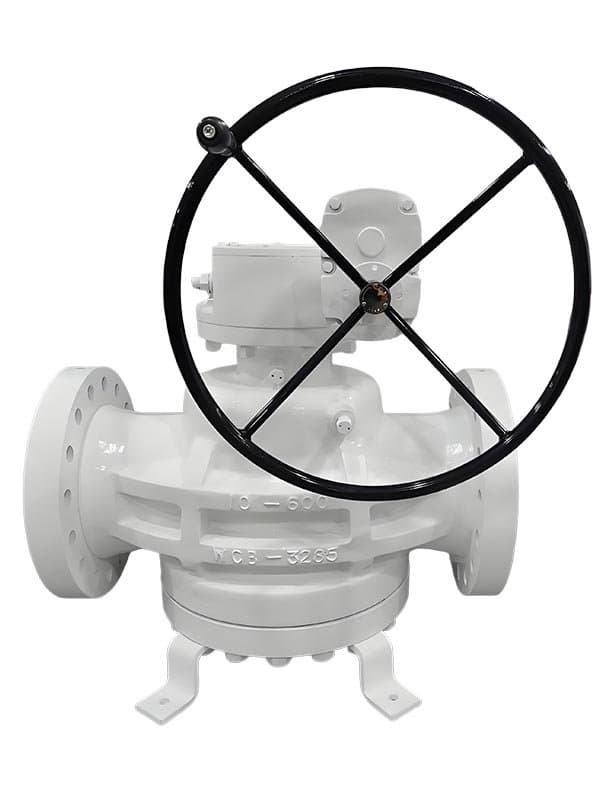
Pressure Balanced Plug Valve
About
Size: 2" - 24" (DN50 - DN600)
Pressure: Class 150 - 900 / PN 10-150
Standard: API 6D, API 599, ASME B16.34
Body Materials: A216 WCB, A217 WC6/WC9, A351 CF8M, A182 F316
Seat: Metal-to-metal (lubricated) or soft seated (PTFE/RPTFE/Viton)
Design: Pressure balanced plug with internal bypass passages, 90° rotation
The Torque Problem That Nobody Talks About
Here's what happens inside an unbalanced plug valve at Class 600 on a 12" line: line pressure pushes on one side of the plug face with nowhere for that force to go except into the body bore. At 600 psi across a 12" diameter, you're looking at thousands of pounds of unbalanced hydraulic force. The operator has to overcome that force to turn the plug — and at those numbers, manual operation becomes physically impossible. Pneumatic actuators struggle. Electric actuators need oversized motors. The torque requirement dictates the actuator specification, and the actuator cost follows.
Pressure balanced plug valves eliminate that hydraulic force. Internal bypass passages connect upstream and downstream pressure to both sides of the plug simultaneously. Upstream pressure pushes on the upstream plug face. The same pressure is routed through internal channels to push on the downstream plug face from the opposite direction. The two forces cancel out. Net hydraulic force on the plug drops to near zero.
The operator only needs to overcome mechanical friction — not hydraulic pressure. That's the difference between a valve you can turn by hand and a valve that requires a multi-thousand-dollar actuator package. You can manually operate a 16" Class 600 pressure balanced plug valve. You can't manually operate the same size and class with an unbalanced design. For pipeline isolation points at high pressure and large diameter, pressure balancing isn't a luxury — it's the only practical way to keep operating torque within manageable limits.
How the Bypass Passages Work Inside the Plug
The internal bypass passages are machined directly into the plug assembly. Channels connect the upstream cavity to the downstream side of the plug face, and vice versa. When line pressure enters the valve, it flows through these passages to both sides of the plug before the plug starts rotating. The pressure equalization happens automatically — no operator intervention, no external balancing lines, no control system required.
The passages add complexity inside the plug. More machined features mean more potential leak paths inside the assembly itself. The plug has to seal those internal channels against cross-flow when the valve is in the closed position — otherwise the bypass passages would bypass the isolation function the valve is supposed to provide. Internal O-rings or metal-to-metal seated bypass closures handle that requirement. It's additional sealing work inside the plug, but the torque reduction justifies the complexity every time on high-pressure large-diameter applications.
Two Seat Options on the Same Platform
Pressure balanced plug valves aren't locked into one seat type. Metal-to-metal lubricated seating works when your line media degrades elastomer seats — crude oil, natural gas, refinery streams with aggressive chemistry. Soft seated PTFE or Viton inserts work when your specification demands zero leakage and the media is compatible with the seat material. Both seat types are available on the pressure balanced platform.
That flexibility matters on pipeline isolation points where the same valve specification might need to cover different service conditions at different locations. A 16" Class 600 isolation valve on a crude trunk line needs lubricated metal seating. The same size and class on a water injection line might need PTFE soft seating for zero leakage. You don't change the body design or the pressure balancing geometry — you change the seat configuration. The torque advantage stays the same regardless of seat type.
A: The crossover point depends on size and media pressure. Generally, above Class 300 on sizes 10" and larger, unbalanced plug torque starts exceeding practical manual operation limits. At Class 600 and above on any size above 6", pressure balancing is standard practice. Below Class 150 on smaller sizes, unbalanced designs work fine — the hydraulic force is manageable.
A: No — when the valve is fully closed, the bypass passages are internally sealed. O-rings or metal-to-metal seated closures inside the plug block cross-flow through the balancing channels. The passages only equalize pressure across the plug faces while the plug is in transit between open and closed positions. Shutoff integrity is maintained by the primary seat, not compromised by the balancing geometry.
A: Not practically. The bypass passages are machined into the plug assembly during manufacturing — you can't retrofit internal channels into a solid plug. Pressure...
Technical Specifications
| Size Range | NPS 1/2-40" |
| Pressure Class | Class150Lb-2500 |
| Design Standard | API 599,API6D |
| Body Materials | A105、LF2、F304、F316、F304L、F316L、F51、WCB、LCB、WCC、CF8、CF8M、CF3、CF3M、A890 4A |
| Parent Standards | API 599, API 6D |
| Parent Size Range | 2" - 24" |
| Parent Pressure Class | Class 150 - 1500 |
Product Downloads
| Size Range | NPS 1/2-40" |
| Pressure Class | Class150Lb-2500 |
| Design Standard | API 599,API6D |
| Body Materials | A105、LF2、F304、F316、F304L、F316L、F51、WCB、LCB、WCC、CF8、CF8M、CF3、CF3M、A890 4A |
Need a quote?
Contact our engineering team for pricing and technical support on Pressure Balanced Plug Valve.
Request a QuoteLooking for more options?
Explore our complete range of industrial valves or contact us for custom solutions.
Ball Valves
FLOWKS offers floating ball valve, trunnion mounted ball valve and top entry ball valve for oil & gas, petrochemical and power generation. Designed per API 6D, API 608 and ASME B16.34.
DBB Valves
FLOWKS Double Block & Bleed (DBB) valves provide dual isolation with bleed verification in a single compact body. Replacing traditional multi-valve installations, FLOWKS DBB valves reduce weight, space and potential leak paths. Available in bolted bonnet, all-welded and expanding gate designs per API 6D and API 607.
Gate Valves
FLOWKS gate valves for isolation service in piping systems. Flexible wedge, solid wedge, slab and expanding gate designs per API 600, API 602 and ASME B16.34.
Globe Valves
FLOWKS globe valves for throttling and isolation. Standard, angle, Y-pattern and bellows seal configurations per API 602 and BS 1868.